Solar

Sunstall’s Tallest Agrivoltaic Installation Yet!

Sunstall’s Tallest Agrivoltaic Installation Yet! 1500 999 Sunzaun

Aerial Photo by Michael Lobato, Colorado State University

In the crisp weather of mid-October, our team completed one of the most unique and inspiring projects in our portfolio to date. Set against the dramatic mountain backdrop of Grand Junction, Colorado, this photovoltaic (PV) system marks a major milestone for agrivoltaics in the US. At completion, the structure stands as the largest viticulture-focused agrivoltaic system (or “viti-voltaic”) in the country.

Our Partners

We were proud to serve as the installation contractor under Sandbox Solar, a local EPC and leader in agrivoltaics across the region. The single-axis tracking system was designed and supplied by SolarGik, and spearheaded by Dr. Horst Caspari, a Colorado State Professor and expert viticulturist.

Located near Colorado State University’s Western Campus, Dr. Caspari’s quarter-acre research vineyard of Chardonnay grapes will serve as a living laboratory for the combination of solar energy and sustainable agriculture. Here, researchers will study everything from soil compaction caused from solar installation to shifts in microclimates and how different panel opacities affect light transmission, vine growth, and fruit quality. 
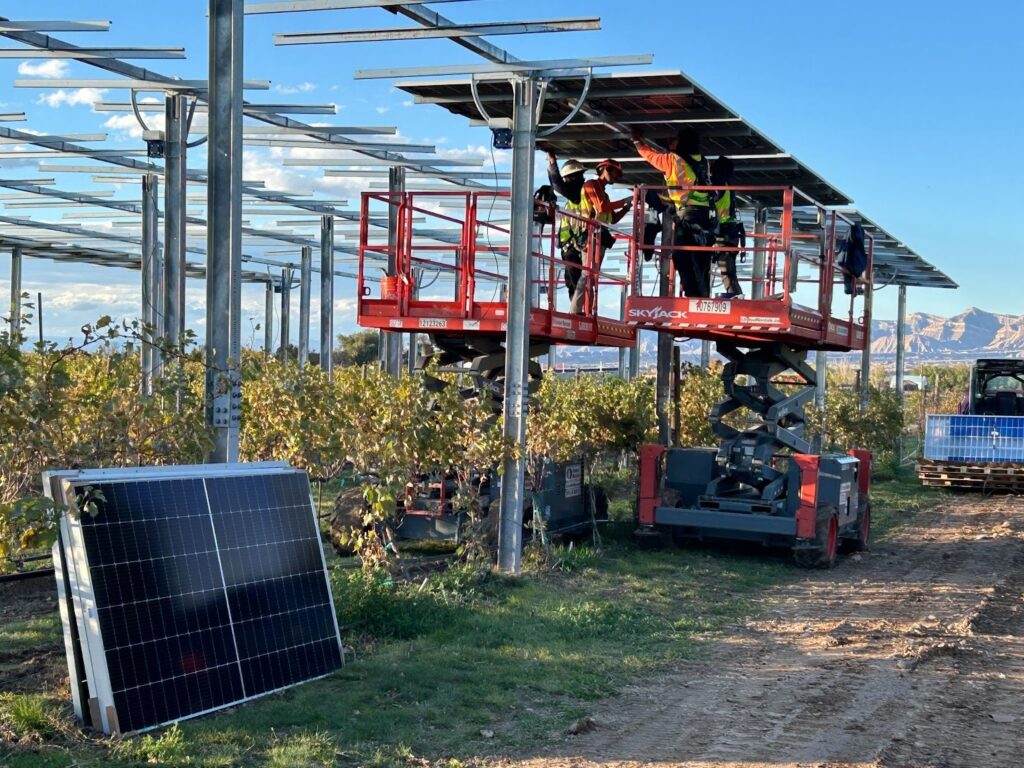
Photo by Dr. Horst Caspari

Why This Installation Was Different (and Challenging)

As interest in agrivoltaics continues to grow, we have had opportunities to build several agrivoltaic systems. With previous builds, our team worked on blank-slate landscapes, not yet populated with soon-to-be-planted vegetation. In this case, however, our crew was faced with the task of building a PV system within rows of mature, established grapevines. 

Our installation team worked carefully within these vines — driving piles, assembling the racking, and installing 240 solar panels — while avoiding major disruption to the crop. This project called for a new level of planning and adaptability, as we adjusted our usual construction methods.

  • The result: a sleek 14-foot-tall steel structure, designed at this height to let the right amount of sunlight in between rows of panels. 

Beyond Energy Generation

According to the Colorado Newline, the system is projected to generate approximately 155 megawatt-hours of clean electricity per year, supplying roughly 40% of CSU Western Campus’s annual energy needs. But the impact and purpose of this project goes far beyond energy production. As Dr. Caspari stated, this system was designed with an “A before the V” mindset. In agrivoltaics, this means agriculture takes priority over voltaics.

For this particular design, the agricultural benefits include:

  • Protection from hail and frost
    • Even a single hailstorm or frost can ruin nearly an entire grape yield. The PV canopy offers an added layer of defense and creates a more temperate microclimate, shielding crops from weather extremes.
  • Beneficial Shading
    • Partial shading helps moderate soil temperatures, allowing the ground to retain moisture longer and reducing irrigation needs. It also protects delicate grapes from intense solar radiation during the hottest weeks of the summer.

Heading into chilly November, observations already show milder temperatures under the system, confirming the climate benefits of elevated PV systems for sensitive crops like grapes.

Looking Ahead

While the U.S. still has ground to cover compared to Europe’s agrivoltaic movement, this project represents a large step in the right direction. It stands as a living demonstration for how clean energy infrastructure can enhance, rather than compete with, agricultural productivity, and we’re thrilled to have contributed to this advancement.

As more growers and researchers explore dual-use solar, Sunstall Inc. looks forward to continuing our role in building the systems that make this progress possible; from vineyards to orchards to open fields.
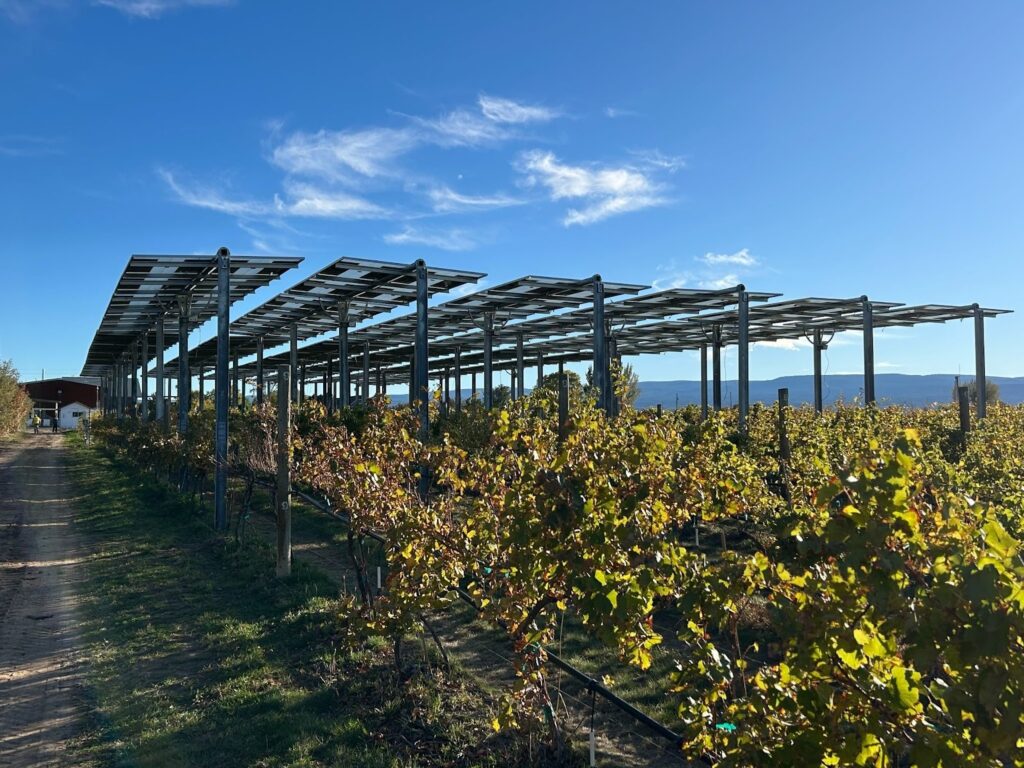
Photo by Dr. Horst Caspari

To lean more about the ongoing viti-voltaic research, visit: https://aes.colostate.edu/wcrc/orchard-mesa/viticulture/

Unlocking More Energy from Less Space: Vertical Solar

Unlocking More Energy from Less Space: Vertical Solar 1500 844 Sunzaun

Adapted from the German article “Vertikal mehr Ertrag” in Technik & Wirtschaft VN+

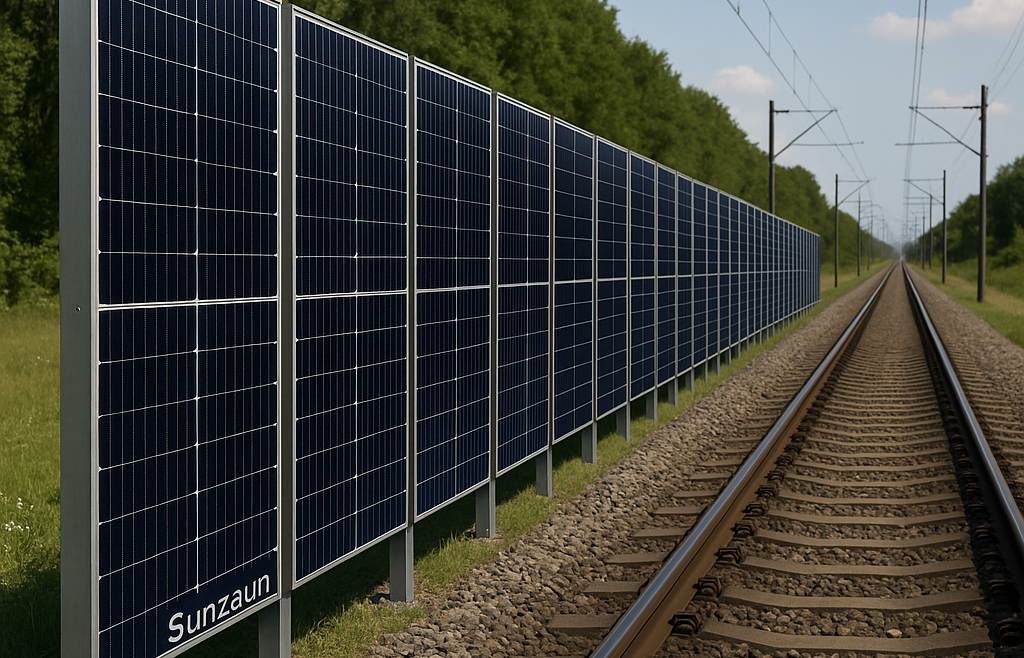
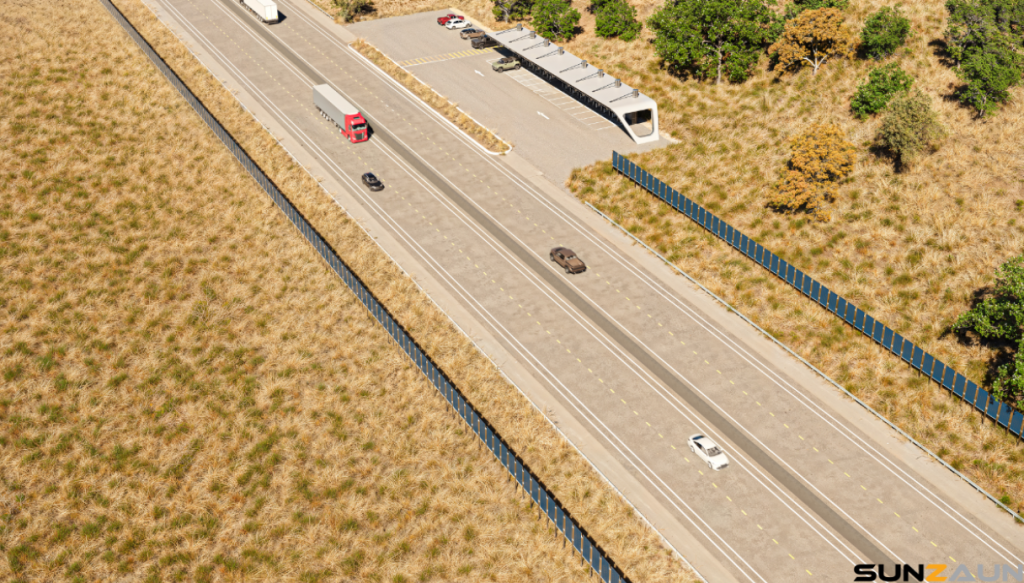
As solar technology continues to evolve, one of the most promising developments is vertical photovoltaic (PV) systems. Unlike traditional panels installed at an angle on rooftops or open fields, vertical PV panels stand upright, like a fence, and can be bifacial, capturing sunlight from both sides.

Where Vertical PV Systems Thrive

Vertical solar panels are particularly useful in spaces where traditional installations are limited. Examples include:

  • Agricultural land, where panels can coexist with crops, maximizing land use efficiency.
  • Noise barriers along highways or as property fences, turning otherwise unused vertical surfaces into energy-generating assets.

The Advantages: More Yield, More Flexibility

Vertical PV systems can increase overall electricity generation in certain conditions. Bifacial panels, for example, capture both direct sunlight and reflected light, while vertical placement can optimize energy collection during low-sun periods, such as morning and evening. This “dual-use” potential allows landowners to produce solar power without sacrificing valuable space for other uses.

Considerations and Limitations

While vertical PV offers unique benefits, there are trade-offs:

  • Peak midday production is typically lower compared to optimally tilted panels. Whereas vertical produces peak energy in the morning and afternoon, often matching energy demand curves.
  • Local conditions, such as sun angles, climate, and shading, significantly influence performance. Vertical bifacial panels perform best where there is high reflectivity from surroundings such as sandy or snow-covered ground and in-between greenhouses. 
  • Upfront costs, especially for bifacial panels, may be higher, so careful economic analysis is needed. However, preliminary research suggests the potential for long term cost savings due to reduced maintenance needs.

Real-World Applications

Vertical PV systems are already being deployed in innovative ways, such as along airport perimeters or integrated into agricultural projects. These systems showcase how flexible solar solutions can expand energy generation opportunities while maintaining productive land use.

The Takeaway

Vertical photovoltaic panels are not just a concept, they are a practical solution for maximizing solar energy in areas with space constraints or multiple land uses. By creatively adapting vertical surfaces, we can generate more power, optimize land use, and move closer to a sustainable energy future.

If you’re a landowner, business, or farmer interested in exploring vertical solar solutions, now is the perfect time to start. Assess available space, consider dual-use opportunities, and connect with a Sunzaun specialist to see how vertical PV can boost your energy output. Small steps today can lead to big savings and sustainable power tomorrow.

Note: This post is a review adapted from the German article “Vertikal mehr Ertrag” in Technik & Wirtschaft VN+.

Protect Crops, Farm the Sun: What Agri-PV Can Do for You

Protect Crops, Farm the Sun: What Agri-PV Can Do for You 1500 844 Sunzaun

Farmers today are under increasing pressure from rising operational costs and a changing climate, both of which threaten the viability of owner-operated farms. At the same time, the growing demand for food and the renewable energy transition compete for space. But what if farmers could harvest both food and solar power from the same land, while becoming more financially secure? Agrivoltaics, also known as agri-photovoltaics (agri-PV), enables farmers to keep farming, while balancing other demands.


How Agrivoltaics Works

Agrivoltaics (Agri-PV) refers to the combined use of agricultural land for food production and solar power generation by enhancing farm operations rather than replacing them. Agri-PV builds farmer resilience by either a) providing a secondary reliable income source when energy is sold to the grid, or b) reducing on-farm energy-related operational costs by using energy generated by their photovoltaics (PV) system. The article from which this blog was based distinguishes between three Agri-PV systems:

  • Overhead Agri-PV
    • PV modules mounted over 6 ½ ft high
    • Protects crops from hail and mitigates heat stress
    • Designed to allow crops, livestock, and machinery underneath
    • More expensive due engineering and installation complexities
  • Ground-Mount Agri-PV 
    • Allows for machines to operate between rows, not under
    • Lower installation costs
    • May cause uneven crop shading
    • Not ideal for sun-demanding field crops like wheat and corn
  • Vertical Agri-PV 
    • Modules mounted upright like fences (east-west orientation is common)
    • Bifacial modules, meaning both sides of the panel convert light into energy
    • Space-efficient: good for pastures or as fencing for livestock
    • Allows machinery to operate between rows 
    • Mid-tier costs

Agricultural Benefits and Tradeoffs

Fortunately for farmers, Agri-PV offers more than just economic benefits from solar power generation. These systems can also complement crop production. Solar infrastructure creates microclimates, mitigating the compounding effects of drought, extreme heat, and storms. Shade from the panels reduces evapotranspiration, helping soil retain moisture, an especially important function in arid climates. These protective-like structures can also shield crops from wind damage and heat stress. In fact, research shows that some crops, such as berries, leafy greens, and herbs, can produce higher yields when grown between PV rows.

In orchards, solar structures may even replace traditional hail nets, reducing long-term operational and maintenance costs. Improved crop resiliency under Agri-PV can reduce damage from fungal and bacterial pests, decreasing the need for pesticides.

However, tradeoffs do exist. Uneven shading, particularly from fixed-tilt ground-mounted systems, can lead to non-uniform soil moisture levels. In wetter regions, this may increase the risk of fungal disease if not properly managed. Crops that require a lot of light, like corn and wheat, may also experience reduced yields under shaded conditions. In such cases, vertical systems, like Sunzaun—where shading patterns are less obstructive—are often better suited.

Recent advances in semi-transparent panels are also worth exploring. Semi-transparent panels allow more light to pass through to the crops, enhancing the growth for traditional open-field crops. However, while they reduce below-ground shading, the panels themselves absorb less sunlight, which leads to decreases in energy production. Ultimately, the right system depends on the farm’s goals. 

Vertical Bifacial PV on an agrivoltaics experimental site, UC Davis, California. Photo by Jael Machndork. Originally published here.

Supporting Farmers – Legal & Economic Context

From an economic stand-point, Agri-PV creates a new, predictive revenue stream. Unlike traditional solar farms, the integration of such systems typically avoids re-zoning farmland as “built-up” areas, which bypasses the need for lengthy planning approvals. Steering clear of re-zoning reinforces the idea that Agri-PV is enhancing farmland rather than replacing it.

In the European Union, Agri-PV systems allow land to remain classified as agricultural, helping farmers maintain access to subsidies. Although there is no nationwide rule that guarantees the same treatment in the U.S., states like Colorado, Massachusetts, New York, and California increasingly recognize agrivoltaics and may preserve agricultural tax status or zoning classifications. In some jurisdictions, installing solar can trigger reassessment unless specific exemptions are in place. It is important to check local zoning laws, property tax codes, and solar/agriculture regulations before moving forward with an Agri-PV project.

A Tool for the Energy Transition

While initial installation costs for Agri-PV systems can be higher, long-term benefits, such as income, climate resilience, and ecological value, often outweigh the investment. The energy sector and agriculture both need to evolve to meet the demands of the future. Agrivoltaics offers an opportunity to meet both demands, while giving farmers the freedom to continue their farming operations.


This blog is based on insights from an article by Thomas Wagner-Nagy, originally published in the May 2025 issue of PM Magazin (in German)

Putting Farmers First: Insights from the Solar Farm Summit

Putting Farmers First: Insights from the Solar Farm Summit 911 671 Sunzaun

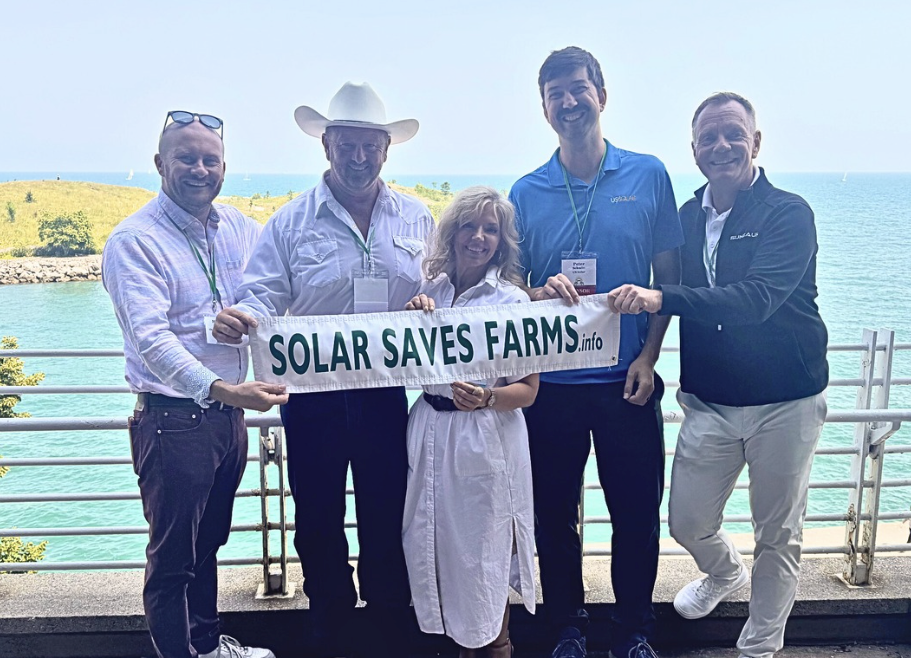
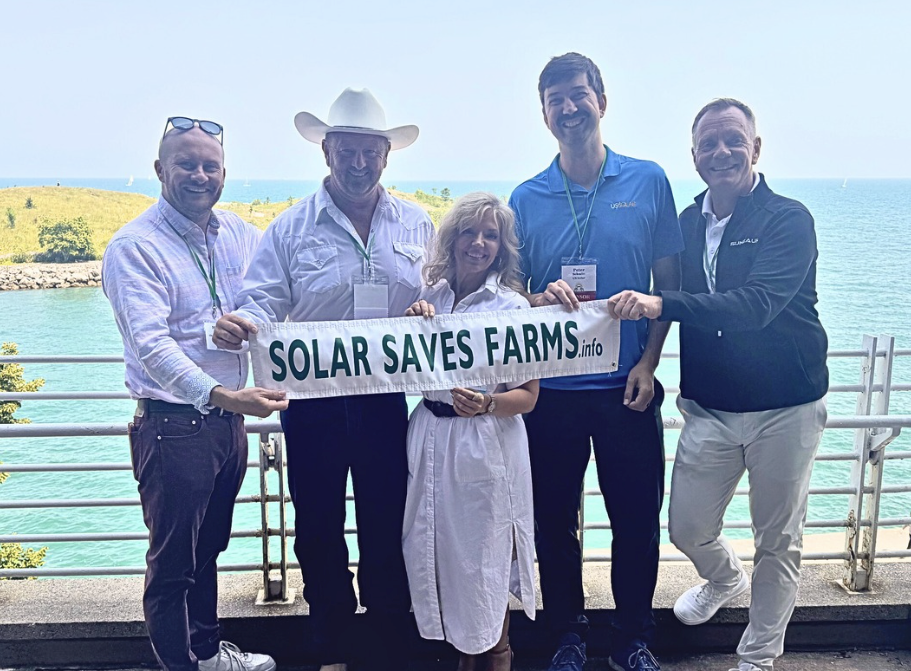
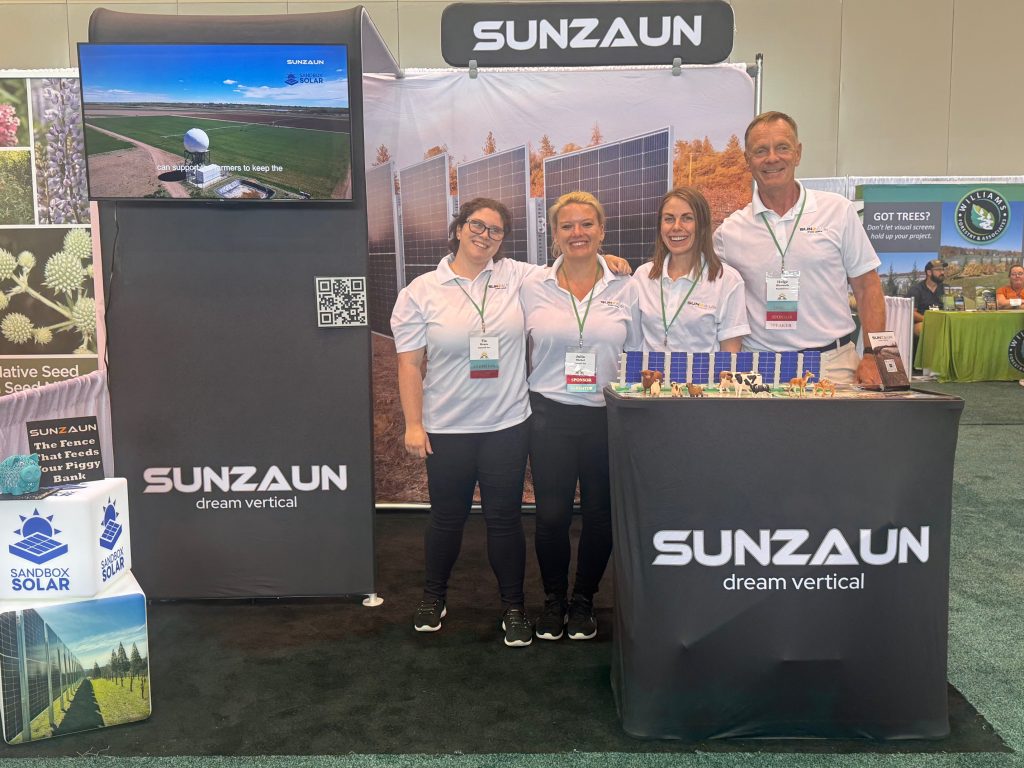
The 2025 Solar Farm Summit in Chicago brought together farmers, developers, researchers, state officials and industry leaders. Some came as curious explorers, others as passionate advocates, but all shared an interest in how solar and farming can work together. Sunzaun’s team was there to showcase its vertical bifacial solar racking system and join in on conversations shaping the next chapters of solar in agriculture. Helge Biernath, CEO of Sunstall, joined a panel with experts from Sandbox Solar and SolarEdge to share insights on vertical solar technology. 

Farmer’s Perspective

While representing its product at the booth, Sunzaun’s team also attended sessions covering topics such as livestock grazing health in the context of solar arrays, the latest developments in agrivoltaics policy and research, and American-made solar. One of the most memorable sessions was The Farmer’s Perspective on Agrivoltaics. Hearing directly from farmers offered an unfiltered look at what’s working, what’s not, and what’s needed to make agrivoltaics viable on real farms, especially for owner-operated or “smallholder” farms.

Key Takeaways:

  • Owner-operated farms are shrinking as corporate farming expands. This trend is due to multiple factors, including rising operational costs.
  • 80% wouldn’t change production systems for agrivoltaics. Many are still uncertain about its benefits.
  • Trust is low. According to an American Farmland Trust survey, the most trusted source of agricultural information for farmers is university-affiliated extension services, followed by farm associations. Solar developers often rank near the bottom of this list.

What Farmers Want from Solar Developers

To make agrivoltaics appealing, farmers with existing solar infrastructure emphasized a few must-haves from solar developers:

  • Clear contracts with transparent $/acre return on investment
  • Ongoing panel maintenance included
  • Freedom to keep farming with minimal disruption
  • Solar designs that fit agricultural needs, such as wide row spacing for machinery and to limit shading

Sunzaun’s Commitment to Farmers

Sunzaun believes that owner-operators deserve a strong voice in shaping agrivoltaic projects. When done right, these systems can provide reliable supplemental income while keeping farmland productive. Sunzaun works with farmers, researchers, EPCs, and developers to design solutions that protect farmland while generating clean energy.

Supporting Trusted Voices in Agriculture

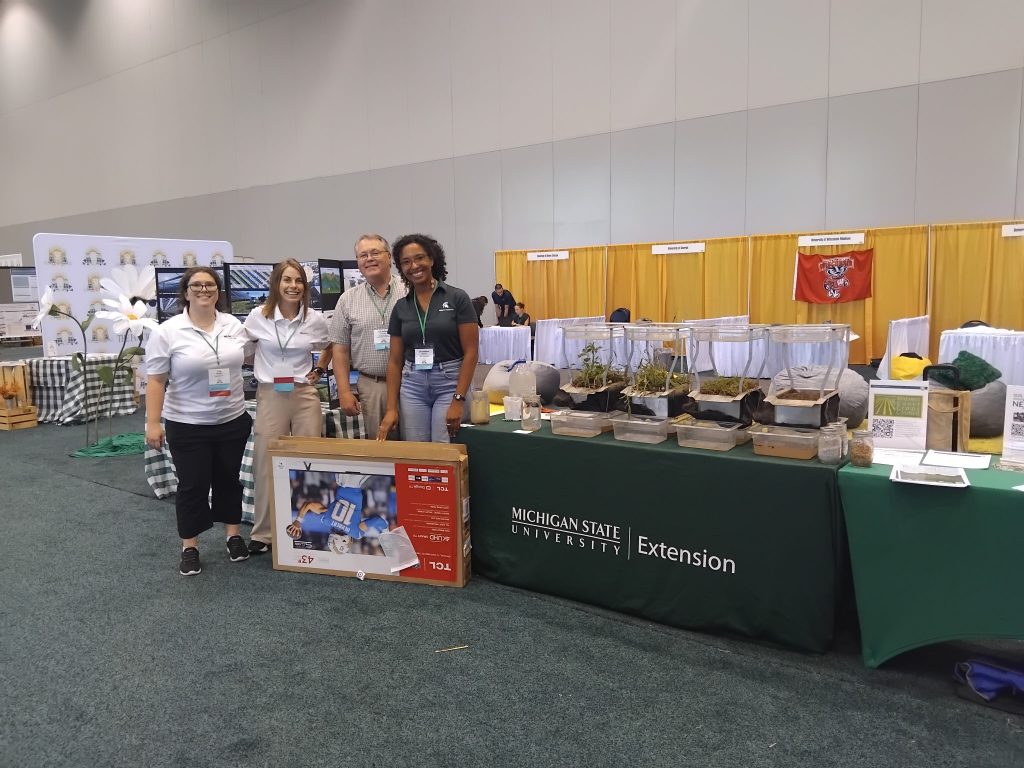
To wrap up the week, Sunzaun donated a TV to Michigan State University Extension Services to support their outreach efforts. Since extension services are among the most trusted sources of agricultural information, Sunzaun is proud to assist with the continuation of delivering reliable, accessible knowledge to the farming community.

Vertical Solar Is Changing the Game: Smarter Design, Real Results for Commercial Projects

Vertical Solar Is Changing the Game: Smarter Design, Real Results for Commercial Projects 512 288 Sunzaun

What if your business or facility could generate solar power all day long—even in snow-heavy regions, tight urban sites, or areas with limited rooftop availability?

That’s exactly what vertical solar installations are making possible.

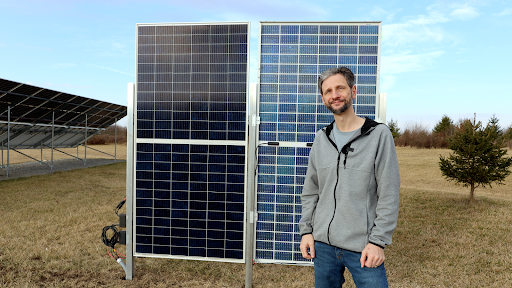
In a new YouTube breakdown, DIY solar enthusiast Projects With Everyday Dave explores how vertical solar setups—especially when paired with bifacial panels—are transforming solar efficiency in real-world environments. While his findings are residential in scale, the underlying data offers compelling insights for commercial developers, infrastructure planners, and large-scale property owners exploring smarter, space-efficient solar solutions.


What Is Vertical Solar?

Vertical solar refers to solar panels mounted upright (typically at a 90° angle), often facing east and west to capture sunlight throughout the day. Unlike traditional rooftop arrays tilted south, vertical orientation offers distinct advantages for large-scale applications:

  • Better solar generation in morning and afternoon hours
  • Reduced snow and debris accumulation
  • Installation flexibility along fences, façades, and perimeters

While bifacial panels (which generate energy from both sides) amplify these benefits, orientation is the real innovation, offering commercial projects new opportunities to integrate solar without sacrificing space or accessibility.

“You get morning sun on one side, and then afternoon sun on the other—it’s like having two shifts of power generation,” Dave explains.


Commercial Advantages: Where Vertical Solar Excels

Dave’s real-world data points to several key advantages that scale beautifully for business, industrial, and infrastructure use cases:

Reliable Performance in Snowy or Harsh Conditions

In colder climates, snow accumulation on rooftop panels causes maintenance headaches and production loss. Vertical panels eliminate buildup and maintain consistent output year-round—crucial for mission-critical facilities and distributed energy systems.

“No need to brush them off—huge for snowy regions,” Dave notes.

 Dual-Peak Output = Smarter Load Matching

East-west vertical arrays create dual generation peaks—morning and late afternoon—closely aligning with real-world commercial energy consumption, reducing demand spikes and enhancing storage and load management strategies.

“Those dual peaks show up clearly in the winter months,” says Dave, citing side-by-side production tests.

 Maximize Vertical Surfaces & Unused Perimeters

In dense commercial zones, rooftop space is often limited or reserved. Vertical solar enables energy generation from:

  • Parking lot boundaries
  • Security fences
  • Sound barriers
  • Retaining walls and building façades

This unlocks energy potential from unused vertical surfaces—turning barriers into power-generating assets.

“You can tuck solar into edges and margins—ideal for tight commercial footprints,” Dave shares.


 Performance in Real-World Conditions

While Dave shows that total average production for vertical panels is generally less than tilted panels, he explains that “In cloudy or snowy weather, the vertical setup held its own—even beat roof panels on some days.” So, even with variable weather, vertical panels proved surprisingly competitive. Sometimes they outperforming rooftop arrays, especially during:

  • Cloud cover
  • Snow events
  • Morning and evening load periods
  • Soiling (natural dust buildup)

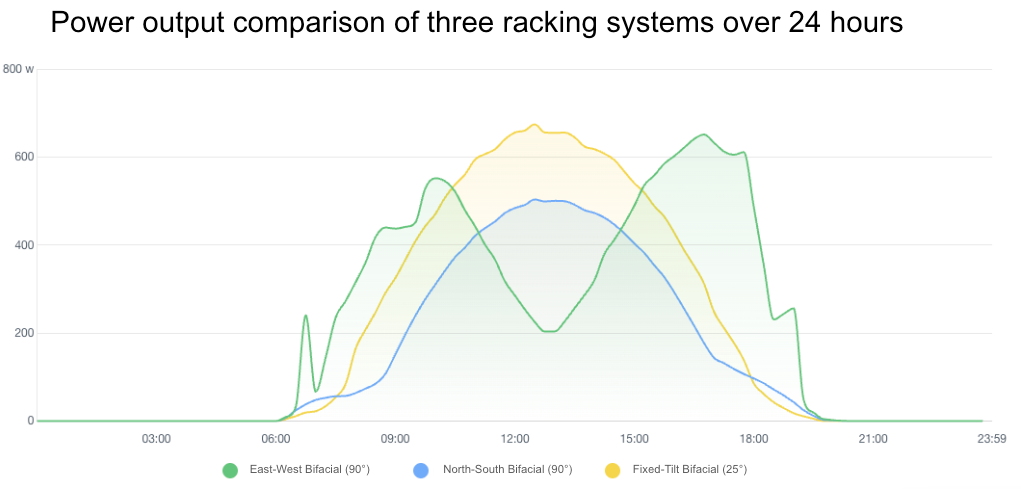
Speaking of morning and evening load periods (as seen in Figure 1), pairing east-west vertical arrays with north-south bifacial configurations, such as perimeter fences or site boundaries, can create a balanced, full-day generation profile. This is particularly ideal for commercial operations with long or irregular hours.

Figure 1: A diurnal power generation curve from the Sunzaun test site in Visalia, California, recorded on a day in mid-August 2024. All systems use the same module model; the only variable is orientation and tilt.


Application Spotlight: Where Vertical Solar Fits in Commercial Settings

Vertical solar is well-suited for:

  • Industrial, commercial, and private spaces such hospitals, data centers, and energy-intensive campuses
  • Agrivoltaic and rural infrastructure projects
  • Municipal and transportation facilities
  • Developments with limited roof access

It avoids challenges like:

  • Roof penetrations and structural retrofits
  • Shading from HVAC units or architecture
  • Safety clearances and access issues

“If your roof isn’t ideal, don’t force it. Go vertical. It’s scalable, accessible, and flexible,” says Dave.


Cost Considerations & Long-Term Value

While vertical arrays may require custom racking and bifacial panel premiums, the maintenance savings, flexible siting, and year-round reliability offer a compelling value proposition for long-term energy planning.

“In some climates, vertical systems may even outperform roof setups annually—especially when snow and shading are factors,” Dave emphasizes.


Final Thoughts: A Smarter Fit for Forward-Thinking Projects

Vertical solar isn’t just a niche idea—it’s a scalable design solution for commercial and infrastructure leaders looking to future-proof their energy strategy. From greater surface utilization to more consistent load matching, vertical systems offer a modular, resilient, and strategic path forward.

“It’s not just about cramming panels on a roof anymore,” Dave concludes. “Vertical solar gives you options—and at scale, those options make a lot of sense.”


Watch the Full Videos

🔗 Visit Projects With Everyday Dave on YouTube for real-world performance tests and innovative solar design ideas.

Sunzaun CEO Interview | Clean Power Hour

Sunzaun CEO Interview | Clean Power Hour 336 333 Sunzaun

“Everybody was just asking for incentives, […] but I’m like, […] you should stop talking about incentives. How about the idea that if you don’t do agrivoltaics, you won’t have the biomass yield you need in the future — period. Because the climate is changing.”  — Helge Biernath, CEO of Sunzaun


This powerful call to action served as an opener on a recent episode of The Clean Power Hour, setting the tone for the types of conversations that are reshaping how we think about the future of agriculture. 

As the clean energy transition accelerates –  largely driven by climate change, energy security, and economic opportunities – stakeholders are increasingly turning to farmland. Not to replace crops, but to use solar infrastructure as a complementary partner to agriculture. In this episode, host Tim Montague is joined by Helge Biernath of Sunzaun and Sunstall, and Ian Skor, CEO of Sandbox Solar, to dive into the growing world of vertical agrivoltaics. 

The Roots of Agrivoltaic Innovation

Sandbox Solar, founded over a decade ago, began testing crop performance under solar arrays back in 2018. What they found was that certain crops actually performed better under semi-transparent solar panels compared to traditional full-sun conditions. 

“[Too much] sun can be stressful for some plants,” Montague elaborated during the podcast. “We’re learning a lot — and there’s still so much to learn.” 

This duality — where crops grow within the sheltered space between solar arrays — may play a critical role in the future of sustainable agriculture. This is especially true for regions that face water scarcity and extreme heat events.

Meanwhile, Sunzaun, which grew out of the solar installation company Sunstall Inc., peered over at European trends. CEO Biernath observed the emergence of vertical racking systems that allowed crops and solar to share the same land with minimal footprint loss. With few domestic options for such systems, Biernath saw an opportunity to bring this innovation stateside.

Most recently, the two companies teamed up to launch an agrivoltaics testing site at Colorado State University. This site was designed to demonstrate real-world applications of agrivoltaics using vertically-aligned modules. With adequate spacing between rows, tractors seed and harvest crops with ease, proving that solar and agriculture don’t have to compete. 

Field crops like corn are being evaluated for their growth under panels, while researchers also monitor how the crops, in turn, affect solar output. The project is already collecting valuable data that could help inform and educate the community, as well as pave the way for the expansion of agrivoltaics nationwide.

The agrivoltaics research site at Colorado State University. In 2024, researchers planted corn within rows of bifacial vertical arrays to monitor crop growth, PV energy output, and a variety of other metrics such as soil moisture and temperature. Sunzaun’s flexible racking system enables panels to be raised by several feet if necessary — an adaptive feature to accommodate taller crops or future design needs.

Europe and Asia: A Glimpse Into the Future

Montague emphasized that Northern Europe and parts of Asia are nearly a decade ahead of the U.S. when it comes to agrivoltaic deployment. Why? Biernath believes space constraints have driven these regions to integrate solar directly into the built and agricultural environment.

“In the U.S., we have lots of land,” Biernath states. The issues lie between where that energy is needed and where it is being generated. Bringing solar photovoltaics to agricultural land found near urban hubs could reduce the need to curtail energy, a challenge recently spotlighted in parts of California. 

As the population expands, so will the pressure to balance land use among conservation, development, agriculture and energy production. Pairing solar with farming, as already seen in parts of Europe and Asia, is critical for sustaining projected growths. 

The Challenge: Awareness and Policy

If agrivoltaics offers so many benefits, why aren’t we seeing it everywhere?

According to the guests, the biggest hurdles might be awareness. Farmers may not be aware of the sheer benefits of incorporating vertical solar on agricultural land. Additionally, policy frameworks may not yet be set up to support dual-use systems, but the movement is growing. Vertical solar offers a low-footprint, high-impact solution that aligns with fostering agricultural productivity, climate mitigation and farmer resilience.

Key Takeaways

  • Vertical agrivoltaics allows solar energy and agriculture to share the land, increasing efficiency and resilience.
  • European and Asian countries are leading in adoption, offering insights for U.S. researchers, developers and the agricultural community.
  • Real-world test sites, like the one at Colorado State University, are proving that tractors, crops, and solar panels can work together.
  • Barriers remain, including public awareness and permitting processes — but growing data and interest are breaking new ground.

Want to Learn More?

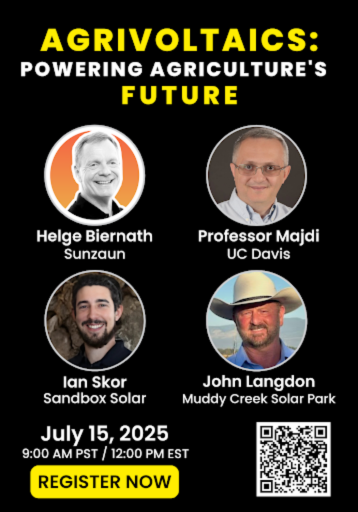
Join Ian Skor, Helge Biernath, John Langdon, and Dr. Najm on July 15, 2025 for an upcoming webinar and panel discussion titled “Powering Agriculture’s Future with Agrivoltaics”.

This free online event will explore how vertical solar is revolutionizing agricultural land use while generating clean energy. We’ll be joined by leading experts from the field, including representatives from Sunzaun, UC Davis, Sandbox Solar, and Muddy Creek Solar Park.

Art to Inspire: Visions for the Next Generations at Hamilton Elementary School

Art to Inspire: Visions for the Next Generations at Hamilton Elementary School 1600 766 Sunzaun

In the heart of Novato’s Hamilton community, a vibrant mural sits above a set of windows, now brightening the library walls at Hamilton Elementary School. This piece does more than decorate a wall; it reveals a story of progress, sustainability, and connection to the natural environment and to others. Painted by local artist Linsey Vera, known as “Miss Vera”, the mural took one month to complete and was the largest and most detailed piece she had completed to date. The piece was spearheaded by school librarian Beatriz Garcia De Gallegos and commissioned by Sunstall Inc. to promote education and environmental stewardship by planting seeds of inspiration in the minds of the young students.

Photograph of School Librarian Beatriz Garcia De Gallegos, standing outside of Hamilton Elementary’s library

“I want to have something in the library that can inspire the kids [firstly] to take care of our Mother Earth, and secondly, to dream big and become interested in science and engineering, (…) and especially encourage girls to be part of this field”, Garcia De Gallegos shared her motivations behind the project. She worked closely with Miss Vera to be sure she captured this idea while incorporating all of the important elements. 

At first glance, the mural is a colorful celebration of nature and children. Upon a closer look, deeper messages unfold. “From what I see, it’s all about inclusion and equality between everyone, like, see how they are doing different tasks, working together?” eighth grader, Jesus, explains his interpretation of the mural as he nods to the painted figures.

In the foreground, three smiling children stand close together, each symbolizing a different facet of interests and cultural background. One cradles a bundle of freshly harvested vegetables, representing local food systems. Another wears a shirt with the text Solar Power with a beaming sun, referencing renewable energy. The third supports a stack of books about plants, clean energy, biology, and the history of California and the Miwok tribe, highlighting the importance of knowledge and cultural roots. Behind them are two more children with hard hats, huddling near solar panels and reviewing documents. They look like “construction workers”, Samantha, a third grader, describes.


Set against a lush green backdrop, the background features rolling farmland, grazing animals and Californian flora coexisting with solar panels and wind turbines. Samatha again, a lover of animals, expressed that she “was amazed” when she first saw the mural. 

Fourth grader, Saul, said the mural is “really nice because it shows the green stuff, solar power, and farms. You can use solar panels to power [the farm] and shield the animals [from the sun].” “I feel like if there is a story [to the mural], it is Protect Nature because solar power is helping the environment by using electricity, so it’s teaching people to help the environment more.” 

Solar array systems and farmlands are elements of a real-world concept called agrivoltaics, where renewable energy and agriculture come together on shared land in a mutually beneficial relationship. Examples of the dual use of agrivoltaic systems with photovoltaics (solar energy) include crop production, livestock grazing and pollinator habitats. These types of arrangements are particularly compelling because solar infrastructure provides microclimates to the surrounding environment. The shade generated from the panels allows for increased moisture retention for plants and serves as a reprieve for livestock during hot summer days. In turn, plants cool the solar panels, increasing their efficiency, and therefore, increasing their energy production. This mural shows that it is entirely possible to incorporate renewable energy and food production, alongside a healthy thriving ecosystem. 

The attention to detail is what makes this art piece special. Each element is thoughtfully placed to spark joy, curiosity and empowerment. Beatriz Garcia De Gallegos hopes people have a connection with the mural as much as she does, “I had this idea for years and thanks to Helge, it became possible.” Helge Biernath, President and CEO of Sunstall Inc., explains his reason for funding the mural, “[We wanted it to] serve as inspiration for children to pursue knowledge while promoting social responsibility and climate awareness.” By blending natural landscapes with clean energy technology, it serves as a daily reminder that sustainable progress is possible and comes from collaboration across interests, fields and backgrounds. A green future includes interdisciplinary cohesion.

On sharing her initial thoughts about her involvement in the mural, Vera, the artist, was “happy this mural was going to be focused around the kids’ futures in renewable energy jobs. Anything that gets them thinking, whilst also enjoying the art is something I’m super excited to work on”.

Garcia De Gallegos, Vera and Biernath have plans to meet with the students in the fall for an in-depth talk and project relating the themes present in the mural. “Hamilton is really a special place and I hope to work more with the kids in the future” Vera stated.

Whether it’s a child who dreams of working with plants, animals, people, or in renewable energy, this mural invites every student to see themselves as part of an environmental stewardship narrative. So now, as students walk through their library this fall, surrounded by stories on the shelves and on the wall, the hope is that this mural will empower students. “What kind of future will you help build?”

You can find more work by Lynsey Vera on her website http://lynseyvera.com/ or follow her on Instagram at lynseyvera.

When it Comes to Land Use, Solar Power Outshines Corn

When it Comes to Land Use, Solar Power Outshines Corn 618 626 Sunzaun

A recent study published in Proceedings of the National Academy of Sciences and featured in Anthropocene Magazine delivers a compelling message: when it comes to using land to produce energy, solar power significantly outperforms corn-based bioenergy. Researchers find that it requires over 30 hectares of cornfields to generate the same amount of energy, in the form of ethanol, that just one hectare of photovoltaic (PV) panels can provide¹.

This has major implications for land use, especially as development faces growing pressure from population growth and environmental degradation. Unlike corn production, solar energy requires no fertilizer, herbicides, or irrigation—resources that are increasingly scarce or harmful when overused. The shift to solar not only increases energy yield per acre, but could free up land for other uses.

The benefits of replacing corn with solar power extend well beyond land efficiency. Corn, while a crucial crop for human consumption and livestock feed, does little to support biodiversity, especially when grown in large monocultures. Corn is self-pollinating and is not considered a primary food source of pollinators. Additionally, the heavy use of pesticides in cornfields inadvertently kills off bees, butterflies, and other important insects. This lack of ecological refuge contributes to the decline of pollinators—many of which are already at risk of extinction from habitat loss and climate change². 

Biodiversity Benefits From Solar; Dual Land Use

In response, stakeholders such as research institutions, private companies, and governmental organizations are promoting dual land use systems that combine pollinator-friendly habitats and solar arrays. By integrating native vegetation, these initiatives create new habitats for at-risk species, helping restore biodiversity³. 

This is where vertical PV systems such as Sunzaun offer real, cutting-edge solutions. These upright solar structures allow sunlight to reach the ground between rows, making it possible for native vegetation and pollinator-friendly plants to thrive among them⁴. Additionally, cash crops such as strawberries, buckwheat, and flowering herbs have been found to perform well under solar arrays while supporting pollinators and soil health, providing additional income opportunities. These systems enable landowners to replace monoculture with multi-functional, living landscapes; a combination of clean energy production with ecological benefits.

A Sustainable Approach: The Future of Energy

Corn remains an essential crop for food and feed, thus its role in agriculture is not under debate. However, using corn to produce fuel is resource-intensive, particularly when better alternatives like solar power exist. By reducing our reliance on corn for energy and reserving farmland for food, we can strike a future-forward balance between energy needs and ecological wellbeing. 

Research demonstrates that PV infrastructure can enhance, rather than displace, natural systems. As the climate crisis intensifies and agricultural pressures mount, the smartest path forward is one that balances our energy demands with sustainability. Vertical PV systems promote a more regenerative, biodiverse, and resilient energy future.

Sources

¹ T. Cornelisse, D.W. Inouye, R.E. Irwin, S. Jepsen, J.R. Mawdsley, M. Ormes, J. Daniels, D.M. Debinski, T. Griswold, J. Klymko, M.C. Orr, L. Richardson, N. Sears, D. Schweitzer, & B.E. Young, Elevated extinction risk in over one-fifth of native North American pollinators, Proc. Natl. Acad. Sci. U.S.A. 122 (14) e2418742122, https://doi.org/10.1073/pnas.2418742122 (2025).
² FAO (2019). The State of the World’s Biodiversity for Food and Agriculture. http://www.fao.org/state-of-biodiversity-for-food-agriculture/en/
³ IPBES (2016). Assessment Report on Pollinators, Pollination and Food Production. https://ipbes.net/pollinators
⁴ NREL (2018). Co-location of Agriculture and Solar Photovoltaics: Design and Management Considerations for Pollinator Habitat. https://www.nrel.gov/docs/fy19osti/73463.pdf

Sunzaun on Track: Vertical Bifacial Solar PV for Railways

Sunzaun on Track: Vertical Bifacial Solar PV for Railways 1024 1024 Sunzaun

As railroads intersect countries and connect cities, they offer a unique opportunity for energy generation. Vertical bifacial solar systems are well-suited to turn these corridors into high-efficiency, low-footprint power sources—without interfering with train operations or requiring additional land.

Why Railways Are Ideal for Vertical Bifacial PV Infrastructure

Railway networks offer miles of underutilized space that is already cleared, maintained, and graded. Traditional horizontal solar systems struggle to fit into these narrow strips. That’s where Sunzaun’s vertical design excels:

  • Small Footprint: Vertical PV (photovoltaic) systems require only a narrow strip of land, making them ideal for trackside positioning in right-of-way areas or even between dual-track corridors (CleanTechnica, 2025).
  • Reduced Afternoon Glare: Unlike tilted PV panels, Sunzaun’s vertical installation reduces glare risks, enhancing railway safety compliance.
  • Preexisting Infrastructure: Panels can be mounted along existing fences, barriers, or access roads, reducing construction effort and regulatory friction.
  • Dual-Sided Generation: Panels absorb direct and reflected light from both sides, increasing energy capture and generation.
  • Morning and Evening Peaks: Energy generation aligns with early and late demand periods—often matching train station energy usage (Overeasy.no, 2024).

Integration with Railway Power Systems

  • DC Coupling Options: Vertical solar systems can feed into traction substations, minimizing energy losses from AC-DC conversion (Electric & Hybrid Rail Technology, 2024).
  • Smart Grid Compatibility: Integration with inverters enables future compatibility with train station microgrids and auxiliary systems.
  • Removable and Modular: Sunzaun structures can be installed with temporary or quick-release mounts to allow access for track maintenance, drawing on concepts similar to the Sun-Ways system in Switzerland (Euronews, 2024).

Additional Benefits for Rail Operators

  • Security Fencing + Energy: Sunzaun infrastructure can double as secure fencing, used to protect both railroad operations and the public from hazards, reducing material and installation costs.
  • Noise Mitigation Potential: Mounted along sound barriers, they attenuate noise pollution, benefiting wildlife and neighboring communities, increasing community acceptance.
  • Low Maintenance: Vertical alignment limits soiling from dust and debris stirred up by passing trains (SolarWA.org).

Vertical Bifacial PV can unlock huge potentials for decentralized, cost-effective renewable energy generation without competing for land or disrupting preexisting infrastructure. Railways have the opportunity to not only serve as transportation arteries, but climate-neutral power corridors.


References:

  1. CleanTechnica (2025): “Three Interesting Ways to Leverage Railways for Solar Power”
    https://cleantechnica.com/2025/01/06/three-interesting-ways-leverage-to-railways-for-solar-power/
  2. Overeasy.no (2024): “Increased Solar Capture Rates from Vertical Bifacial Solar Panels”
    https://www.overeasy.no/post/increased-solar-capture-rates-from-vertical-bifacial-solar-panels
  3. ResearchGate (2023): “Modeling of Energy Gain in Bifacial Vertical PV Fences”
    https://www.researchgate.net/publication/387699162_Modeling_of_energy_gain_in_bifacial_vertical_PV_fences
  4. Electric & Hybrid Rail (2024): “Using Solar Power to Provide Traction Energy”
    https://www.electricandhybridrail.com/content/in-depth/using-solar-power-to-provide-traction-energy-for-electrified-trains/
  5. Euronews (2024): “Solar Panels Could Be Installed in the Spaces Between Railway Tracks”
    https://www.euronews.com/green/2024/10/14/solar-panels-could-be-installed-in-the-spaces-between-railway-tracks-in-world-first
  6. SolarWA.org (n.d.): “Vertical Bifacial Solar Panels”
    https://www.solarwa.org/vertical_bifacial_solar_panels

From Runways to Renewables: Vertical Solar Power at US Airports

From Runways to Renewables: Vertical Solar Power at US Airports 512 288 Sunzaun

As the world intensifies efforts to reduce carbon emissions and embrace renewable energy, the role of airports in this transition is often overlooked. Traditionally seen as major energy consumers due to the constant demands of air traffic and facilities, airports are now becoming key players in sustainable energy generation. A particularly innovative approach gaining traction is the use of vertical solar farms. This article explores how vertical photovoltaic (PV) systems can revolutionize energy production at airports and contribute to a greener aviation industry.

Airports as Ideal Locations for Solar Installations

Airports represent some of the most promising locations for large-scale solar energy generation. With large expanses of unused or underutilized land around runways and taxiways, airports can install solar farms without impacting air traffic. In fact, airports are already being recognized for their potential as renewable energy hubs. Around 20% of public airports in the U.S. have adopted some form of solar power, including rooftop and ground-mounted systems [https://solartribune.com/solar-power-takes-off-at-u-s-airports/].

Vertical solar systems like this installation by Sunzaun offer a variety of innovative applications, e.g. on farms or airports

How Vertical Solar Farms Benefit Airports

Energy Savings and Reducing Airports’ Carbon Footprints

Vertical solar farms can help airports significantly reduce energy costs by generating clean, renewable electricity on-site. This cuts down on utility bills and also reduces the airport’s overall carbon emissions, contributing to a greener, more sustainable operation.

Opportunities for Additional Revenue Streams

In addition to energy savings, airports with large solar installations have the potential to sell excess power back to the grid, creating additional revenue streams. This economic benefit adds to the appeal of solar farms for airport operators.

Impact on Operational Efficiency and Public Image

Adopting solar energy can enhance an airport’s operational efficiency by providing a stable, renewable power source. Furthermore, it can improve the airport’s public image, positioning it as a leader in sustainability and innovation, which is increasingly important in the eyes of environmentally conscious travelers.

Rendering showing how unused areas on airports could be used for vertical PV development

Challenges of Installing Vertical Solar Farms Near Airports

Potential Concerns About Aviation Safety, Including Glare and Air Traffic Disruption

One of the key concerns about solar farms near airports is the potential for glare, which could impair pilots’ vision during takeoff or landing. However, vertical solar farms tend to produce less glare than traditional horizontal installations, as they are designed to absorb sunlight from different angles. Strategic placement and the use of anti-glare technologies can further mitigate these risks [https://www.airsight.de/projects/item/solar-farms-at-airports-a-key-to-the-transition-to-renewable-energy-at-aerodromes/].

Engineering and Regulatory Challenges Specific to Airport Environments

Solar farms at airports face unique regulatory and engineering challenges, particularly regarding aviation safety standards. Developers must ensure that solar installations do not interfere with radar or communication systems, and they must comply with strict Federal Aviation Administration (FAA) regulations.

Solutions: Anti-Glare Technology, Strategic Placement

To address these challenges, developers are employing advanced anti-glare technology and carefully planning the placement of vertical panels. By positioning panels at the correct angles and distances from runways, airports can enjoy the benefits of solar energy without compromising safety.

Future Prospects: Expanding Solar Farms on U.S. Airports

Case Studies of U.S. Airports with Solar Installations

Several U.S. airports have already embraced solar energy. Indianapolis International Airport is home to one of the largest airport-based solar farms in the world, generating enough power to supply 10,000 homes annually. Denver International Airport has also made strides in solar energy, with four separate solar arrays that collectively generate over 10 MW of power [https://solartribune.com/solar-power-takes-off-at-u-s-airports/].

Highlight Key Projects, Such as the Frankfurt Airport Vertical PV Installation

Globally, airports are setting the stage for the adoption of vertical solar farms. Frankfurt Airport, for example, has recently launched the world’s largest vertical PV installation, covering 30.8 hectares and generating 17.4 MW of power [https://www.linkedin.com/pulse/worlds-largest-vertical-pv-system-welserprofilenorthamerica-jatvf]. This project serves as a model for U.S. airports looking to adopt similar systems.

How U.S. Airports Can Replicate These Successful Projects

U.S. airports can follow in the footsteps of international leaders like Frankfurt by investing in vertical solar technology, adapting it to local regulations, and addressing safety concerns through engineering solutions. Collaboration between solar developers and airport operators will be key to realizing these projects.

Conclusion

Vertical solar farms have the potential to transform energy production at airports. As technology advances and policy support for renewable energy grows, vertical PV installations can become a cornerstone of sustainability initiatives at airports across the U.S. With their ability to optimize space, reduce energy costs, and lower carbon emissions, vertical solar farms offer a bright future for the aviation industry.