Solar

The Future of Solar Energy: How Agri-PV Is Revolutionizing Sustainable Farming

The Future of Solar Energy: How Agri-PV Is Revolutionizing Sustainable Farming 617 514 Sunzaun

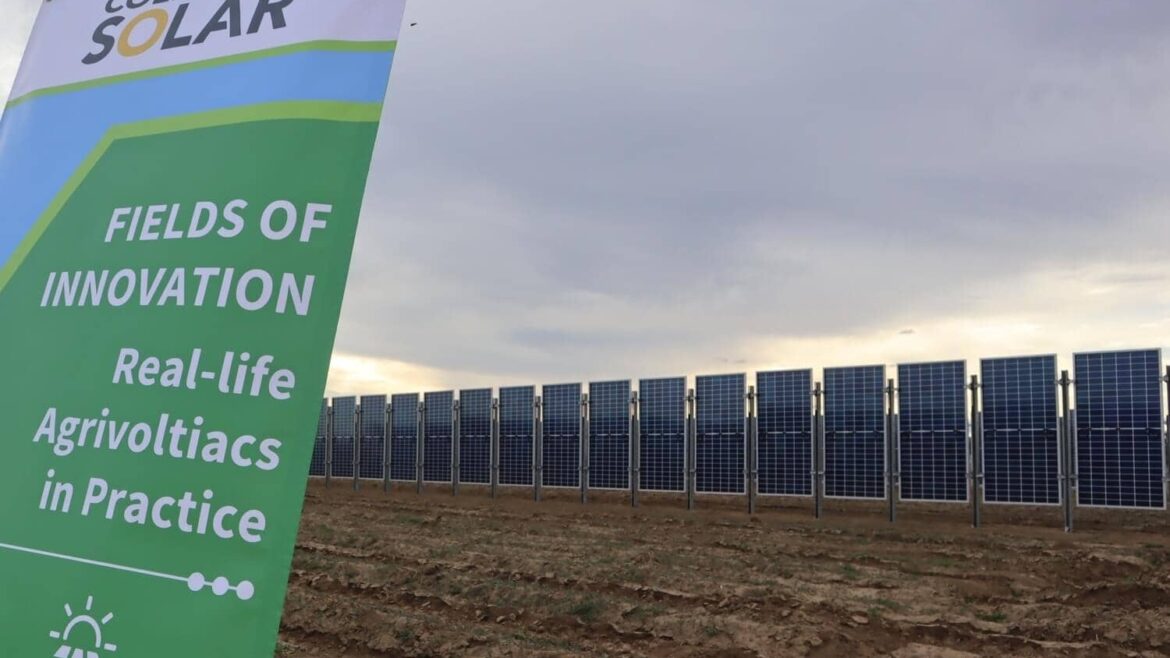
As the world increasingly turns to renewable energy sources, solar power remains at the forefront of this green revolution. However, traditional ground-mounted solar panels (GM-PV) come with a significant trade-off: they require large swathes of land that could otherwise be used for farming. With the availability of arable farmland shrinking—down by 49% per person globally—this competition between energy production and agricultural space is becoming more pronounced. Agri-PV (agricultural photovoltaics), is an innovative solution that promises to harmonize the needs of both farmers and the renewable energy sector.

The Dilemma of Ground-Mounted Solar Panels

GM-PV systems are undeniably effective in harnessing solar energy, but they pose a challenge when it comes to land use. Farmland is increasingly in demand for growing crops to feed a growing global population. As the amount of arable land per person decreases, the expansion of traditional GM-PV systems often means taking away land that could be used to grow food. This creates a tension where solar energy and agriculture are pitted against each other, rather than working together.

Introducing Agri-PV: A Harmonious Solution

Agri-PV represents a groundbreaking approach to integrating solar energy with agriculture. Unlike traditional GM-PV, which sits on the ground and competes with farming, Agri-PV systems are designed to coexist with crops on the same land. Here’s how Agri-PV is transforming the landscape:

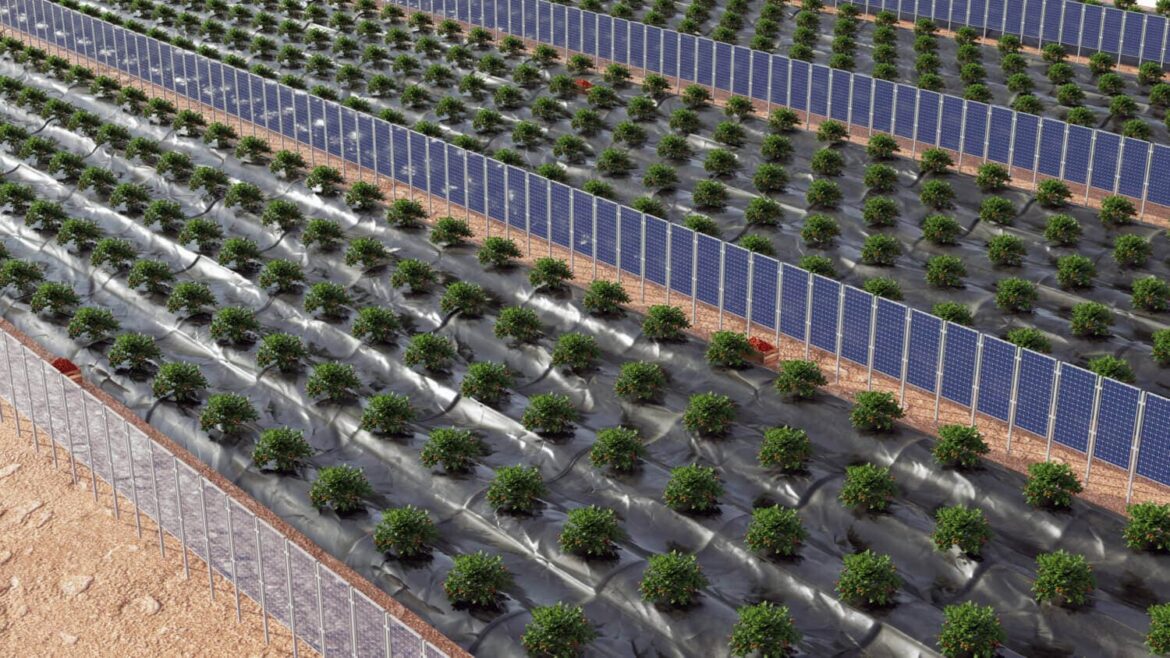
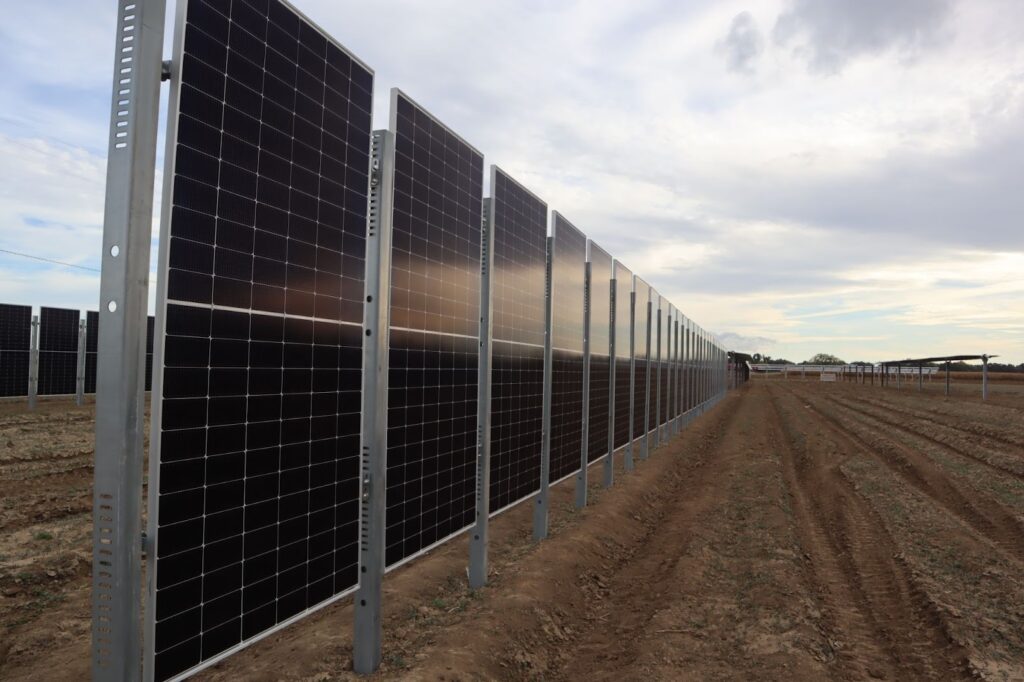
  1. Dual Use of Land: By installing solar panels vertically next to crops, Agri-PV systems make it possible to produce renewable energy without displacing agricultural activities. This dual-use model maximizes land efficiency and addresses the pressing issue of reduced farmland availability.
  2. Climate Resilience for Farmers: One of the most significant benefits of Agri-PV is its ability to help farmers cope with extreme weather conditions. Solar panels provide much-needed shade, which reduces water loss due to evaporation and protects plants from excessive heat and wind. This not only helps in maintaining crop health but also mitigates the effects of drought and other climate-related challenges.
  3. Preservation of Organic Status: Agri-PV installations are designed to work in harmony with the natural environment, ensuring that crops maintain their organic status. This is crucial for farmers who are committed to sustainable practices and wish to preserve the integrity of their produce.
  4. Urban and Rural Flexibility: Unlike traditional GM-PV, which often requires large, open spaces, Agri-PV systems can be installed in urban areas or emerging rural towns. This flexibility reduces the need for expansive solar farms and allows for a more decentralized approach to renewable energy production.

The Path Forward

Integrating solar technology with agriculture through Agri-PV is a promising development for sustainable solutions. By addressing the land use conflict between energy production and farming, Agri-PV supports the growth of renewable energy and enhances agricultural productivity and resilience.

As we move forward, the continued advancement and adoption of Agri-PV could play a crucial role in meeting our energy needs while ensuring that we have enough land to produce the food necessary to sustain our global population. This innovative approach represents a significant step towards a future where energy and agriculture can thrive together in a balanced and mutually beneficial way.

In conclusion, Agri-PV is more than just a technological advancement—it’s a beacon of hope for a future where renewable energy and sustainable farming practices go hand in hand.

New study shows how agrivoltaics systems can protect crops from extreme wind conditions 

New study shows how agrivoltaics systems can protect crops from extreme wind conditions  1500 844 Sunzaun

About the Author: Henry Williams is a recent PhD graduate in Mechanical Engineering from Cornell University, where his dissertation focused on microclimate impacts of solar panels in agrivoltaics systems. His agrivoltaics research has been featured in media outlets like Fast Company and PV Magazine, and his agrivoltaics design company, Serida Inc., was a semi-finalist in the Department of Energy American Made Solar Prize Round 8.

High wind speeds can cause severe damage to crops and soils that lack protection from a windbreak or shelterbelt. In the US, the estimated cost of wind damage in the agricultural sector surpasses $9 billion annually.

Wind speeds can be reduced by windbreaks, typically made of shrubs or trees. Well-designed windbreaks can increase crop yield, reduce soil loss, and increase pasture productivity compared to an open field without a windbreak. But windbreaks made of shrubs and trees can be challenging for producers to establish and manage. The shrubs and trees compete for resources with adjacent rows of crops, and they are sometimes removed due to poor condition or age.

Solar panels offer a revenue-generating solution for farmers seeking to establish new windbreaks or replace aging ones. Compared to conventional windbreaks, solar panels offer wind shelter benefits without the downside of soil resource competition.

For a producer turning to an agrivoltaics wind protection system, the question becomes: how should solar panels be designed and managed to control airflow underneath?

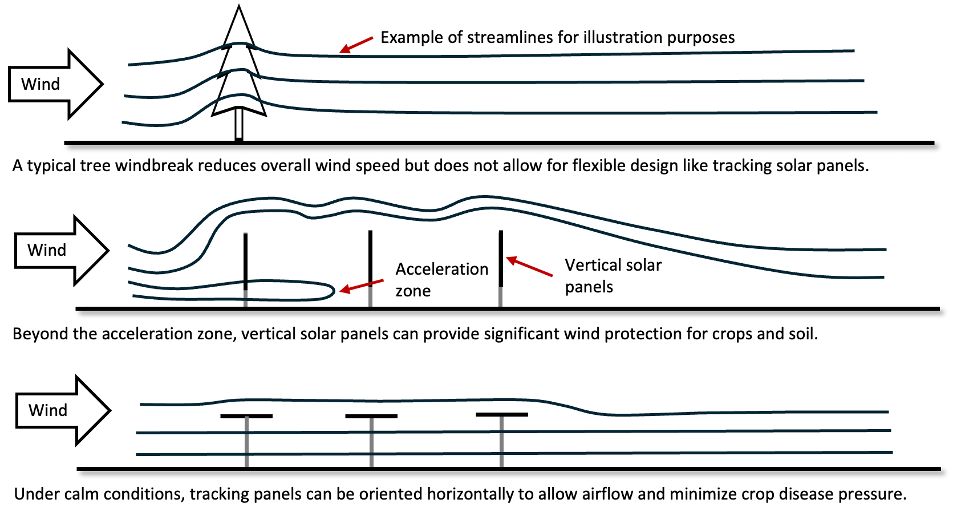
In our recent study published in Agricultural and Forest Meteorology[1], we developed a computational fluid dynamics (CFD) model to quantify the windbreak effect of solar panels in various configurations, demonstrating how different panel orientations can alter airflow underneath. Our simulations show that vertical panels provide excellent protection from high wind speeds for crops and soils in the interior of the agrivoltaics system. There is a tradeoff, however. In the first few rows, an acceleration zone is created from air squeezing into the open space between the ground and the lower edge of the solar panels. This tunneling effect can be minimized by dropping the leading row of solar panels closer to the ground.

At the other extreme, when panels are oriented horizontally, airflow is largely uninhibited below. This can be useful in calm conditions if mildew is a concern for producers.

Above: Illustrative streamlines show how air moves through a tree windbreak, vertical solar panels, and horizontal solar panels.

Our study identifies a shelter zone starting after the acceleration zone. In the shelter zone, crops and soils are largely protected from extreme wind. To maximize windbreak benefits in an agrivoltaics system, crops would be planted in the shelter zone.

Under high inlet wind speeds, our simulations indicate that vertical solar panels can achieve a wind reduction of up to 40% of inlet wind speed in the shelter zone. The tree windbreak in our model only achieves up to 20% reduction in the shelter zone. For extreme wind gusts, the difference between 40% and 20% wind reduction can save crops and soils from major damage. This indicates that vertical solar panels can perform better under the simulated conditions than a row of trees planted as a windbreak.

Overall, these results point to the importance of considering airflow in agrivoltaics designs. When solar installations are designed to control wind conditions, agrivoltaics systems can prevent severe wind damage to crops and soils while also generating revenue for the producer.

Combined with other microclimate alterations in agrivoltaics systems, wind protection from solar panels is a meaningful benefit to crops and soils facing extreme weather conditions.


[1] Henry J. Williams, Khaled Hashad, K. Max Zhang, Agrivoltaics wind shelter benefits with single-axis tracking solar panels, Agricultural and Forest Meteorology, Volume 380, 2026, 111091, ISSN 0168-1923, https://doi.org/10.1016/j.agrformet.2026.111091.

Más allá de la Super Bowl: Bad Bunny, ‘El Apagón’ y una mirada profunda a la energía 

Más allá de la Super Bowl: Bad Bunny, ‘El Apagón’ y una mirada profunda a la energía  358 372 Sunzaun

This blog post was originally written in Spanish. An English translated version can be found in the second portion below.

Cuando Bad Bunny subió al escenario de la Super Bowl, no fue solo otro espectáculo de medio tiempo — fue una declaración de resonancia cultural en el escenario más grande del mundo. Su música está en tendencia porque conecta con la experiencia vivida de las personas, y “El Apagón” no es la excepción.

Pero aquí está lo importante: la canción no es popular solo por su ritmo o su impacto viral. Resuena porque captura algo real y generalizado — una realidad que la gente entiende, ya sea en Puerto Rico o en cualquier lugar donde la confiabilidad eléctrica importa.

Los apagones no son solo una anécdota caribeña.
Son una señal. Un síntoma de sistemas que fueron diseñados para condiciones distintas a las que hoy les exigimos.

En todo el mundo estamos viendo el mismo patrón:

  • Redes eléctricas construidas hace décadas
  • Nuevas cargas derivadas de la electrificación
  • Generación renovable que, por naturaleza, es variable
  • Creciente demanda sin una inversión equivalente en resiliencia

Por eso “El Apagón” toca tan de cerca a tantas personas. Aunque la canción se refiere específicamente a los problemas energéticos en Puerto Rico, el sentimiento refleja una tensión universal entre las expectativas y la realidad de la infraestructura.

Esto nos lleva a una pregunta sencilla pero crucial:

¿Cómo producimos más energía sin sacrificar productividad, territorio o resiliencia?

Ahí es donde la energía solar — y especialmente la agrovoltaica — deja de ser una idea atractiva y se convierte en una estrategia práctica.

Energía solar fotovoltaica y resiliencia de la red: una contribución real

La energía solar tradicional cumple un papel en la descarbonización y en el aumento de la capacidad de generación. Pero la agrovoltaica (agricultura + energía fotovoltaica) aporta algo más integral:

No es competencia, es integración.

  • La agrovoltaica no le quita la tierra a la producción. Trabaja con ella.
  • Los cultivos siguen creciendo
  • El ganado continúa pastando
  • La tierra se mantiene productiva
  • La energía se genera en los mismos lugares donde la gente vive y trabaja

No se trata solo de instalar paneles — se trata de diseñar sistemas que cumplan múltiples funciones al mismo tiempo.

Por qué esto importa en el contexto de “El Apagón”

La canción ha llevado el tema de la confiabilidad energética a la conversación cultural — y eso representa una oportunidad.

Podemos aprovechar ese impulso para avanzar hacia soluciones que:

  • Fortalezcan la generación energética local
  • Reduzcan la dependencia de infraestructura distante y vulnerable
  • Hagan que las redes sean más resilientes frente a eventos climáticos, picos de demanda y cambios estructurales.

La energía solar fotovoltaica — distribuida, bien pensada y combinada con la agricultura — forma parte de la historia de la resiliencia. No es una solución mágica, pero sí es una pieza real de la solución.

La música de Bad Bunny está en tendencia porque refleja una verdad que las personas sienten en su vida cotidiana.
La energía solar y la agrovoltaica merecen estar en la conversación porque ofrecen una forma concreta de enfrentar una realidad que nuestra infraestructura ya no puede ignorar.

La oportunidad que tenemos por delante

La atención hacia los desafíos energéticos está creciendo — tanto cultural como políticamente. El siguiente paso es transformar esa conciencia en cambios prácticos.

La pregunta no es si la energía renovable es necesaria.
La pregunta es si estamos diseñando nuestros sistemas de manera que hagan a las comunidades más resilientes, no más frágiles.

La agrovoltaica no es solo sostenibilidad — es una forma de trabajar con la tierra, con las personas y con los sistemas energéticos para construir un futuro más fuerte y resiliente.

— Pablo Anós, MRA – Logistics & Supply Chain Management at Sunstall Inc.


Bad Bunny’s Super Bowl Performance, “El Apagón,” and a Deeper Energy Conversation

When Bad Bunny took the stage at the Super Bowl, it wasn’t just another halftime show. It was a declaration of cultural resonance on one of the largest stages in the world. His music is trending because it speaks to people’s lived experience, and “El Apagón” is no exception.

But here’s what’s important: the song isn’t just popular because of its beat or viral appeal. It resonates because it captures something real and widespread — a lived reality that people understand, whether they’re in Puerto Rico, or anywhere power reliability matters.

Blackouts aren’t just a Caribbean anecdote.
They’re a signal. A symptom of systems that were designed for different conditions than the ones we’re asking them to handle today.

Across the globe, we’re seeing the same pattern:

  • Grids built decades ago
  • New loads from electrification
  • Renewable generation that’s variable by nature
  • Growing demand without equal investment in resiliency

That’s why El Apagón hits close to home for so many. Although the song is specific to energy issues in Puerto Rico, the sentiment reflects a universal tension between expectation and infrastructure reality.

This leads us to a simple but crucial question:

How do we produce more energy without sacrificing productivity, land, or resilience?

That’s where solar — and especially agrivoltaics — moves from being a catchy idea to a practical strategy.

Solar PV and Grid Resiliency: A Real Contribution

Traditional solar plays a role in decarbonization and generation capacity. But agrivoltaics (agriculture + photovoltaics) brings something more layered:

It’s not competition, it’s integration.

Agrivoltaics doesn’t take land away from productive use. It works with it.

  • Crops continue to grow
  • Livestock continues to graze
  • Land remains productive*
  • Energy is generated in the very places where people live and work

This isn’t just about adding panels — it’s about designing systems that serve multiple purposes at once.

Why This Matters in the Context of “El Apagón”

The song has put energy reliability into cultural conversation, which presents an opportunity.

We can use that momentum to push toward solutions that:

  • Strengthen local energy generation
  • Reduce reliance on distant, brittle infrastructure
  • Make grids more resilient to weather, demand spikes, and climate shifts

Solar PV — distributed, thoughtful, and combined with agriculture — is part of the resiliency story. It’s not a silver bullet, but it is a real piece of the solution.

Bad Bunny’s music is trending because it reflects a truth people feel in their lives.
Solar and agrivoltaics deserve to be part of the conversation because they offer a real way to address a truth our infrastructure can no longer ignore.

The Opportunity Ahead

Attention to energy challenges is rising, both culturally and politically. The next step is turning that awareness into practical change.

The question isn’t whether renewable energy is necessary.
It’s whether we’re designing our systems in a way that makes communities more resilient, not more fragile.

Agrivoltaics isn’t just sustainability; it’s a way to work with land, people, and energy systems for a stronger, more resilient future.

— Pablo Anós, MRA – Logistics & Supply Chain Management at Sunstall Inc.

UC Davis Expands Agrivoltaics Research, Includes New Sunzaun System

UC Davis Expands Agrivoltaics Research, Includes New Sunzaun System 1500 979 Sunzaun

Back in 2023, University of California (UC) Davis had a small set of Sunzaun vertical bifacial racking installed – three rows of three modules – to support early agrivoltaics (agriculture + solar, or photovoltaic, energy) research. Sunstall donated the racking system so the university could begin exploring how vertical solar might work alongside crops in California farmland.

Two years later, and after immense collaboration, the research site looks quite different.

A New Research Installation 

In late October 2025, several solar companies came together to complete a new, and significantly larger, system on one of the campus’s agricultural fields, just across from the original test site. Its completion came just in time for the 3rd Annual California Germany Agrivoltaics Day at UC Davis, organized by German American Chamber of Commerce. This event gathered researchers, farmers, and industry professionals to discuss the progress and potential of agrivoltaics in California, drawing on Germany’s extensive experience in the field. The newly expanded project offered visitors the opportunity to walk through the site, examine the equipment up close, and speak directly with the experts who are building and studying these systems. 

The photovoltaic acquisition process was led by Professor Majdi Abou Najm from the Department of Land, Air and Water Resources at UC Davis. He is one of California’s leading figures in agrivoltaics research.

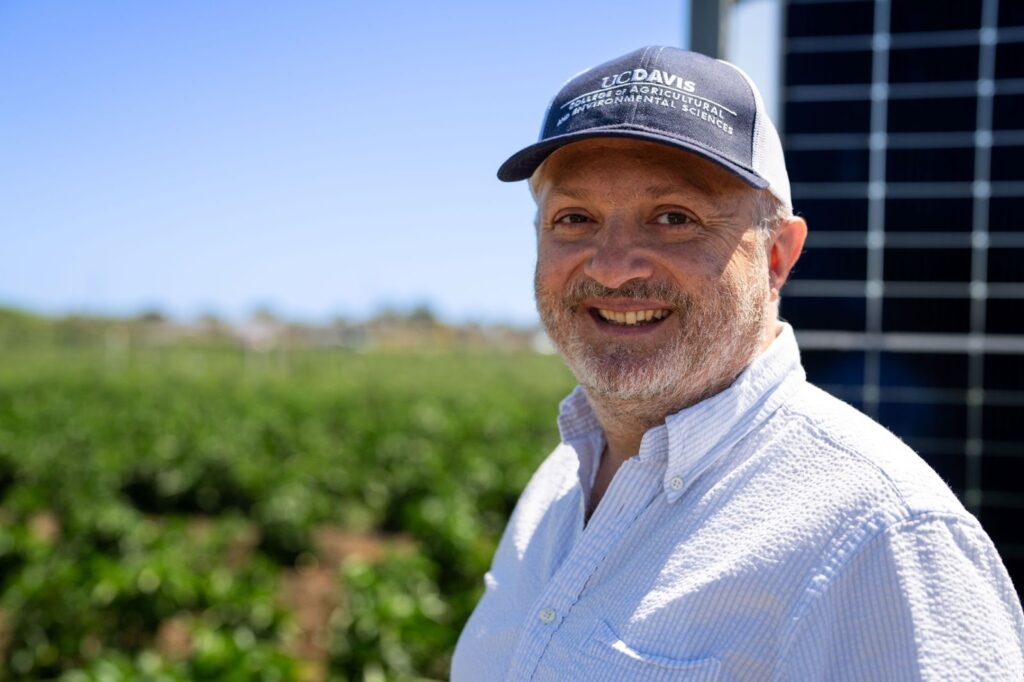
Professor Majdi Abou Najm standing in front of the old Sunzaun installation, surrounded by pepper and basil test crops.

Four Agrivoltaic Systems, One Field

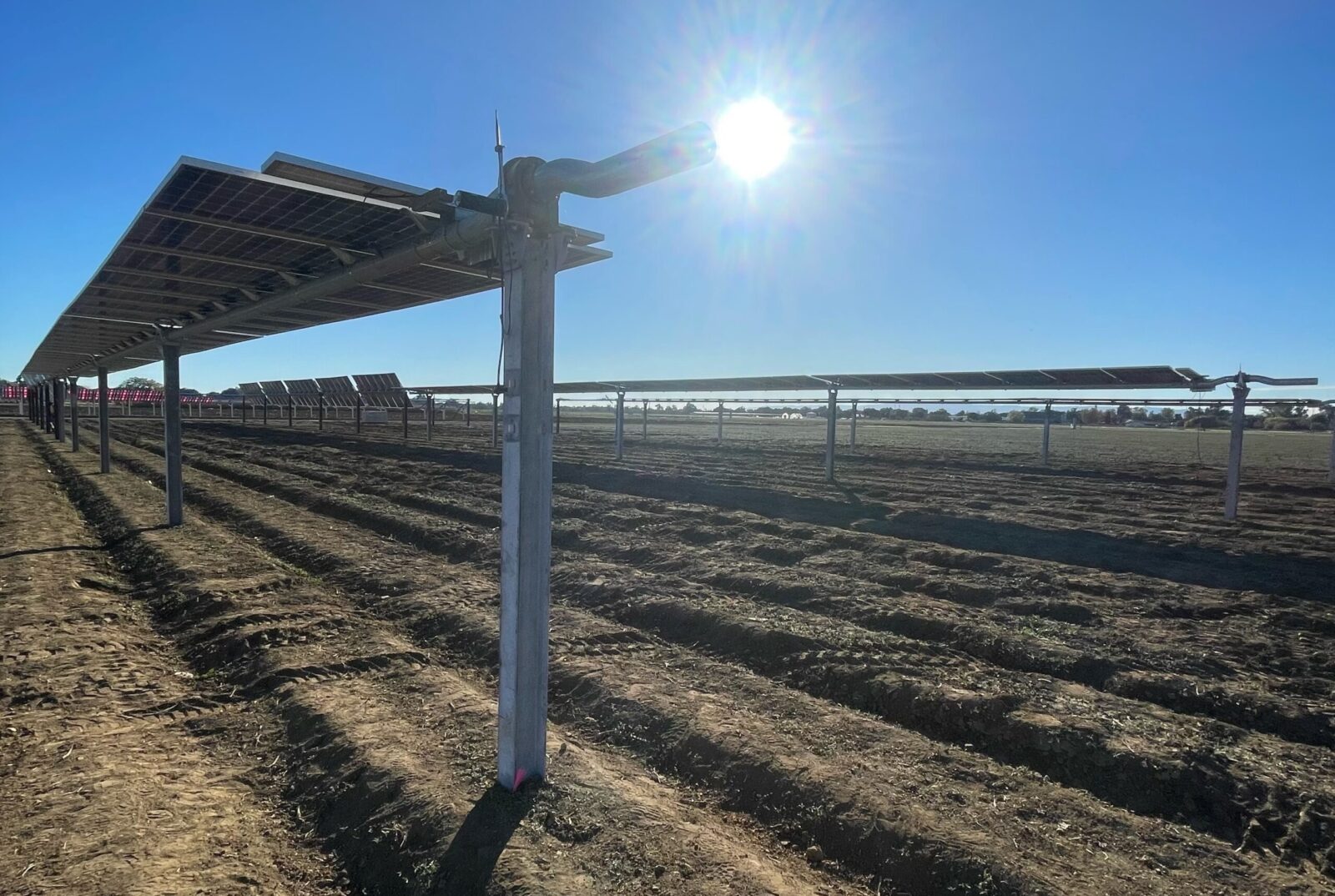
The new research site is unique in its variety. Instead of a single system, the field now hosts four different ground-mounted PV designs, each with its own racking and module configuration. The multi-system format is meant to support decision-making by farmers, developers, and policymakers. comparison that allows researchers to look closely at energy production, crop response, and equipment access. The full site contains 448 modules totaling 200.44 kW.

“This site will inform growers how to select PV systems that align with their needs,” Abou Najm said. “If wind is damaging your crops, vertical systems can help. If heat stress is the issue, spectrally selective panels may be more appropriate,” he said, highlighting how agrivoltaic design choices can be tailored to specific on-farm challenges.

“My hope is to have this facility serve as the technology and science hub for shaping the future of agrivoltaics,” Abou Najm said. “For policy makers, it provides the visual (…) that this is not a one-size-fits-all technology (…), and that if designed with the agriculture-first mindset, can be transformative.”

From north to south, the systems include:

1. Sunzaun Vertical Bifacial System

Panels mounted vertically, producing from both east and west, designed to morning and afternoon energy generaton. This design offers uniform shading, easy equipment access, and strong potential for crop compatibility.

Photo Credit, Maximilian Dedden

2. Two Single-Axis Trackers

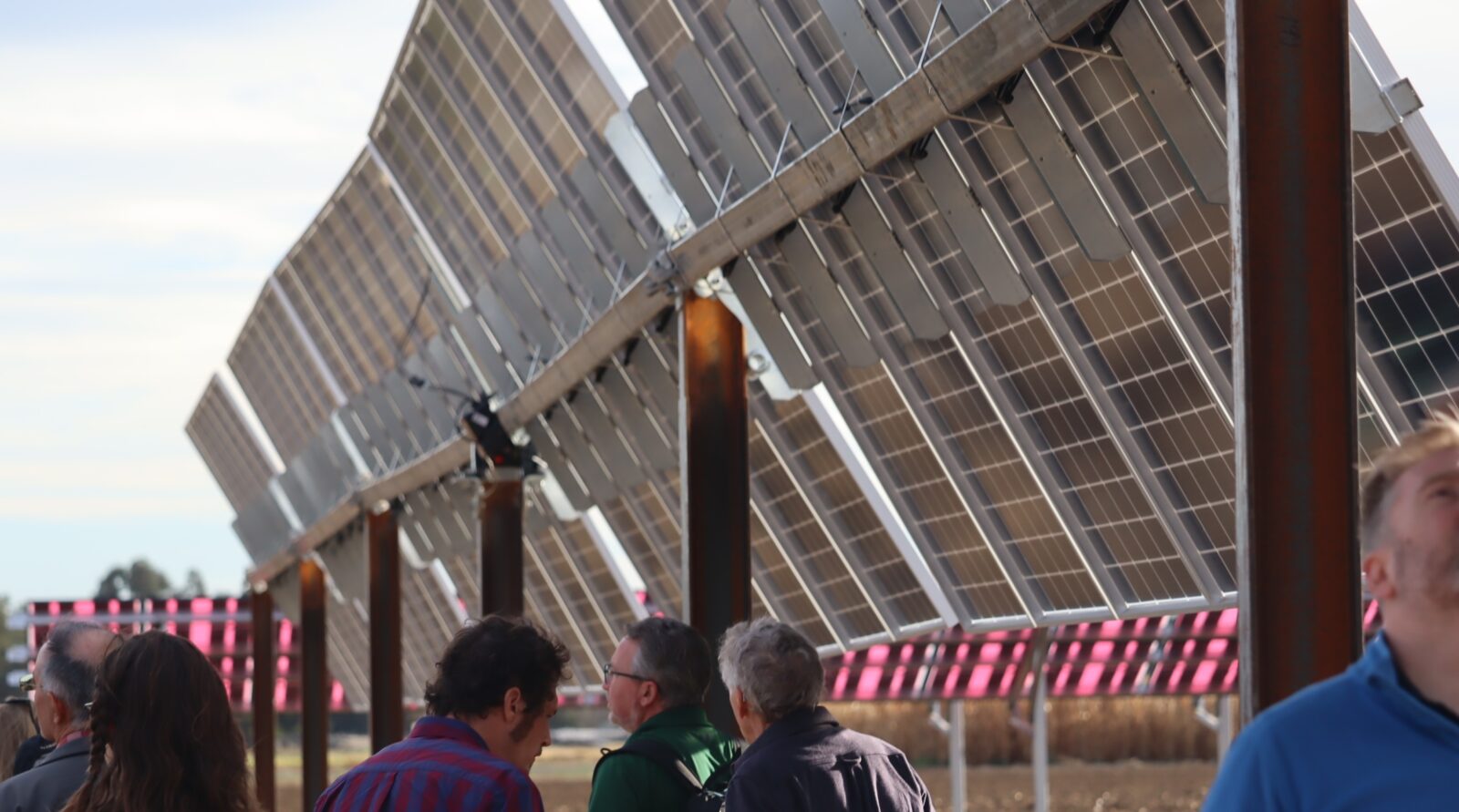
Two commercial tracker design, Nextracker and Nevados, installed next to each other to compare performance and crop impacts. Trackers typically deliver the highest energy yield, and the side-by-side setup gives researchers a rare opportunity to study differences in modules, design, and crop yield.

Photo Credit, Maximilian Dedden

3. OMCO Fixed-Tilt With Red Modules

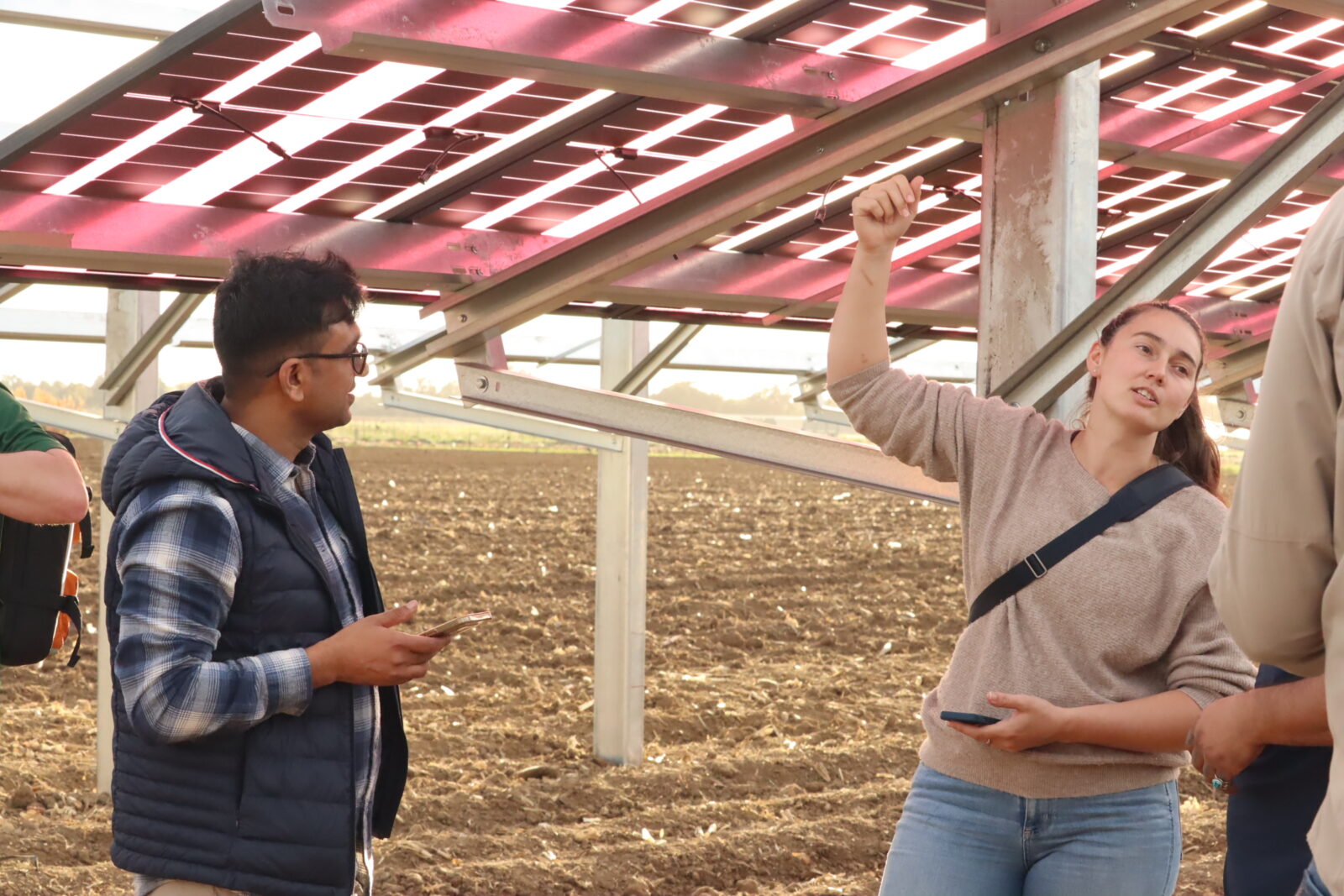
A fixed-tilt system fitted with red-tinted solar modules. These are spectrally selective modules supplied by Constructive Systems to support plant growth while still generating electricity.

Photo Credit, Maximilian Dedden

Built for Farming Operations, Not Just PV Density

A defining feature of the installation is its approximately 50-foot row spacing; wide enough to accommodate commercial farming equipment. Abou Najm said the spacing was driven by harvesting realities.

“In California, tomato harvesters operate across six rows at a time, alongside trucks collecting the crop,” he said. Tighter spacing would make commercial harvesting inefficient and would ultimately result in more agricultural land being lost to solar.

Over the coming seasons and as funding permits, UC Davis researchers plan to grow tomatoes, among other crops, between PV rows while monitoring crop yield, soil moisture, microclimate effects, carbon sequestration, and operational compatibility.

Installed by Sunstall, Inc.

All four systems were installed by Sunstall Inc., the parent company of Sunzaun and is quickly becoming one of the leading agrivoltaics installation teams in the country. The project highlights Sunstall’s ongoing commitment to supporting universities and research organizations as agrivoltaics shifts from an emerging idea to a tested, practical approach to farming and energy production.

Agrivoltaics has the potential to make food production more resilient while reducing emissions from the electricity sector. Sunzaun is grateful to contribute to this work and looks forward to the research results that will come from UC Davis’s expanded testing ground.

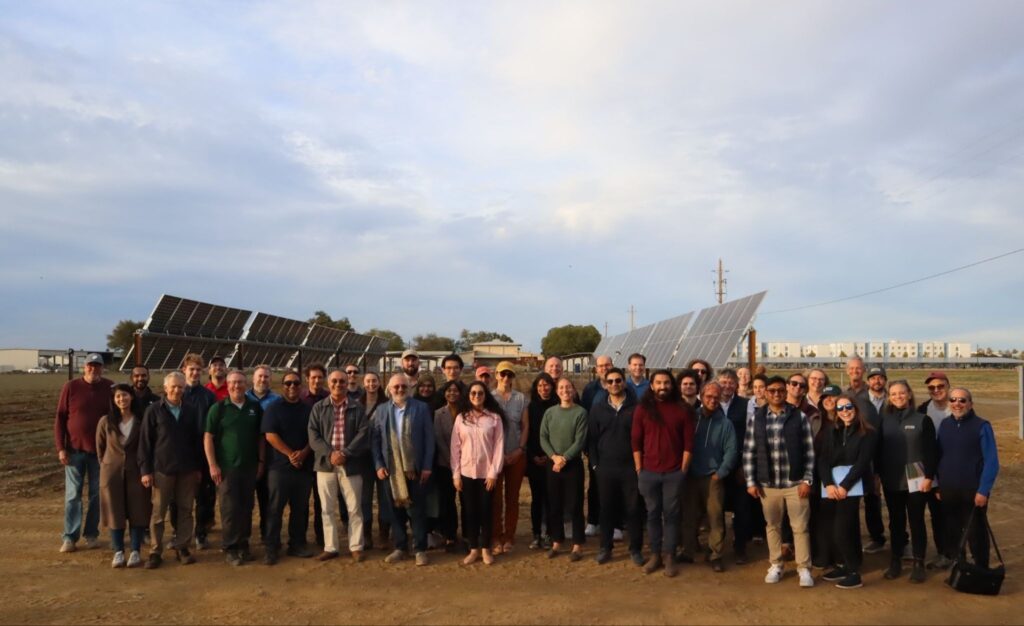
Group photo from the UC Davis Agrivoltaics Day Tour. Photo Credit, Maximilian Dedden

If you’d like to follow updates on vertical solar and agrivoltaics research, please consider joining our Newsletter! 

The previous blog post covering the original 9 module installation can be found here: https://sunzaun.com/vertical-agrivoltaics-at-uc-davis/

Our Tallest Agrivoltaic Installation Yet!

Our Tallest Agrivoltaic Installation Yet! 1500 999 Sunzaun

Aerial Photo by Michael Lobato, Colorado State University

In the crisp weather of mid-October, our team completed one of the most unique and inspiring projects in our portfolio to date. Set against the dramatic mountain backdrop of Grand Junction, Colorado, this photovoltaic (PV) system marks a major milestone for agrivoltaics in the US. At completion, the structure stands as the largest viticulture-focused agrivoltaic system (or “viti-voltaic”) in the country.

Our Partners

We were proud to serve as the installation contractor under Sandbox Solar, a local EPC and leader in agrivoltaics across the region. The single-axis tracking system was designed and supplied by SolarGik, and spearheaded by Dr. Horst Caspari, a Colorado State Professor and expert viticulturist.

Located near Colorado State University’s Western Campus, Dr. Caspari’s quarter-acre research vineyard of Chardonnay grapes will serve as a living laboratory for the combination of solar energy and sustainable agriculture. Here, researchers will study everything from soil compaction caused from solar installation to shifts in microclimates and how different panel opacities affect light transmission, vine growth, and fruit quality. 

Photo by Dr. Horst Caspari

Why This Installation Was Different (and Challenging)

As interest in agrivoltaics continues to grow, we have had opportunities to build several agrivoltaic systems. With previous builds, our team worked on blank-slate landscapes, not yet populated with soon-to-be-planted vegetation. In this case, however, our crew was faced with the task of building a PV system within rows of mature, established grapevines. 

Our installation team worked carefully within these vines — driving piles, assembling the racking, and installing 240 solar panels — while avoiding major disruption to the crop. This project called for a new level of planning and adaptability, as we adjusted our usual construction methods.

  • The result: a sleek 14-foot-tall steel structure, designed at this height to let the right amount of sunlight in between rows of panels. 

Beyond Energy Generation

According to the Colorado Newline, the system is projected to generate approximately 155 megawatt-hours of clean electricity per year, supplying roughly 40% of CSU Western Campus’s annual energy needs. But the impact and purpose of this project goes far beyond energy production. As Dr. Caspari stated, this system was designed with an “A before the V” mindset. In agrivoltaics, this means agriculture takes priority over voltaics.

For this particular design, the agricultural benefits include:

  • Protection from hail and frost
    • Even a single hailstorm or frost can ruin nearly an entire grape yield. The PV canopy offers an added layer of defense and creates a more temperate microclimate, shielding crops from weather extremes.
  • Beneficial Shading
    • Partial shading helps moderate soil temperatures, allowing the ground to retain moisture longer and reducing irrigation needs. It also protects delicate grapes from intense solar radiation during the hottest weeks of the summer.

Heading into chilly November, observations already show milder temperatures under the system, confirming the climate benefits of elevated PV systems for sensitive crops like grapes.

Looking Ahead

While the U.S. still has ground to cover compared to Europe’s agrivoltaic movement, this project represents a large step in the right direction. It stands as a living demonstration for how clean energy infrastructure can enhance, rather than compete with, agricultural productivity, and we’re thrilled to have contributed to this advancement.

As more growers and researchers explore dual-use solar, Sunstall Inc. looks forward to continuing our role in building the systems that make this progress possible; from vineyards to orchards to open fields.

Photo by Dr. Horst Caspari

To lean more about the ongoing viti-voltaic research, visit: https://aes.colostate.edu/wcrc/orchard-mesa/viticulture/

Unlocking More Energy from Less Space: Vertical Solar

Unlocking More Energy from Less Space: Vertical Solar 1500 844 Sunzaun

Adapted from the German article “Vertikal mehr Ertrag” in Technik & Wirtschaft VN+

As solar technology continues to evolve, one of the most promising developments is vertical photovoltaic (PV) systems. Unlike traditional panels installed at an angle on rooftops or open fields, vertical PV panels stand upright, like a fence, and can be bifacial, capturing sunlight from both sides.

Where Vertical PV Systems Thrive

Vertical solar panels are particularly useful in spaces where traditional installations are limited. Examples include:

  • Agricultural land, where panels can coexist with crops, maximizing land use efficiency.
  • Noise barriers along highways or as property fences, turning otherwise unused vertical surfaces into energy-generating assets.

The Advantages: More Yield, More Flexibility

Vertical PV systems can increase overall electricity generation in certain conditions. Bifacial panels, for example, capture both direct sunlight and reflected light, while vertical placement can optimize energy collection during low-sun periods, such as morning and evening. This “dual-use” potential allows landowners to produce solar power without sacrificing valuable space for other uses.

Considerations and Limitations

While vertical PV offers unique benefits, there are trade-offs:

  • Peak midday production is typically lower compared to optimally tilted panels. Whereas vertical produces peak energy in the morning and afternoon, often matching energy demand curves.
  • Local conditions, such as sun angles, climate, and shading, significantly influence performance. Vertical bifacial panels perform best where there is high reflectivity from surroundings such as sandy or snow-covered ground and in-between greenhouses. 
  • Upfront costs, especially for bifacial panels, may be higher, so careful economic analysis is needed. However, preliminary research suggests the potential for long term cost savings due to reduced maintenance needs.

Real-World Applications

Vertical PV systems are already being deployed in innovative ways, such as along airport perimeters or integrated into agricultural projects. These systems showcase how flexible solar solutions can expand energy generation opportunities while maintaining productive land use.

The Takeaway

Vertical photovoltaic panels are not just a concept, they are a practical solution for maximizing solar energy in areas with space constraints or multiple land uses. By creatively adapting vertical surfaces, we can generate more power, optimize land use, and move closer to a sustainable energy future.

If you’re a landowner, business, or farmer interested in exploring vertical solar solutions, now is the perfect time to start. Assess available space, consider dual-use opportunities, and connect with a Sunzaun specialist to see how vertical PV can boost your energy output. Small steps today can lead to big savings and sustainable power tomorrow.

Note: This post is a review adapted from the German article “Vertikal mehr Ertrag” in Technik & Wirtschaft VN+.

Protect Crops, Farm the Sun: What Agri-PV Can Do for You

Protect Crops, Farm the Sun: What Agri-PV Can Do for You 1500 844 Sunzaun

Farmers today are under increasing pressure from rising operational costs and a changing climate, both of which threaten the viability of owner-operated farms. At the same time, the growing demand for food and the renewable energy transition compete for space. But what if farmers could harvest both food and solar power from the same land, while becoming more financially secure? Agrivoltaics, also known as agri-photovoltaics (agri-PV), enables farmers to keep farming, while balancing other demands.


How Agrivoltaics Works

Agrivoltaics (Agri-PV) refers to the combined use of agricultural land for food production and solar power generation by enhancing farm operations rather than replacing them. Agri-PV builds farmer resilience by either a) providing a secondary reliable income source when energy is sold to the grid, or b) reducing on-farm energy-related operational costs by using energy generated by their photovoltaics (PV) system. The article from which this blog was based distinguishes between three Agri-PV systems:

  • Overhead Agri-PV
    • PV modules mounted over 6 ½ ft high
    • Protects crops from hail and mitigates heat stress
    • Designed to allow crops, livestock, and machinery underneath
    • More expensive due engineering and installation complexities
  • Ground-Mount Agri-PV 
    • Allows for machines to operate between rows, not under
    • Lower installation costs
    • May cause uneven crop shading
    • Not ideal for sun-demanding field crops like wheat and corn
  • Vertical Agri-PV 
    • Modules mounted upright like fences (east-west orientation is common)
    • Bifacial modules, meaning both sides of the panel convert light into energy
    • Space-efficient: good for pastures or as fencing for livestock
    • Allows machinery to operate between rows 
    • Mid-tier costs

Agricultural Benefits and Tradeoffs

Fortunately for farmers, Agri-PV offers more than just economic benefits from solar power generation. These systems can also complement crop production. Solar infrastructure creates microclimates, mitigating the compounding effects of drought, extreme heat, and storms. Shade from the panels reduces evapotranspiration, helping soil retain moisture, an especially important function in arid climates. These protective-like structures can also shield crops from wind damage and heat stress. In fact, research shows that some crops, such as berries, leafy greens, and herbs, can produce higher yields when grown between PV rows.

In orchards, solar structures may even replace traditional hail nets, reducing long-term operational and maintenance costs. Improved crop resiliency under Agri-PV can reduce damage from fungal and bacterial pests, decreasing the need for pesticides.

However, tradeoffs do exist. Uneven shading, particularly from fixed-tilt ground-mounted systems, can lead to non-uniform soil moisture levels. In wetter regions, this may increase the risk of fungal disease if not properly managed. Crops that require a lot of light, like corn and wheat, may also experience reduced yields under shaded conditions. In such cases, vertical systems, like Sunzaun—where shading patterns are less obstructive—are often better suited.

Recent advances in semi-transparent panels are also worth exploring. Semi-transparent panels allow more light to pass through to the crops, enhancing the growth for traditional open-field crops. However, while they reduce below-ground shading, the panels themselves absorb less sunlight, which leads to decreases in energy production. Ultimately, the right system depends on the farm’s goals. 

Vertical Bifacial PV on an agrivoltaics experimental site, UC Davis, California. Photo by Jael Machndork. Originally published here.

Supporting Farmers – Legal & Economic Context

From an economic stand-point, Agri-PV creates a new, predictive revenue stream. Unlike traditional solar farms, the integration of such systems typically avoids re-zoning farmland as “built-up” areas, which bypasses the need for lengthy planning approvals. Steering clear of re-zoning reinforces the idea that Agri-PV is enhancing farmland rather than replacing it.

In the European Union, Agri-PV systems allow land to remain classified as agricultural, helping farmers maintain access to subsidies. Although there is no nationwide rule that guarantees the same treatment in the U.S., states like Colorado, Massachusetts, New York, and California increasingly recognize agrivoltaics and may preserve agricultural tax status or zoning classifications. In some jurisdictions, installing solar can trigger reassessment unless specific exemptions are in place. It is important to check local zoning laws, property tax codes, and solar/agriculture regulations before moving forward with an Agri-PV project.

A Tool for the Energy Transition

While initial installation costs for Agri-PV systems can be higher, long-term benefits, such as income, climate resilience, and ecological value, often outweigh the investment. The energy sector and agriculture both need to evolve to meet the demands of the future. Agrivoltaics offers an opportunity to meet both demands, while giving farmers the freedom to continue their farming operations.


This blog is based on insights from an article by Thomas Wagner-Nagy, originally published in the May 2025 issue of PM Magazin (in German)

Putting Farmers First: Insights from the Solar Farm Summit

Putting Farmers First: Insights from the Solar Farm Summit 911 671 Sunzaun

The 2025 Solar Farm Summit in Chicago brought together farmers, developers, researchers, state officials and industry leaders. Some came as curious explorers, others as passionate advocates, but all shared an interest in how solar and farming can work together. Sunzaun’s team was there to showcase its vertical bifacial solar racking system and join in on conversations shaping the next chapters of solar in agriculture. Helge Biernath, CEO of Sunstall, joined a panel with experts from Sandbox Solar and SolarEdge to share insights on vertical solar technology. 

Farmer’s Perspective

While representing its product at the booth, Sunzaun’s team also attended sessions covering topics such as livestock grazing health in the context of solar arrays, the latest developments in agrivoltaics policy and research, and American-made solar. One of the most memorable sessions was The Farmer’s Perspective on Agrivoltaics. Hearing directly from farmers offered an unfiltered look at what’s working, what’s not, and what’s needed to make agrivoltaics viable on real farms, especially for owner-operated or “smallholder” farms.

Key Takeaways:

  • Owner-operated farms are shrinking as corporate farming expands. This trend is due to multiple factors, including rising operational costs.
  • 80% wouldn’t change production systems for agrivoltaics. Many are still uncertain about its benefits.
  • Trust is low. According to an American Farmland Trust survey, the most trusted source of agricultural information for farmers is university-affiliated extension services, followed by farm associations. Solar developers often rank near the bottom of this list.

What Farmers Want from Solar Developers

To make agrivoltaics appealing, farmers with existing solar infrastructure emphasized a few must-haves from solar developers:

  • Clear contracts with transparent $/acre return on investment
  • Ongoing panel maintenance included
  • Freedom to keep farming with minimal disruption
  • Solar designs that fit agricultural needs, such as wide row spacing for machinery and to limit shading

Sunzaun’s Commitment to Farmers

Sunzaun believes that owner-operators deserve a strong voice in shaping agrivoltaic projects. When done right, these systems can provide reliable supplemental income while keeping farmland productive. Sunzaun works with farmers, researchers, EPCs, and developers to design solutions that protect farmland while generating clean energy.

Supporting Trusted Voices in Agriculture

To wrap up the week, Sunzaun donated a TV to Michigan State University Extension Services to support their outreach efforts. Since extension services are among the most trusted sources of agricultural information, Sunzaun is proud to assist with the continuation of delivering reliable, accessible knowledge to the farming community.

Vertical Solar Is Changing the Game: Smarter Design, Real Results for Commercial Projects

Vertical Solar Is Changing the Game: Smarter Design, Real Results for Commercial Projects 512 288 Sunzaun

What if your business or facility could generate solar power all day long—even in snow-heavy regions, tight urban sites, or areas with limited rooftop availability?

That’s exactly what vertical solar installations are making possible.

In a new YouTube breakdown, DIY solar enthusiast Projects With Everyday Dave explores how vertical solar setups—especially when paired with bifacial panels—are transforming solar efficiency in real-world environments. While his findings are residential in scale, the underlying data offers compelling insights for commercial developers, infrastructure planners, and large-scale property owners exploring smarter, space-efficient solar solutions.


What Is Vertical Solar?

Vertical solar refers to solar panels mounted upright (typically at a 90° angle), often facing east and west to capture sunlight throughout the day. Unlike traditional rooftop arrays tilted south, vertical orientation offers distinct advantages for large-scale applications:

  • Better solar generation in morning and afternoon hours
  • Reduced snow and debris accumulation
  • Installation flexibility along fences, façades, and perimeters

While bifacial panels (which generate energy from both sides) amplify these benefits, orientation is the real innovation, offering commercial projects new opportunities to integrate solar without sacrificing space or accessibility.

“You get morning sun on one side, and then afternoon sun on the other—it’s like having two shifts of power generation,” Dave explains.


Commercial Advantages: Where Vertical Solar Excels

Dave’s real-world data points to several key advantages that scale beautifully for business, industrial, and infrastructure use cases:

Reliable Performance in Snowy or Harsh Conditions

In colder climates, snow accumulation on rooftop panels causes maintenance headaches and production loss. Vertical panels eliminate buildup and maintain consistent output year-round—crucial for mission-critical facilities and distributed energy systems.

“No need to brush them off—huge for snowy regions,” Dave notes.

 Dual-Peak Output = Smarter Load Matching

East-west vertical arrays create dual generation peaks—morning and late afternoon—closely aligning with real-world commercial energy consumption, reducing demand spikes and enhancing storage and load management strategies.

“Those dual peaks show up clearly in the winter months,” says Dave, citing side-by-side production tests.

 Maximize Vertical Surfaces & Unused Perimeters

In dense commercial zones, rooftop space is often limited or reserved. Vertical solar enables energy generation from:

  • Parking lot boundaries
  • Security fences
  • Sound barriers
  • Retaining walls and building façades

This unlocks energy potential from unused vertical surfaces—turning barriers into power-generating assets.

“You can tuck solar into edges and margins—ideal for tight commercial footprints,” Dave shares.


 Performance in Real-World Conditions

While Dave shows that total average production for vertical panels is generally less than tilted panels, he explains that “In cloudy or snowy weather, the vertical setup held its own—even beat roof panels on some days.” So, even with variable weather, vertical panels proved surprisingly competitive. Sometimes they outperforming rooftop arrays, especially during:

  • Cloud cover
  • Snow events
  • Morning and evening load periods
  • Soiling (natural dust buildup)

Speaking of morning and evening load periods (as seen in Figure 1), pairing east-west vertical arrays with north-south bifacial configurations, such as perimeter fences or site boundaries, can create a balanced, full-day generation profile. This is particularly ideal for commercial operations with long or irregular hours.

Figure 1: A diurnal power generation curve from the Sunzaun test site in Visalia, California, recorded on a day in mid-August 2024. All systems use the same module model; the only variable is orientation and tilt.


Application Spotlight: Where Vertical Solar Fits in Commercial Settings

Vertical solar is well-suited for:

  • Industrial, commercial, and private spaces such hospitals, data centers, and energy-intensive campuses
  • Agrivoltaic and rural infrastructure projects
  • Municipal and transportation facilities
  • Developments with limited roof access

It avoids challenges like:

  • Roof penetrations and structural retrofits
  • Shading from HVAC units or architecture
  • Safety clearances and access issues

“If your roof isn’t ideal, don’t force it. Go vertical. It’s scalable, accessible, and flexible,” says Dave.


Cost Considerations & Long-Term Value

While vertical arrays may require custom racking and bifacial panel premiums, the maintenance savings, flexible siting, and year-round reliability offer a compelling value proposition for long-term energy planning.

“In some climates, vertical systems may even outperform roof setups annually—especially when snow and shading are factors,” Dave emphasizes.


Final Thoughts: A Smarter Fit for Forward-Thinking Projects

Vertical solar isn’t just a niche idea—it’s a scalable design solution for commercial and infrastructure leaders looking to future-proof their energy strategy. From greater surface utilization to more consistent load matching, vertical systems offer a modular, resilient, and strategic path forward.

“It’s not just about cramming panels on a roof anymore,” Dave concludes. “Vertical solar gives you options—and at scale, those options make a lot of sense.”


Watch the Full Videos

🔗 Visit Projects With Everyday Dave on YouTube for real-world performance tests and innovative solar design ideas.

Sunzaun CEO Interview | Clean Power Hour

Sunzaun CEO Interview | Clean Power Hour 336 333 Sunzaun

“Everybody was just asking for incentives, […] but I’m like, […] you should stop talking about incentives. How about the idea that if you don’t do agrivoltaics, you won’t have the biomass yield you need in the future — period. Because the climate is changing.”  — Helge Biernath, CEO of Sunzaun


This powerful call to action served as an opener on a recent episode of The Clean Power Hour, setting the tone for the types of conversations that are reshaping how we think about the future of agriculture. 

As the clean energy transition accelerates –  largely driven by climate change, energy security, and economic opportunities – stakeholders are increasingly turning to farmland. Not to replace crops, but to use solar infrastructure as a complementary partner to agriculture. In this episode, host Tim Montague is joined by Helge Biernath of Sunzaun and Sunstall, and Ian Skor, CEO of Sandbox Solar, to dive into the growing world of vertical agrivoltaics. 

The Roots of Agrivoltaic Innovation

Sandbox Solar, founded over a decade ago, began testing crop performance under solar arrays back in 2018. What they found was that certain crops actually performed better under semi-transparent solar panels compared to traditional full-sun conditions. 

“[Too much] sun can be stressful for some plants,” Montague elaborated during the podcast. “We’re learning a lot — and there’s still so much to learn.” 

This duality — where crops grow within the sheltered space between solar arrays — may play a critical role in the future of sustainable agriculture. This is especially true for regions that face water scarcity and extreme heat events.

Meanwhile, Sunzaun, which grew out of the solar installation company Sunstall Inc., peered over at European trends. CEO Biernath observed the emergence of vertical racking systems that allowed crops and solar to share the same land with minimal footprint loss. With few domestic options for such systems, Biernath saw an opportunity to bring this innovation stateside.

Most recently, the two companies teamed up to launch an agrivoltaics testing site at Colorado State University. This site was designed to demonstrate real-world applications of agrivoltaics using vertically-aligned modules. With adequate spacing between rows, tractors seed and harvest crops with ease, proving that solar and agriculture don’t have to compete. 

Field crops like corn are being evaluated for their growth under panels, while researchers also monitor how the crops, in turn, affect solar output. The project is already collecting valuable data that could help inform and educate the community, as well as pave the way for the expansion of agrivoltaics nationwide.

The agrivoltaics research site at Colorado State University. In 2024, researchers planted corn within rows of bifacial vertical arrays to monitor crop growth, PV energy output, and a variety of other metrics such as soil moisture and temperature. Sunzaun’s flexible racking system enables panels to be raised by several feet if necessary — an adaptive feature to accommodate taller crops or future design needs.

Europe and Asia: A Glimpse Into the Future

Montague emphasized that Northern Europe and parts of Asia are nearly a decade ahead of the U.S. when it comes to agrivoltaic deployment. Why? Biernath believes space constraints have driven these regions to integrate solar directly into the built and agricultural environment.

“In the U.S., we have lots of land,” Biernath states. The issues lie between where that energy is needed and where it is being generated. Bringing solar photovoltaics to agricultural land found near urban hubs could reduce the need to curtail energy, a challenge recently spotlighted in parts of California. 

As the population expands, so will the pressure to balance land use among conservation, development, agriculture and energy production. Pairing solar with farming, as already seen in parts of Europe and Asia, is critical for sustaining projected growths. 

The Challenge: Awareness and Policy

If agrivoltaics offers so many benefits, why aren’t we seeing it everywhere?

According to the guests, the biggest hurdles might be awareness. Farmers may not be aware of the sheer benefits of incorporating vertical solar on agricultural land. Additionally, policy frameworks may not yet be set up to support dual-use systems, but the movement is growing. Vertical solar offers a low-footprint, high-impact solution that aligns with fostering agricultural productivity, climate mitigation and farmer resilience.

Key Takeaways

  • Vertical agrivoltaics allows solar energy and agriculture to share the land, increasing efficiency and resilience.
  • European and Asian countries are leading in adoption, offering insights for U.S. researchers, developers and the agricultural community.
  • Real-world test sites, like the one at Colorado State University, are proving that tractors, crops, and solar panels can work together.
  • Barriers remain, including public awareness and permitting processes — but growing data and interest are breaking new ground.

Want to Learn More?

Join Ian Skor, Helge Biernath, John Langdon, and Dr. Najm on July 15, 2025 for an upcoming webinar and panel discussion titled “Powering Agriculture’s Future with Agrivoltaics”.

This free online event will explore how vertical solar is revolutionizing agricultural land use while generating clean energy. We’ll be joined by leading experts from the field, including representatives from Sunzaun, UC Davis, Sandbox Solar, and Muddy Creek Solar Park.