Resource Center

Explore our collection of articles, project updates, research summaries, and technical resources covering vertical solar, agrivoltaics, and the evolving solar industry.

In today’s ever-changing landscape of real estate, sustainability and renewable energy solutions have become essential considerations for property owners and developers. Among the leading initiatives in this realm, LEED certification and solar energy integration hold immense promise for creating eco-friendly and energy-efficient buildings. By harnessing the combined benefits of LEED certification and solar energy, real estate owners can unlock a multitude of advantages that go beyond environmental stewardship.

In this blog post, we will explore the powerful synergy between LEED certification and vertical solar energy and shed light on the remarkable benefits they offer to real estate owners. From enhanced energy efficiency and cost savings to reduced carbon footprint and increased property value, we will delve into how this dynamic duo can revolutionize your real estate portfolio.

By adopting LEED certification, real estate owners can ensure that their buildings are designed and operated in a sustainable manner, optimizing energy usage and minimizing environmental impact. Meanwhile, the integration of vertical solar energy systems empowers these buildings to generate clean and renewable electricity on-site, reducing reliance on traditional energy sources and lowering operating costs.

What is LEED?

LEED stands for Leadership in Energy and Environmental Design, which is the most widely used green building rating system globally (source). It was developed by the non-profit U.S. Green Building Council (USGBC) to provide a framework for designing, constructing, operating, and maintaining environmentally responsible and resource-efficient buildings, homes, and neighborhoods.

LEED certification is a voluntary program that enables building owners and operators to demonstrate their commitment to sustainability. The LEED rating system consists of a set of criteria and standards that cover various aspects of building design and operation, including:

By meeting these criteria, a building can earn points and achieve different levels of LEED certification, such as Certified, Silver, Gold, or Platinum, based on the total number of points earned.

LEED is applicable to various building types, including commercial buildings, residential buildings, schools, healthcare facilities, and more. It provides guidelines and best practices for creating healthy, efficient, and cost-saving buildings that minimize environmental impact while promoting occupant well-being and sustainability (source).
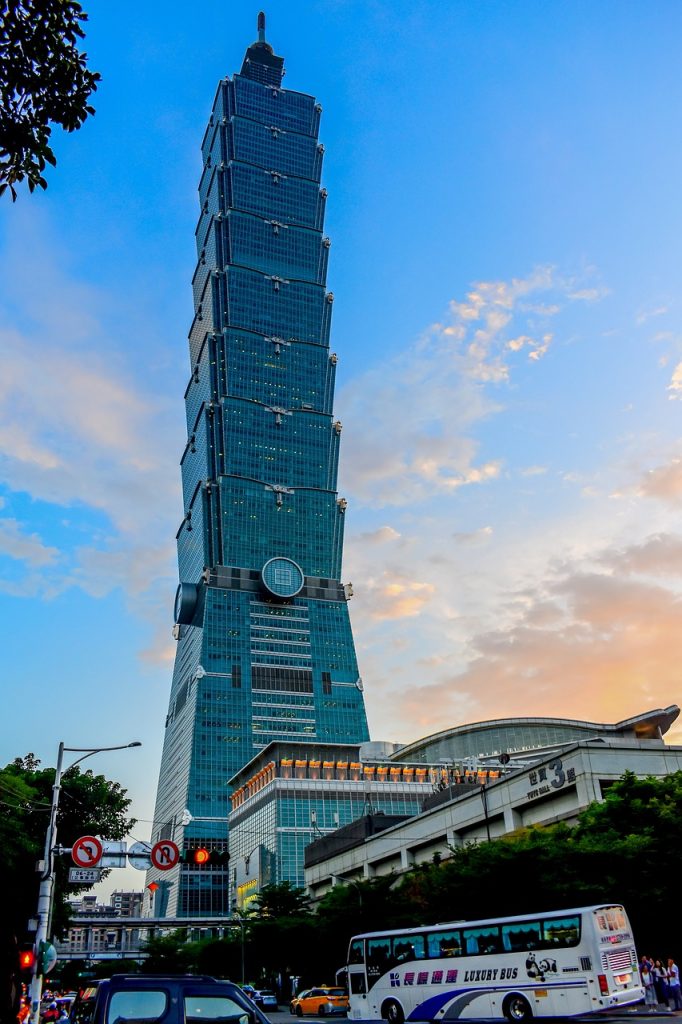
The Taipei 101 in Taiwan is one of the tallest LEED certified buildings

LEED certification has become a recognized symbol of sustainability and is often sought after by building owners, developers, and occupants who value energy efficiency, environmental stewardship, and sustainable practices. LEED also helps investors to meet their ESG requirements (read our blog on ESG requirements). It promotes the adoption of green building strategies, encourages innovation in the construction industry, and contributes to reducing the environmental footprint of the built environment.

Vertical solar panels contribute to earning LEED credits

Vertical Solar panels can contribute to earning LEED credits for buildings by demonstrating the use of renewable energy and promoting sustainability. The primary LEED category relevant to solar panels is the “Energy & Atmosphere” category, specifically EA Credit 2, which is the “On-Site Renewable Energy” credit (source).

The On-Site Renewable Energy credit within LEED rewards projects that generate renewable energy on-site, such as through solar panel installations. This credit can provide up to 7 possible LEED points, depending on the specific project and the percentage of energy output supplied by the renewable source. Builders can earn points under the renewable energy sub-category based on the tier and the percentage of electricity generation provided by the renewable source (source).

Here is a breakdown of the points available under Tier 1 for renewable energy generation:

  • 1 point: 2% electricity generation
  • 2 points: 5% electricity generation
  • 3 points: 10% electricity generation
  • 4 points: 15% electricity generation

The specific number of points earned will depend on the amount of energy produced by the solar panels and its contribution to the overall energy needs of the building.

By incorporating solar panels into a building’s design, owners and developers can demonstrate their commitment to utilizing clean and renewable energy sources, reducing greenhouse gas emissions, and decreasing reliance on fossil fuels. Solar projects can help achieve LEED certification at various levels, such as Basic, Silver, Gold, or Platinum, based on the number of credits attained.
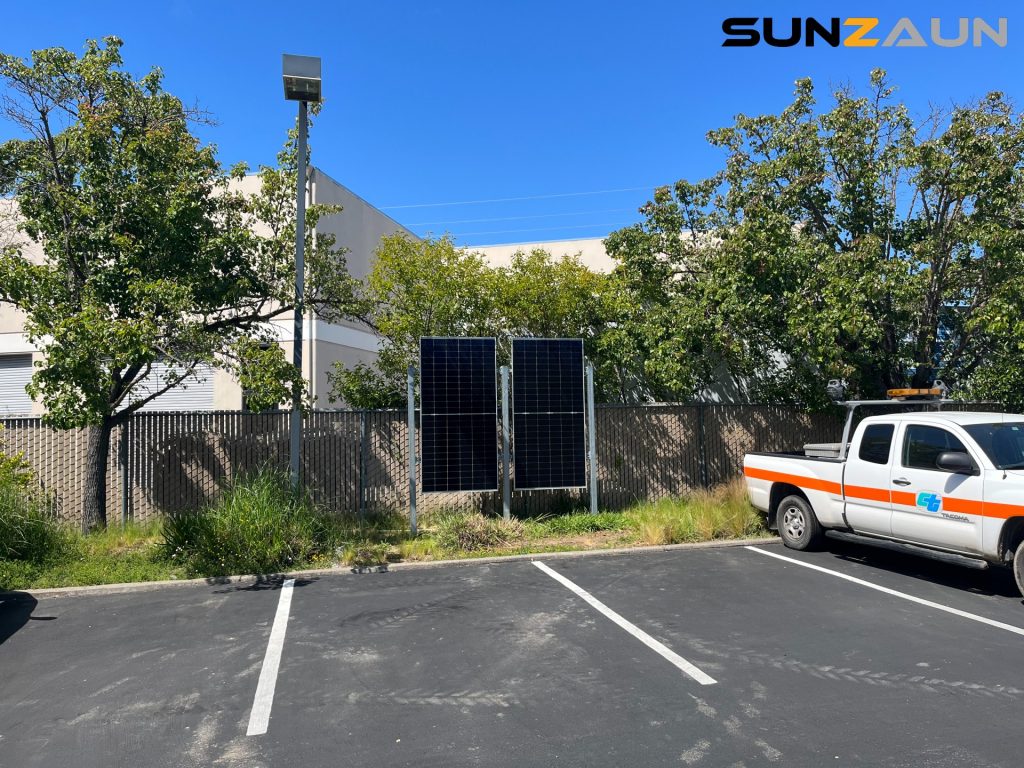
A Sunzaun showcase installation on a parking lot

Benefits of vertical solar for buildings and EV charging

In addition to rooftop solar and panels on a carport, vertical ground-mount solar panels can be integrated into the design of a building. Vertical panels can be used as a fence around property lines. Another way to power batteries and electrical vehicle charging opportunities is to install them on parking lots (Here is an example from Japan). Sunstall Inc. recently installed two Sunzaun modules on the parking lot of the headquarters as a proof of concept model.

In the United States, there are various financial incentives and policies in place to encourage the installation of electric vehicle (EV) charging infrastructure. These incentives aim to promote the widespread adoption of EVs and support the development of a reliable charging network. While the specific details may vary by state, here are some common financial incentives and support mechanisms:

  1. Tax Credits: Many states offer tax credits to individuals, businesses, or property owners who install EV charging stations. These credits can help offset a portion of the installation costs. The availability and amount of tax credits vary by state.
  2. Grants and Rebates: Some states provide grants or rebate programs that offer financial assistance for the installation of EV charging infrastructure. These programs can provide funding for both public and private charging stations, encouraging their deployment in various locations such as workplaces, multi-unit dwellings, and public areas.
  3. Utility Incentives: Many utility companies offer incentives to promote EV charging infrastructure. These incentives may include rebates, grants, or special electricity rates for EV charging stations. Utility incentives can help reduce the upfront costs of installation and make operating the charging stations more cost-effective.
  4. Public Funding Programs: In certain cases, federal or local government entities may provide funding opportunities or grants specifically aimed at supporting the installation of EV charging infrastructure. These programs often target public or semi-public locations such as parks, government buildings, and transportation hubs.
  5. Public-Private Partnerships: Collaborative initiatives between public and private entities can also contribute to the financial incentives for installing EV charging infrastructure. These partnerships may involve cost-sharing arrangements, revenue-sharing models, or other cooperative mechanisms to facilitate the expansion of charging networks.

If you are interested in exploring vertical solar opportunities for the LEED certification of your project, visit our office to see the Sunzaun racking system or reach out to us!
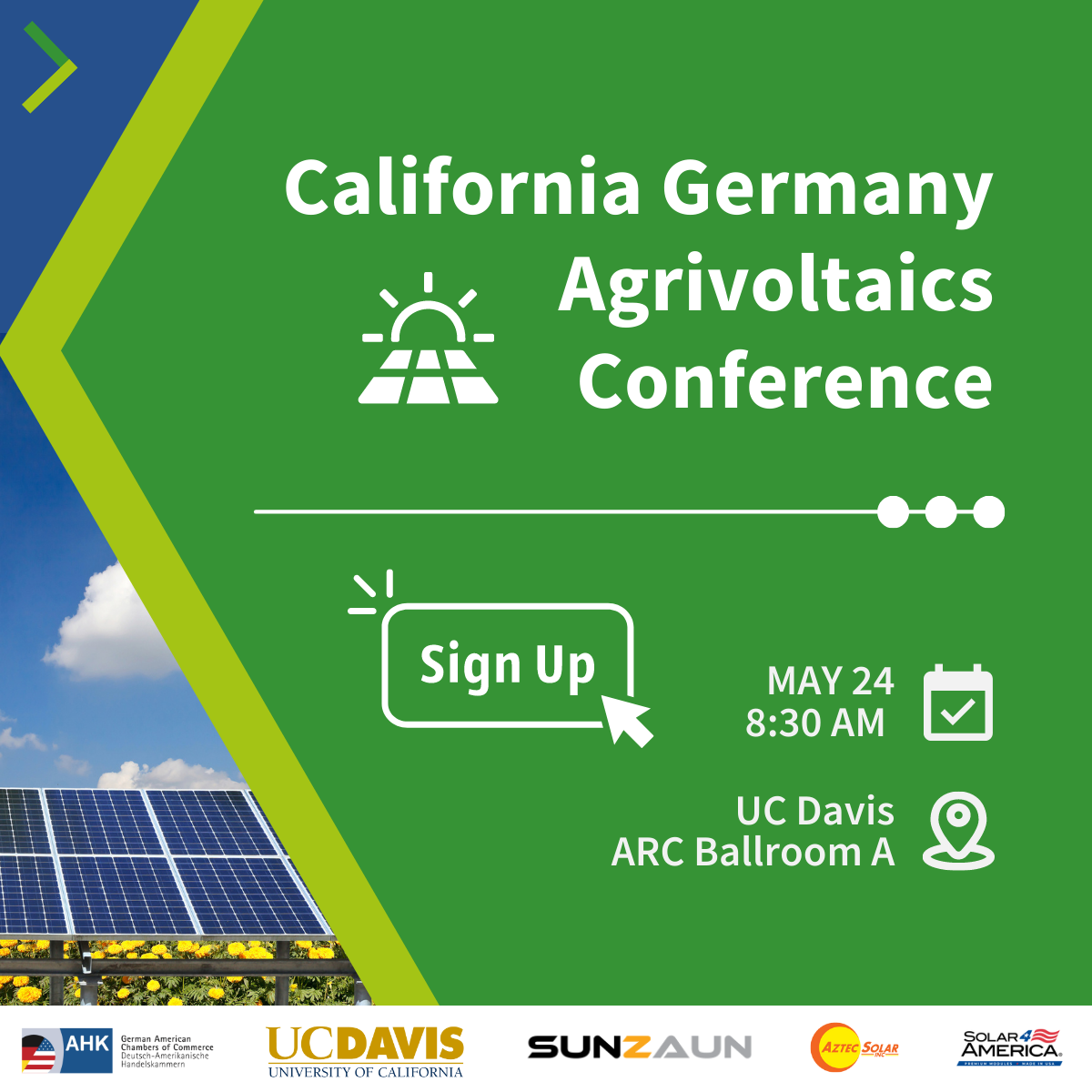
A Day of Exploring Sustainable Agriculture through Solar Energy Integration

The California Germany Agrivoltaics Conference is set to take place at UC Davis on November 1st, 2023, from 8:30 AM to 6:30 PM. This exciting one-day event promises to be a day of inspiration, innovation, and discovery for anyone with an interest in the intersection of solar energy and agriculture.

More than 200 attendees, including agrivoltaic experts, corporates, policy-makers, founders, researchers, academia, developers, and farmers from California and Germany will converge to share their knowledge and best practices.

Use the registration link to save your ticket!

The conference is hosted by the German American Chamber of Commerce and sponsored by Aztec Solar, Solar4America, and Sunzaun, making it one of the most anticipated events in the field of agrivoltaics.

Attendees can look forward to a packed day of engaging talks, panel discussions, and breakout sessions, exploring the latest advances and trends in agrivoltaics.

Attendees can look forward to a packed day of engaging talks, panel discussions, and breakout sessions, exploring the latest advances and trends in agrivoltaics. They will have the opportunity to learn from leading experts and practitioners in the field, exchange ideas, and collaborate on innovative solutions that will help shape the future of sustainable agriculture and energy.

Topics

The conference will cover a wide range of topics related to agrivoltaics, including the benefits of agrivoltaics for farmers and developers, farm optimization, existing technologies and types of agrivoltaic PV systems, resilience and sustainability for energy and farming, and possible partnerships between California and Germany.

During the conference, attendees will be able to engage with experts and gain practical insights into the latest developments and innovations in the field. They will also learn about successful agrivoltaic projects and the challenges that were overcome during the implementation process.

One of the key topics of the conference will be the benefits of agrivoltaics for farmers and developers. This session will explore how the integration of solar energy and agriculture can lead to increased profitability, reduced water use, and improved soil health. Attendees will learn about the different strategies and technologies used to implement agrivoltaic projects, and how these projects can bring about positive economic, social, and environmental impacts.

Another important topic that will be covered during the conference is farm optimization. This session will explore how agrivoltaics can be used to optimize farm operations and increase efficiency. Attendees will learn about the different types of agrivoltaic systems and how they can be designed to maximize energy production and crop yield.

An agrivoltaics site in Massachusetts

The conference will also cover the latest advances in agrivoltaic PV systems, including the different types of systems and their applications. Attendees will learn about the existing technologies and how they can be used to generate renewable energy while simultaneously supporting sustainable agriculture.

In addition, the conference will explore resilience and sustainability for energy and farming. This session will cover how agrivoltaics can help increase energy and food security, reduce greenhouse gas emissions, and improve soil health. Attendees will learn about the various benefits that agrivoltaics can bring to sustainable agriculture and energy systems, as well as the challenges that need to be overcome to implement these projects successfully.

Finally, the conference will examine possible partnerships between California and Germany. This session will explore how the two regions can work together to advance the adoption of agrivoltaics and create a more sustainable future for agriculture and energy.

Attendees can expect to leave the conference feeling inspired, energized, and equipped with the knowledge and connections to drive change in their organizations and communities. The conference will provide a platform for attendees to network with peers, share their experiences, and explore potential collaborations.

Scan the QR code on the flyer to save the date and join us for an exciting and informative day of exploring the intersection of solar energy and agriculture!

What is the duck curve?

The duck curve is a phenomenon that occurs in some regions with high solar power penetration, where the electricity demand drops during midday hours when solar power generation is high, and then ramps up rapidly as the sun sets and solar power generation decreases. This creates a mismatch between electricity supply and demand, which can strain the electricity grid and increase the need for fossil fuel-based power generation. 

Fattening and Flattening

The National Renewable Energy Laboratory (NREL) describes two ways of re-shaping the duck chart: To “fatten” the curve and to “flatten” the curve. Fattening means increasing the flexibility of power systems to allow them to start and stop more frequently. Flattening is shifting load and supply so that the power supply meets the demand.   

Vertical solar panels can help to flatten the duck curve by producing power during the hours when demand is highest. This is because vertical panels are more efficient at capturing sunlight when the sun is low in the sky, such as in the morning and evening. Additionally, vertical panels can be installed on buildings, which can help to reduce the amount of land that is needed for solar power generation. Vertical solar panels can also be integrated into farmland which increases the land use efficiency as well.

This will give us power when we actually need it.

David Harde, the owner of a Californian Winery emphasizes the supply benefits of the Sunzaun installation on his vineyard: 

“I think it will do very well, producing a great amount of power in the morning. Midday – not so much. And then in the later afternoon, in contrast with horizontal designed systems. Those systems produce more efficiently in the midday, but they fall off in the morning and are inefficient in the afternoon. So this will give us power when we actually need it.”

Advantages of vertical solar panels for the grid

Vertical solar panels are a promising technology that can help to mitigate the duck curve and reduce our reliance on fossil fuels.

Here are some additional details about how vertical solar panels can help to support the duck curve:

  • Vertical solar panels can be installed on buildings, which can help to reduce the amount of land that is needed for solar power generation. This is important because land is a scarce resource in California.
  • Vertical solar panels are more efficient at capturing sunlight when the sun is low in the sky, such as in the morning and evening. This is when demand for electricity is highest, so vertical solar panels can help to meet this demand.
  • Vertical solar panels can be installed on a variety of surfaces, including rooftops, parking lots, and even the sides of buildings. This makes them a versatile option for solar power generation.
  • Vertical solar panels are a relatively new technology, so they are still being developed. However, they have the potential to play a significant role in the future of solar power generation
  • Reducing the need for transmission infrastructure: Installing vertical solar on buildings in densely populated areas can reduce the need for expensive transmission infrastructure to deliver electricity from remote power plants to urban areas. This can help to minimize the strain on the grid during periods of high demand and improve grid reliability

Overall, vertical solar can help to address the challenges posed by the duck curve by increasing solar power generation capacity, shifting solar generation to peak demand hours, and reducing the need for long-distance transmission lines.

#duckcurve #dreamvertical #agrisolar #agrivoltaics #solarchitecture

I just went to the Solar Farm Summit, presented and spoke to the experts in the industry – one topic never came up – How will #esg requirements from companies like Cocacola Now and Walmart  influence agricultural photovoltaics?

Just to make sure that everybody understands the terms – please google for more context – ESG (Environmental, Social, and Governance) ; #apv ( agricultural photovoltaics)/ #agrivoltaics  / #agrisolar  are kind of the same.

ESG requirements from companies like Coca-Cola and Walmart are likely to have a significant impact on APV, which is the practice of integrating solar panels into agricultural lands.

Firstly, these companies have committed to reducing their #carbonfootprint  and promoting sustainable practices in their operations, which will require them to procure renewable energy. APV is a form of renewable energy that can be integrated into agricultural production and help reduce the carbon footprint of these companies. Therefore, the ESG requirements of these companies may drive the adoption of APV by their suppliers and partners. And not only that they will ask and require their suppliers to follow similar regiments to reduce the carbon footprint they will ask for strategic plans to get there and reports on the success.

ESG requirements are increasingly becoming a factor in investment decisions, with investors looking for companies that prioritize sustainability and social responsibility.

Secondly, APV can offer several benefits to #farmers , including providing an additional source of income, reducing water evaporation, and improving crop yield. By promoting the adoption of APV, these companies can encourage sustainable agricultural practices and support local communities. Given the ESG requirements farmers will be asked to support the goal of #carbonneutrality – it will be a challenge but also a huge opportunity through #solarfarming.

Rendering of an APV Strawberry Field

Finally, ESG requirements are increasingly becoming a factor in investment decisions, with investors looking for companies that prioritize sustainability and social responsibility. The adoption of APV can enhance the ESG profile of companies in the agriculture sector and help them attract more socially responsible investment.

In summary, the ESG requirements of companies like Coca-Cola and Walmart are likely to drive the adoption of APV in the agriculture sector, promoting sustainable practices, reducing carbon footprint, and improving the ESG profile of companies in the sector.

And the Oscar goes to THE FARMERS!! They will be asked to help!

I feel with the solutions we have seen over the last days at the conference the AG and solar community is ready to support the ESG goals!

March 20, 2023 by Helge Biernath

Talos, the ancient greek ancestor of todays AI tools you can see on this drachma, used to swim around Crete three times daily. Nowadays, some authors use ChatGPT three times daily to answer their questions or even get their work done. Well, we were curious to see what the chatbot can teach us about the solar industry. We asked for a text about vertical solar and this is what showed up:

One of the primary benefits of vertical PV systems is their ability to conserve land space

“Vertical photovoltaic (PV) systems are a new and innovative way of harnessing solar energy, and they have gained popularity in recent years due to their many benefits. In a vertical PV system, solar panels are installed on the sides of buildings or structures, instead of on the roof. This allows for the use of otherwise unused vertical space and makes it possible to generate electricity in densely populated urban areas.

One of the primary benefits of vertical PV systems is their ability to conserve land space. In urban areas, where land is scarce and valuable, vertical PV systems allow for the generation of electricity without taking up valuable real estate. Additionally, vertical PV systems can be aesthetically pleasing and add to the overall appearance of a building.

Another advantage of vertical PV systems is that they can reduce the cooling load on a building. When installed on the sides of a building, they provide shade, which can lower the temperature inside the building and reduce the need for air conditioning. This can result in significant energy savings and reduced energy costs.

What ChatGPT thinks vertical solar looks like

Vertical PV systems are also easy to install and maintain, making them a cost-effective solution for many building owners. They can be integrated into new construction or retrofitted into existing buildings, and they typically have a long lifespan, making them a good investment for the long term.

However, there are also some limitations to the use of vertical PV systems. For example, the efficiency of vertical PV systems may be lower compared to horizontal systems due to the shading effects from the building itself. Additionally, the installation of vertical PV systems can be more challenging and may require specialized equipment.

In conclusion, vertical photovoltaic systems offer a unique and sustainable solution for energy generation in urban areas. With their ability to conserve land, reduce cooling loads, and provide long-term energy savings, they are an attractive option for building owners looking to generate clean energy. However, it is important to consider the limitations and challenges associated with vertical PV systems when making a decision on whether to install them.”

What Sunzaun looks like – A ground mount vertical PV system

This is a nice text about vertical PV on buildings, of course, but ChatGPT seems not to be aware of all the other applications that are possible with a vertical racking with bifacial modules: agrivoltaics, solarchitecture, next to freeways, railroads, gas stations, carports and so forth.  

Dear ChatGPT, You need to learn more about the latest trends in renewable energies, you need to learn more about Sunzaun! Feel free to reach out, we are happy to chat!

The sunzaun is a new product category. This vertical solar system combines the new technology of bifacial modules with the primary or secondary use as a barrier between roads, properties and or whatever else you can think of. It produces power and shows the environmental consciousness of its owner!

The sunzaun is designed  to accommodate framed and unframed bifacial panels and to manage the wires in a safe and sound way. For more details call 415 707 0305 or email us at info@sunstall.com

Have a Custom Boundary, Farm, or Corridor in Mind?

Speak directly with our solar infrastructure engineering team in Novato, CA to model boundary generation, wind tolerances, foundation engineering, and financial payback.