Sunzaun

Sunzaun CEO Interview | Clean Power Hour

Sunzaun CEO Interview | Clean Power Hour 336 333 Sunzaun

“Everybody was just asking for incentives, […] but I’m like, […] you should stop talking about incentives. How about the idea that if you don’t do agrivoltaics, you won’t have the biomass yield you need in the future — period. Because the climate is changing.”  — Helge Biernath, CEO of Sunzaun


This powerful call to action served as an opener on a recent episode of The Clean Power Hour, setting the tone for the types of conversations that are reshaping how we think about the future of agriculture. 

As the clean energy transition accelerates –  largely driven by climate change, energy security, and economic opportunities – stakeholders are increasingly turning to farmland. Not to replace crops, but to use solar infrastructure as a complementary partner to agriculture. In this episode, host Tim Montague is joined by Helge Biernath of Sunzaun and Sunstall, and Ian Skor, CEO of Sandbox Solar, to dive into the growing world of vertical agrivoltaics. 

The Roots of Agrivoltaic Innovation

Sandbox Solar, founded over a decade ago, began testing crop performance under solar arrays back in 2018. What they found was that certain crops actually performed better under semi-transparent solar panels compared to traditional full-sun conditions. 

“[Too much] sun can be stressful for some plants,” Montague elaborated during the podcast. “We’re learning a lot — and there’s still so much to learn.” 

This duality — where crops grow within the sheltered space between solar arrays — may play a critical role in the future of sustainable agriculture. This is especially true for regions that face water scarcity and extreme heat events.

Meanwhile, Sunzaun, which grew out of the solar installation company Sunstall Inc., peered over at European trends. CEO Biernath observed the emergence of vertical racking systems that allowed crops and solar to share the same land with minimal footprint loss. With few domestic options for such systems, Biernath saw an opportunity to bring this innovation stateside.

Most recently, the two companies teamed up to launch an agrivoltaics testing site at Colorado State University. This site was designed to demonstrate real-world applications of agrivoltaics using vertically-aligned modules. With adequate spacing between rows, tractors seed and harvest crops with ease, proving that solar and agriculture don’t have to compete. 

Field crops like corn are being evaluated for their growth under panels, while researchers also monitor how the crops, in turn, affect solar output. The project is already collecting valuable data that could help inform and educate the community, as well as pave the way for the expansion of agrivoltaics nationwide.

The agrivoltaics research site at Colorado State University. In 2024, researchers planted corn within rows of bifacial vertical arrays to monitor crop growth, PV energy output, and a variety of other metrics such as soil moisture and temperature. Sunzaun’s flexible racking system enables panels to be raised by several feet if necessary — an adaptive feature to accommodate taller crops or future design needs.

Europe and Asia: A Glimpse Into the Future

Montague emphasized that Northern Europe and parts of Asia are nearly a decade ahead of the U.S. when it comes to agrivoltaic deployment. Why? Biernath believes space constraints have driven these regions to integrate solar directly into the built and agricultural environment.

“In the U.S., we have lots of land,” Biernath states. The issues lie between where that energy is needed and where it is being generated. Bringing solar photovoltaics to agricultural land found near urban hubs could reduce the need to curtail energy, a challenge recently spotlighted in parts of California. 

As the population expands, so will the pressure to balance land use among conservation, development, agriculture and energy production. Pairing solar with farming, as already seen in parts of Europe and Asia, is critical for sustaining projected growths. 

The Challenge: Awareness and Policy

If agrivoltaics offers so many benefits, why aren’t we seeing it everywhere?

According to the guests, the biggest hurdles might be awareness. Farmers may not be aware of the sheer benefits of incorporating vertical solar on agricultural land. Additionally, policy frameworks may not yet be set up to support dual-use systems, but the movement is growing. Vertical solar offers a low-footprint, high-impact solution that aligns with fostering agricultural productivity, climate mitigation and farmer resilience.

Key Takeaways

  • Vertical agrivoltaics allows solar energy and agriculture to share the land, increasing efficiency and resilience.
  • European and Asian countries are leading in adoption, offering insights for U.S. researchers, developers and the agricultural community.
  • Real-world test sites, like the one at Colorado State University, are proving that tractors, crops, and solar panels can work together.
  • Barriers remain, including public awareness and permitting processes — but growing data and interest are breaking new ground.

Want to Learn More?

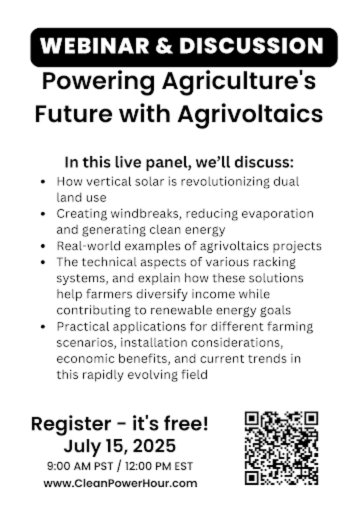
Join Ian Skor, Helge Biernath, John Langdon, and Dr. Najm on July 15, 2025 for an upcoming webinar and panel discussion titled “Powering Agriculture’s Future with Agrivoltaics”.

This free online event will explore how vertical solar is revolutionizing agricultural land use while generating clean energy. We’ll be joined by leading experts from the field, including representatives from Sunzaun, UC Davis, Sandbox Solar, and Muddy Creek Solar Park.

From Runways to Renewables: Vertical Solar Power at US Airports

From Runways to Renewables: Vertical Solar Power at US Airports 512 288 Sunzaun

As the world intensifies efforts to reduce carbon emissions and embrace renewable energy, the role of airports in this transition is often overlooked. Traditionally seen as major energy consumers due to the constant demands of air traffic and facilities, airports are now becoming key players in sustainable energy generation. A particularly innovative approach gaining traction is the use of vertical solar farms. This article explores how vertical photovoltaic (PV) systems can revolutionize energy production at airports and contribute to a greener aviation industry.

Airports as Ideal Locations for Solar Installations

Airports represent some of the most promising locations for large-scale solar energy generation. With large expanses of unused or underutilized land around runways and taxiways, airports can install solar farms without impacting air traffic. In fact, airports are already being recognized for their potential as renewable energy hubs. Around 20% of public airports in the U.S. have adopted some form of solar power, including rooftop and ground-mounted systems [https://solartribune.com/solar-power-takes-off-at-u-s-airports/].

Vertical solar systems like this installation by Sunzaun offer a variety of innovative applications, e.g. on farms or airports

How Vertical Solar Farms Benefit Airports

Energy Savings and Reducing Airports’ Carbon Footprints

Vertical solar farms can help airports significantly reduce energy costs by generating clean, renewable electricity on-site. This cuts down on utility bills and also reduces the airport’s overall carbon emissions, contributing to a greener, more sustainable operation.

Opportunities for Additional Revenue Streams

In addition to energy savings, airports with large solar installations have the potential to sell excess power back to the grid, creating additional revenue streams. This economic benefit adds to the appeal of solar farms for airport operators.

Impact on Operational Efficiency and Public Image

Adopting solar energy can enhance an airport’s operational efficiency by providing a stable, renewable power source. Furthermore, it can improve the airport’s public image, positioning it as a leader in sustainability and innovation, which is increasingly important in the eyes of environmentally conscious travelers.

Rendering showing how unused areas on airports could be used for vertical PV development

Challenges of Installing Vertical Solar Farms Near Airports

Potential Concerns About Aviation Safety, Including Glare and Air Traffic Disruption

One of the key concerns about solar farms near airports is the potential for glare, which could impair pilots’ vision during takeoff or landing. However, vertical solar farms tend to produce less glare than traditional horizontal installations, as they are designed to absorb sunlight from different angles. Strategic placement and the use of anti-glare technologies can further mitigate these risks [https://www.airsight.de/projects/item/solar-farms-at-airports-a-key-to-the-transition-to-renewable-energy-at-aerodromes/].

Engineering and Regulatory Challenges Specific to Airport Environments

Solar farms at airports face unique regulatory and engineering challenges, particularly regarding aviation safety standards. Developers must ensure that solar installations do not interfere with radar or communication systems, and they must comply with strict Federal Aviation Administration (FAA) regulations.

Solutions: Anti-Glare Technology, Strategic Placement

To address these challenges, developers are employing advanced anti-glare technology and carefully planning the placement of vertical panels. By positioning panels at the correct angles and distances from runways, airports can enjoy the benefits of solar energy without compromising safety.

Future Prospects: Expanding Solar Farms on U.S. Airports

Case Studies of U.S. Airports with Solar Installations

Several U.S. airports have already embraced solar energy. Indianapolis International Airport is home to one of the largest airport-based solar farms in the world, generating enough power to supply 10,000 homes annually. Denver International Airport has also made strides in solar energy, with four separate solar arrays that collectively generate over 10 MW of power [https://solartribune.com/solar-power-takes-off-at-u-s-airports/].

Highlight Key Projects, Such as the Frankfurt Airport Vertical PV Installation

Globally, airports are setting the stage for the adoption of vertical solar farms. Frankfurt Airport, for example, has recently launched the world’s largest vertical PV installation, covering 30.8 hectares and generating 17.4 MW of power [https://www.linkedin.com/pulse/worlds-largest-vertical-pv-system-welserprofilenorthamerica-jatvf]. This project serves as a model for U.S. airports looking to adopt similar systems.

How U.S. Airports Can Replicate These Successful Projects

U.S. airports can follow in the footsteps of international leaders like Frankfurt by investing in vertical solar technology, adapting it to local regulations, and addressing safety concerns through engineering solutions. Collaboration between solar developers and airport operators will be key to realizing these projects.

Conclusion

Vertical solar farms have the potential to transform energy production at airports. As technology advances and policy support for renewable energy grows, vertical PV installations can become a cornerstone of sustainability initiatives at airports across the U.S. With their ability to optimize space, reduce energy costs, and lower carbon emissions, vertical solar farms offer a bright future for the aviation industry.

SB 49: Advancing Renewable Energy on California Highways🛣☀

SB 49: Advancing Renewable Energy on California Highways🛣☀ 963 690 Sunzaun

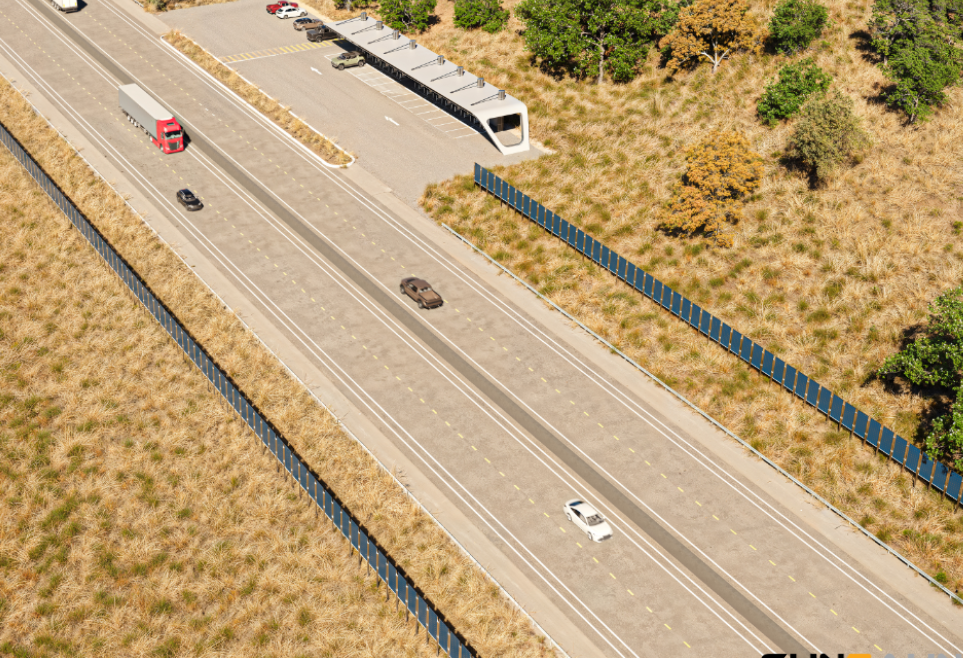
Senate Bill No. 49, also known as SB 49, was signed into law on October 7, 2023, marking a significant step toward advancing California’s renewable energy goals. The bill directs the California Department of Transportation (Caltrans) to evaluate the potential for developing renewable energy generation, energy storage, and electrical transmission infrastructure along state highways. The goal is to explore how public lands, particularly highways and their rights-of-way, can be leveraged to meet California’s energy needs while promoting sustainability.

read more