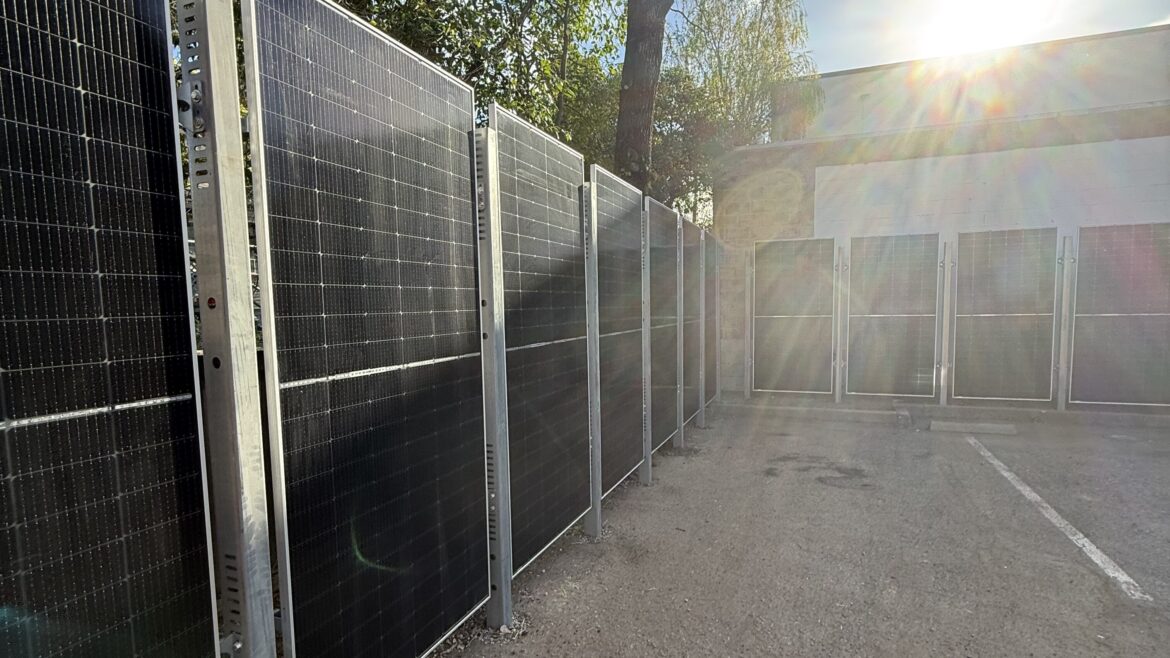
vertical solar

UC Davis Expands Agrivoltaics Research, Includes New Sunzaun System

UC Davis Expands Agrivoltaics Research, Includes New Sunzaun System 1500 979 Sunzaun

Back in 2023, University of California (UC) Davis had a small set of Sunzaun vertical bifacial racking installed – three rows of three modules – to support early agrivoltaics (agriculture + solar, or photovoltaic, energy) research. Sunstall donated the racking system so the university could begin exploring how vertical solar might work alongside crops in California farmland.

Two years later, and after immense collaboration, the research site looks quite different.

A New Research Installation 

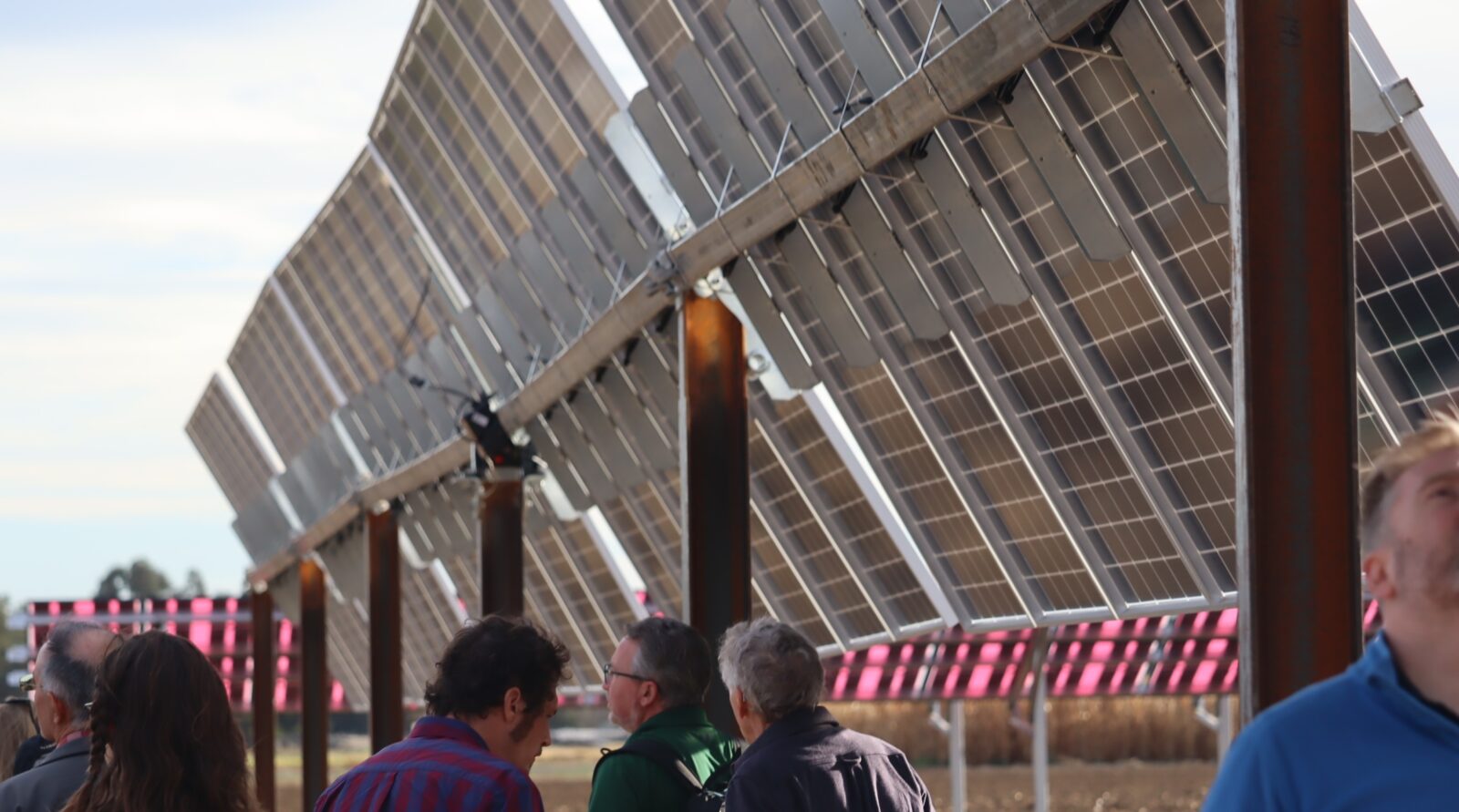
In late October 2025, several solar companies came together to complete a new, and significantly larger, system on one of the campus’s agricultural fields, just across from the original test site. Its completion came just in time for the 3rd Annual California Germany Agrivoltaics Day at UC Davis, organized by German American Chamber of Commerce. This event gathered researchers, farmers, and industry professionals to discuss the progress and potential of agrivoltaics in California, drawing on Germany’s extensive experience in the field. The newly expanded project offered visitors the opportunity to walk through the site, examine the equipment up close, and speak directly with the experts who are building and studying these systems. 

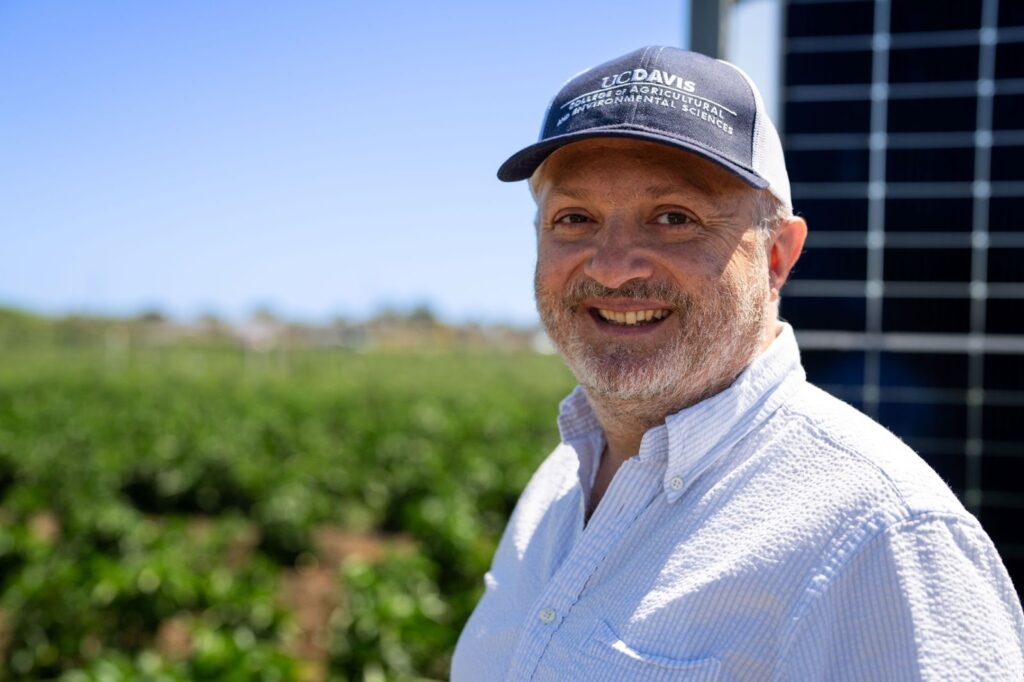
The photovoltaic acquisition process was led by Professor Majdi Abou Najm from the Department of Land, Air and Water Resources at UC Davis. He is one of California’s leading figures in agrivoltaics research.

Professor Majdi Abou Najm standing in front of the old Sunzaun installation, surrounded by pepper and basil test crops.

Four Agrivoltaic Systems, One Field

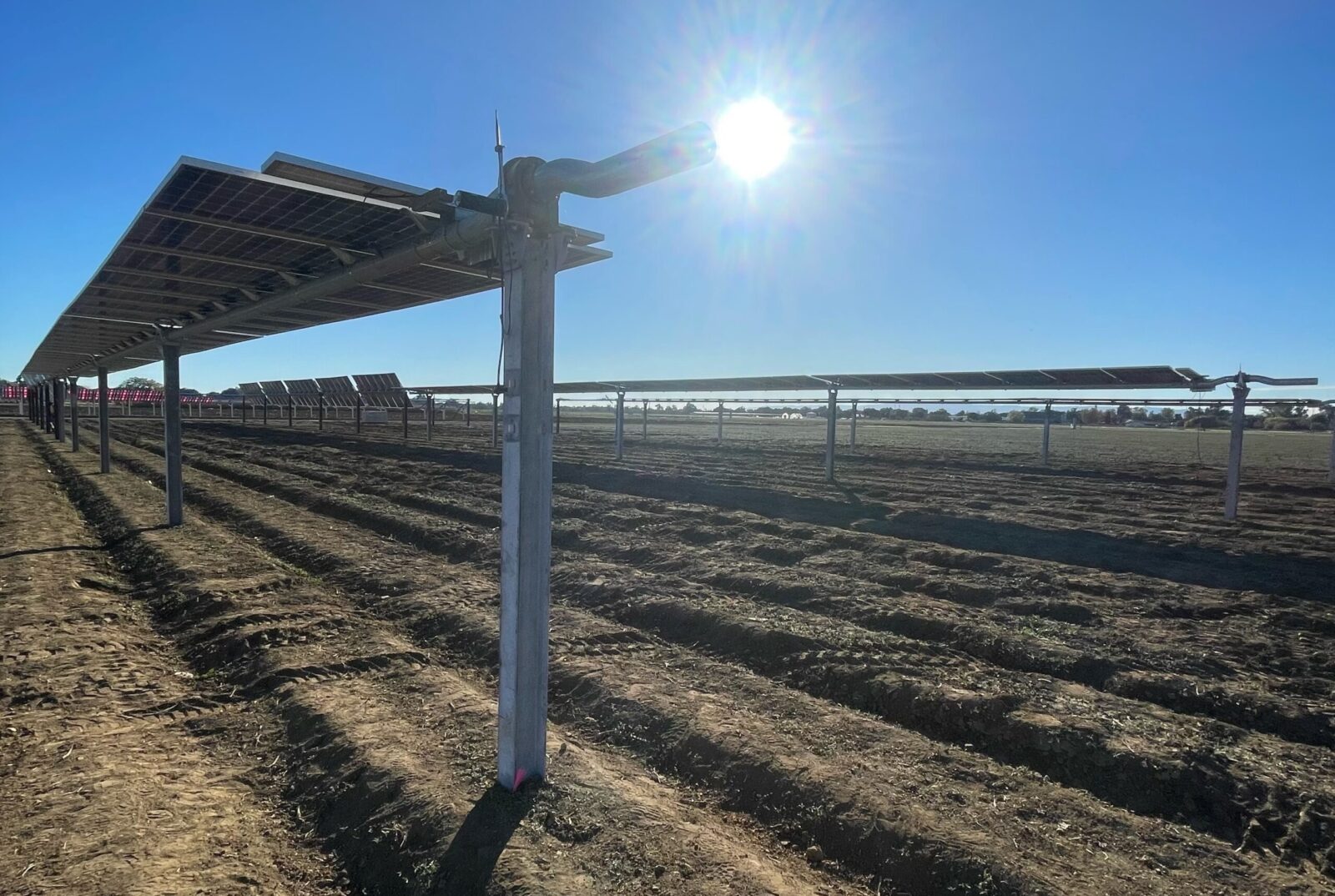
The new research site is unique in its variety. Instead of a single system, the field now hosts four different ground-mounted PV designs, each with its own racking and module configuration. The multi-system format is meant to support decision-making by farmers, developers, and policymakers. comparison that allows researchers to look closely at energy production, crop response, and equipment access. The full site contains 448 modules totaling 200.44 kW.

“This site will inform growers how to select PV systems that align with their needs,” Abou Najm said. “If wind is damaging your crops, vertical systems can help. If heat stress is the issue, spectrally selective panels may be more appropriate,” he said, highlighting how agrivoltaic design choices can be tailored to specific on-farm challenges.

“My hope is to have this facility serve as the technology and science hub for shaping the future of agrivoltaics,” Abou Najm said. “For policy makers, it provides the visual (…) that this is not a one-size-fits-all technology (…), and that if designed with the agriculture-first mindset, can be transformative.”

From north to south, the systems include:

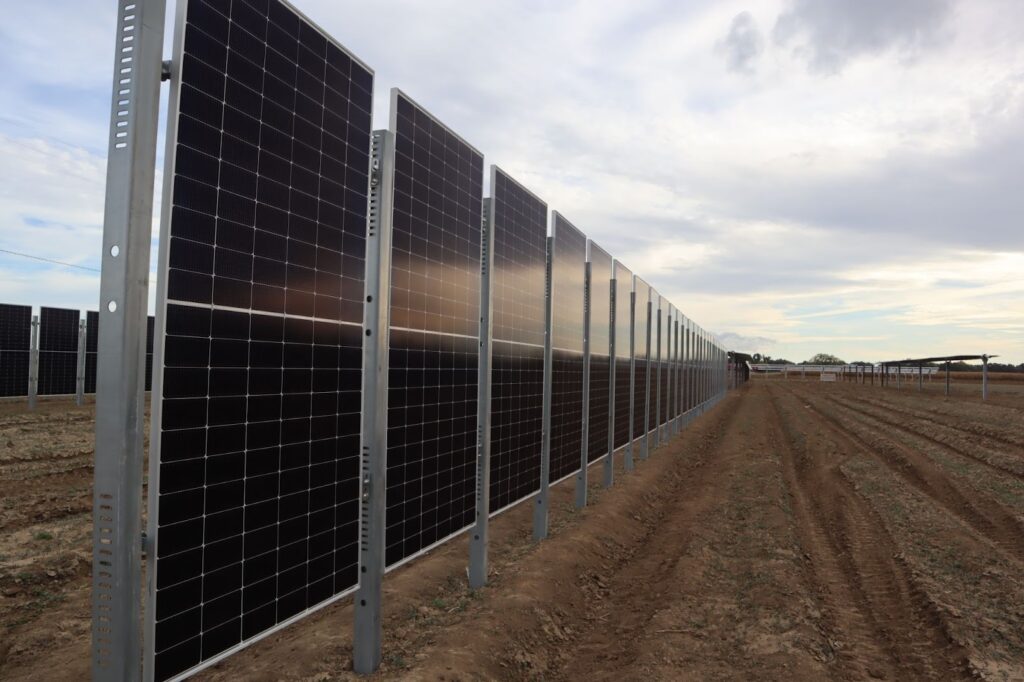
1. Sunzaun Vertical Bifacial System

Panels mounted vertically, producing from both east and west, designed to morning and afternoon energy generaton. This design offers uniform shading, easy equipment access, and strong potential for crop compatibility.

Photo Credit, Maximilian Dedden

2. Two Single-Axis Trackers

Two commercial tracker design, Nextracker and Nevados, installed next to each other to compare performance and crop impacts. Trackers typically deliver the highest energy yield, and the side-by-side setup gives researchers a rare opportunity to study differences in modules, design, and crop yield.

Photo Credit, Maximilian Dedden

3. OMCO Fixed-Tilt With Red Modules

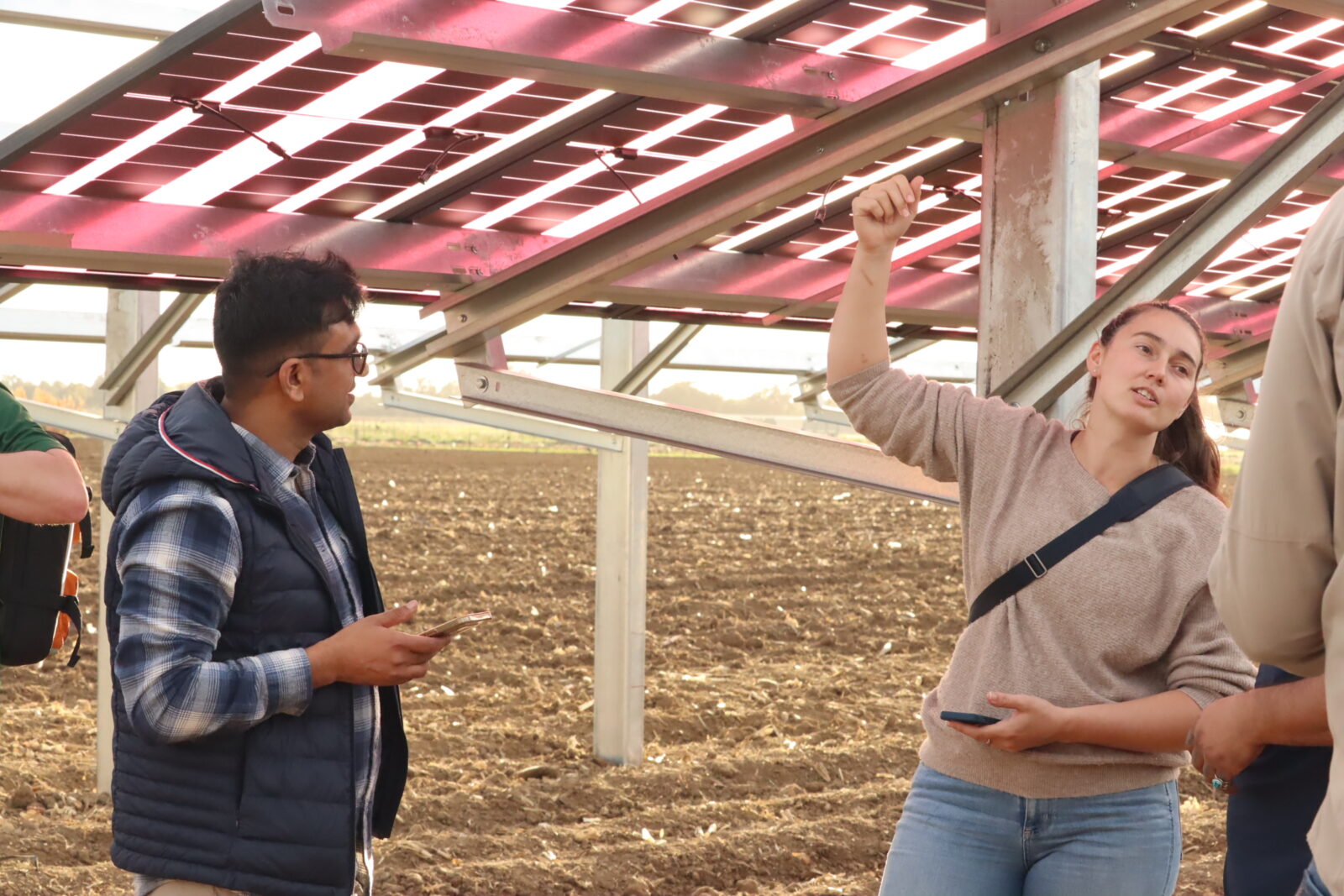
A fixed-tilt system fitted with red-tinted solar modules. These are spectrally selective modules supplied by Constructive Systems to support plant growth while still generating electricity.

Photo Credit, Maximilian Dedden

Built for Farming Operations, Not Just PV Density

A defining feature of the installation is its approximately 50-foot row spacing; wide enough to accommodate commercial farming equipment. Abou Najm said the spacing was driven by harvesting realities.

“In California, tomato harvesters operate across six rows at a time, alongside trucks collecting the crop,” he said. Tighter spacing would make commercial harvesting inefficient and would ultimately result in more agricultural land being lost to solar.

Over the coming seasons and as funding permits, UC Davis researchers plan to grow tomatoes, among other crops, between PV rows while monitoring crop yield, soil moisture, microclimate effects, carbon sequestration, and operational compatibility.

Installed by Sunstall, Inc.

All four systems were installed by Sunstall Inc., the parent company of Sunzaun and is quickly becoming one of the leading agrivoltaics installation teams in the country. The project highlights Sunstall’s ongoing commitment to supporting universities and research organizations as agrivoltaics shifts from an emerging idea to a tested, practical approach to farming and energy production.

Agrivoltaics has the potential to make food production more resilient while reducing emissions from the electricity sector. Sunzaun is grateful to contribute to this work and looks forward to the research results that will come from UC Davis’s expanded testing ground.

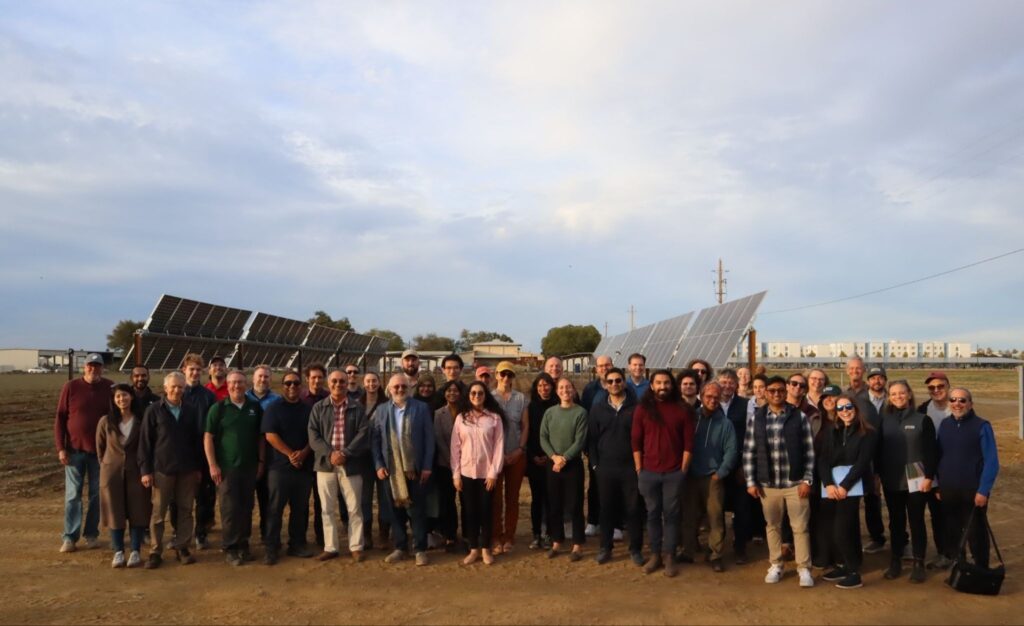
Group photo from the UC Davis Agrivoltaics Day Tour. Photo Credit, Maximilian Dedden

If you’d like to follow updates on vertical solar and agrivoltaics research, please consider joining our Newsletter! 

The previous blog post covering the original 9 module installation can be found here: https://sunzaun.com/vertical-agrivoltaics-at-uc-davis/

Putting Farmers First: Insights from the Solar Farm Summit

Putting Farmers First: Insights from the Solar Farm Summit 911 671 Sunzaun

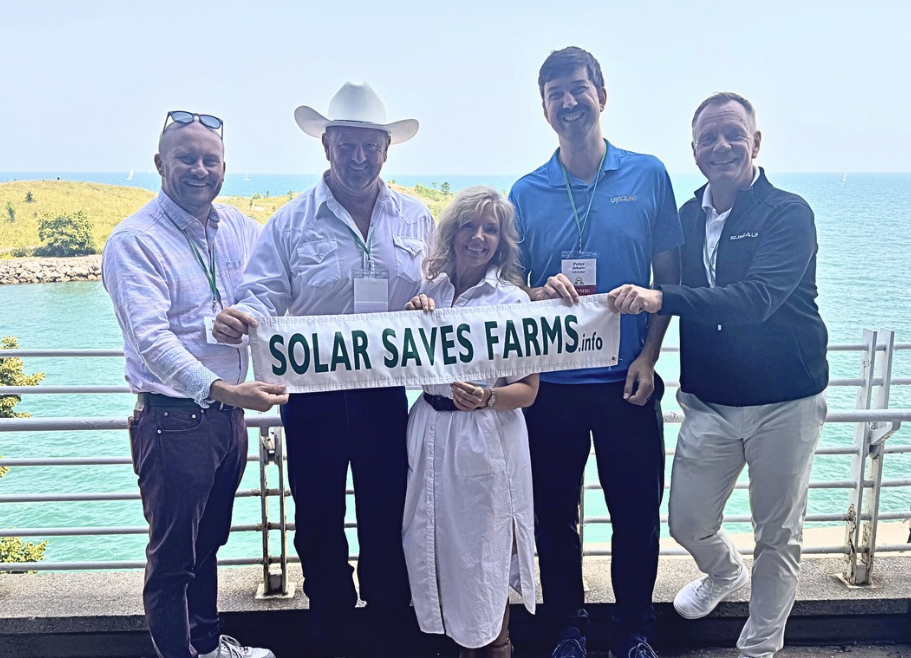
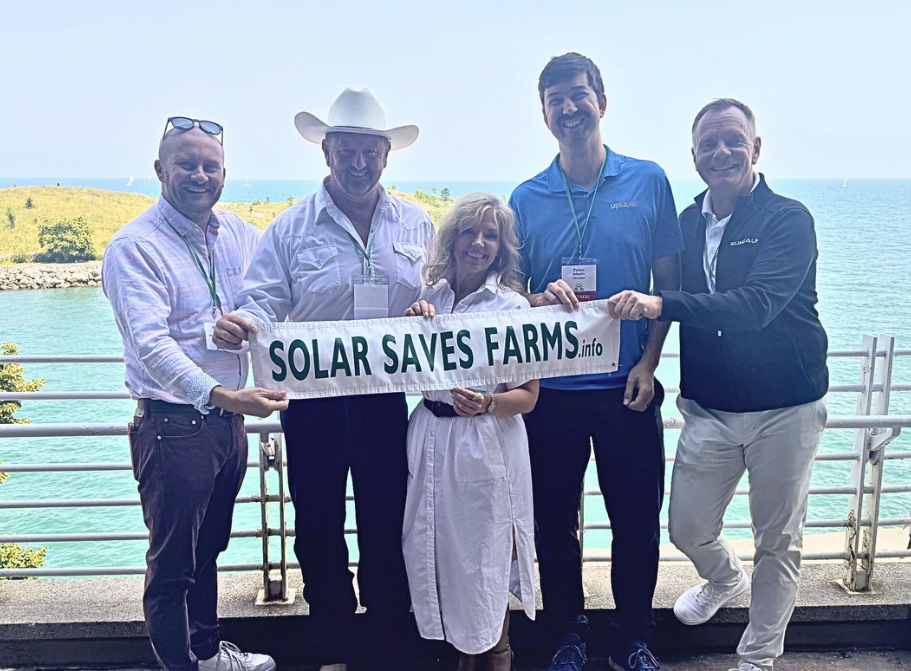
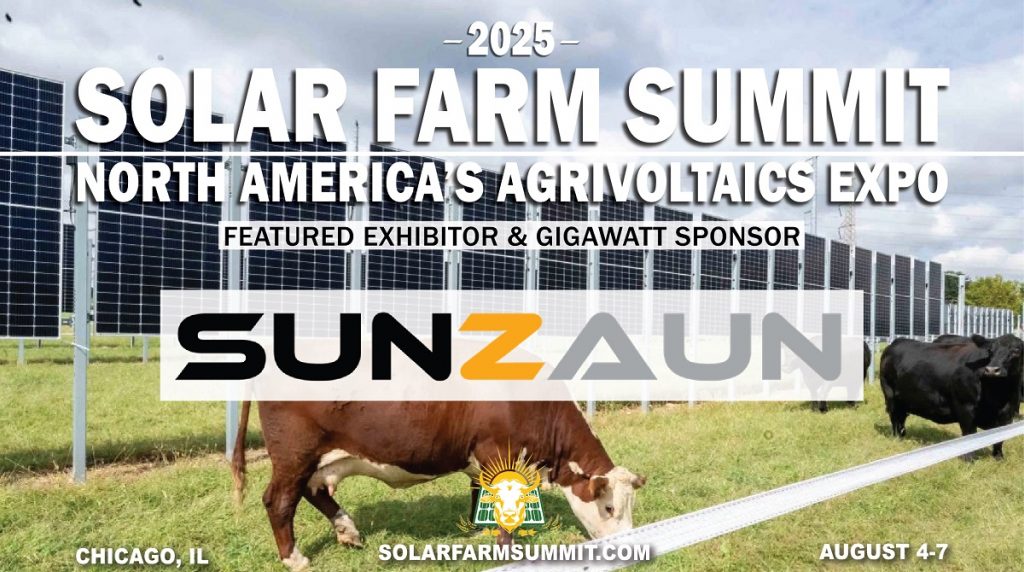
The 2025 Solar Farm Summit in Chicago brought together farmers, developers, researchers, state officials and industry leaders. Some came as curious explorers, others as passionate advocates, but all shared an interest in how solar and farming can work together. Sunzaun’s team was there to showcase its vertical bifacial solar racking system and join in on conversations shaping the next chapters of solar in agriculture. Helge Biernath, CEO of Sunstall, joined a panel with experts from Sandbox Solar and SolarEdge to share insights on vertical solar technology. 

Farmer’s Perspective

While representing its product at the booth, Sunzaun’s team also attended sessions covering topics such as livestock grazing health in the context of solar arrays, the latest developments in agrivoltaics policy and research, and American-made solar. One of the most memorable sessions was The Farmer’s Perspective on Agrivoltaics. Hearing directly from farmers offered an unfiltered look at what’s working, what’s not, and what’s needed to make agrivoltaics viable on real farms, especially for owner-operated or “smallholder” farms.

Key Takeaways:

  • Owner-operated farms are shrinking as corporate farming expands. This trend is due to multiple factors, including rising operational costs.
  • 80% wouldn’t change production systems for agrivoltaics. Many are still uncertain about its benefits.
  • Trust is low. According to an American Farmland Trust survey, the most trusted source of agricultural information for farmers is university-affiliated extension services, followed by farm associations. Solar developers often rank near the bottom of this list.

What Farmers Want from Solar Developers

To make agrivoltaics appealing, farmers with existing solar infrastructure emphasized a few must-haves from solar developers:

  • Clear contracts with transparent $/acre return on investment
  • Ongoing panel maintenance included
  • Freedom to keep farming with minimal disruption
  • Solar designs that fit agricultural needs, such as wide row spacing for machinery and to limit shading

Sunzaun’s Commitment to Farmers

Sunzaun believes that owner-operators deserve a strong voice in shaping agrivoltaic projects. When done right, these systems can provide reliable supplemental income while keeping farmland productive. Sunzaun works with farmers, researchers, EPCs, and developers to design solutions that protect farmland while generating clean energy.

Supporting Trusted Voices in Agriculture

To wrap up the week, Sunzaun donated a TV to Michigan State University Extension Services to support their outreach efforts. Since extension services are among the most trusted sources of agricultural information, Sunzaun is proud to assist with the continuation of delivering reliable, accessible knowledge to the farming community.

Sunzaun CEO Interview | Clean Power Hour

Sunzaun CEO Interview | Clean Power Hour 336 333 Sunzaun

“Everybody was just asking for incentives, […] but I’m like, […] you should stop talking about incentives. How about the idea that if you don’t do agrivoltaics, you won’t have the biomass yield you need in the future — period. Because the climate is changing.”  — Helge Biernath, CEO of Sunzaun


This powerful call to action served as an opener on a recent episode of The Clean Power Hour, setting the tone for the types of conversations that are reshaping how we think about the future of agriculture. 

As the clean energy transition accelerates –  largely driven by climate change, energy security, and economic opportunities – stakeholders are increasingly turning to farmland. Not to replace crops, but to use solar infrastructure as a complementary partner to agriculture. In this episode, host Tim Montague is joined by Helge Biernath of Sunzaun and Sunstall, and Ian Skor, CEO of Sandbox Solar, to dive into the growing world of vertical agrivoltaics. 

The Roots of Agrivoltaic Innovation

Sandbox Solar, founded over a decade ago, began testing crop performance under solar arrays back in 2018. What they found was that certain crops actually performed better under semi-transparent solar panels compared to traditional full-sun conditions. 

“[Too much] sun can be stressful for some plants,” Montague elaborated during the podcast. “We’re learning a lot — and there’s still so much to learn.” 

This duality — where crops grow within the sheltered space between solar arrays — may play a critical role in the future of sustainable agriculture. This is especially true for regions that face water scarcity and extreme heat events.

Meanwhile, Sunzaun, which grew out of the solar installation company Sunstall Inc., peered over at European trends. CEO Biernath observed the emergence of vertical racking systems that allowed crops and solar to share the same land with minimal footprint loss. With few domestic options for such systems, Biernath saw an opportunity to bring this innovation stateside.

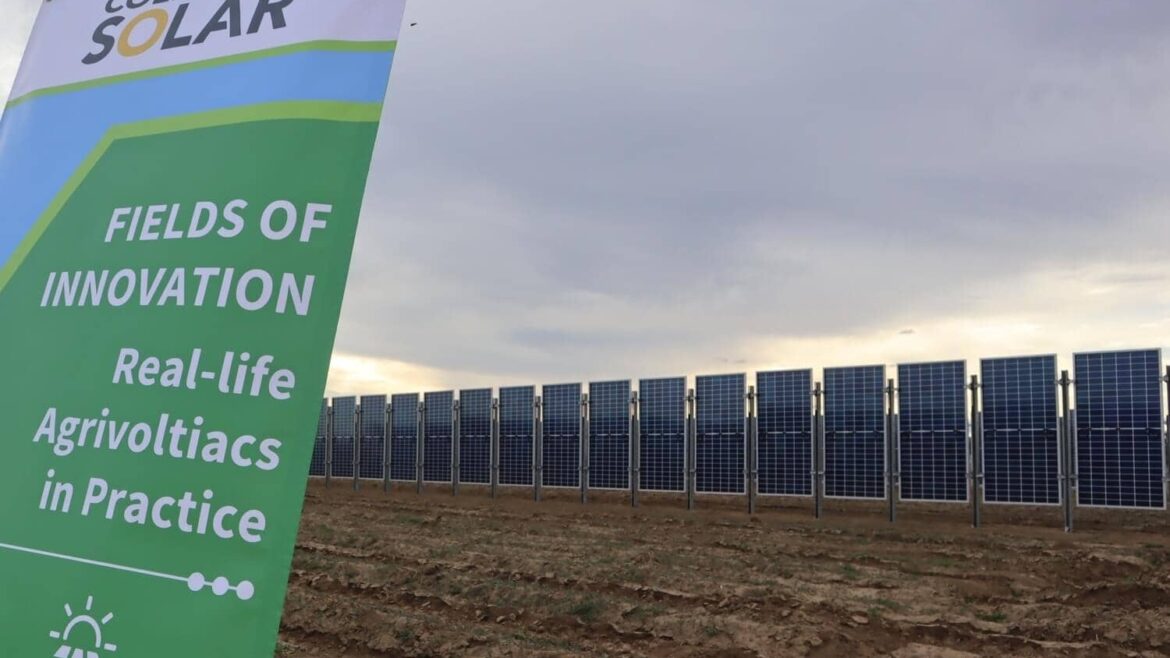
Most recently, the two companies teamed up to launch an agrivoltaics testing site at Colorado State University. This site was designed to demonstrate real-world applications of agrivoltaics using vertically-aligned modules. With adequate spacing between rows, tractors seed and harvest crops with ease, proving that solar and agriculture don’t have to compete. 

Field crops like corn are being evaluated for their growth under panels, while researchers also monitor how the crops, in turn, affect solar output. The project is already collecting valuable data that could help inform and educate the community, as well as pave the way for the expansion of agrivoltaics nationwide.

The agrivoltaics research site at Colorado State University. In 2024, researchers planted corn within rows of bifacial vertical arrays to monitor crop growth, PV energy output, and a variety of other metrics such as soil moisture and temperature. Sunzaun’s flexible racking system enables panels to be raised by several feet if necessary — an adaptive feature to accommodate taller crops or future design needs.

Europe and Asia: A Glimpse Into the Future

Montague emphasized that Northern Europe and parts of Asia are nearly a decade ahead of the U.S. when it comes to agrivoltaic deployment. Why? Biernath believes space constraints have driven these regions to integrate solar directly into the built and agricultural environment.

“In the U.S., we have lots of land,” Biernath states. The issues lie between where that energy is needed and where it is being generated. Bringing solar photovoltaics to agricultural land found near urban hubs could reduce the need to curtail energy, a challenge recently spotlighted in parts of California. 

As the population expands, so will the pressure to balance land use among conservation, development, agriculture and energy production. Pairing solar with farming, as already seen in parts of Europe and Asia, is critical for sustaining projected growths. 

The Challenge: Awareness and Policy

If agrivoltaics offers so many benefits, why aren’t we seeing it everywhere?

According to the guests, the biggest hurdles might be awareness. Farmers may not be aware of the sheer benefits of incorporating vertical solar on agricultural land. Additionally, policy frameworks may not yet be set up to support dual-use systems, but the movement is growing. Vertical solar offers a low-footprint, high-impact solution that aligns with fostering agricultural productivity, climate mitigation and farmer resilience.

Key Takeaways

  • Vertical agrivoltaics allows solar energy and agriculture to share the land, increasing efficiency and resilience.
  • European and Asian countries are leading in adoption, offering insights for U.S. researchers, developers and the agricultural community.
  • Real-world test sites, like the one at Colorado State University, are proving that tractors, crops, and solar panels can work together.
  • Barriers remain, including public awareness and permitting processes — but growing data and interest are breaking new ground.

Want to Learn More?

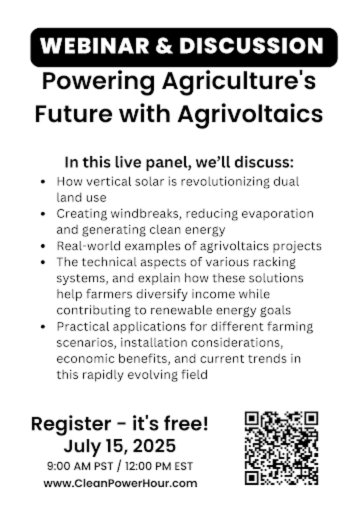
Join Ian Skor, Helge Biernath, John Langdon, and Dr. Najm on July 15, 2025 for an upcoming webinar and panel discussion titled “Powering Agriculture’s Future with Agrivoltaics”.

This free online event will explore how vertical solar is revolutionizing agricultural land use while generating clean energy. We’ll be joined by leading experts from the field, including representatives from Sunzaun, UC Davis, Sandbox Solar, and Muddy Creek Solar Park.

Sunzaun on Track: Vertical Bifacial Solar PV for Railways

Sunzaun on Track: Vertical Bifacial Solar PV for Railways 1024 1024 Sunzaun

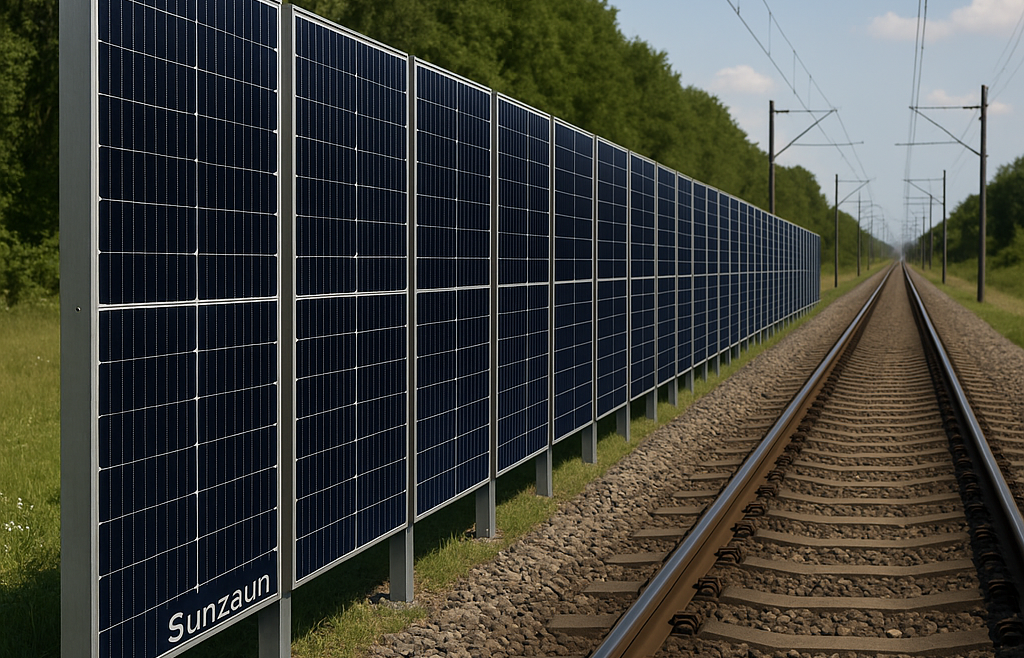
As railroads intersect countries and connect cities, they offer a unique opportunity for energy generation. Vertical bifacial solar systems are well-suited to turn these corridors into high-efficiency, low-footprint power sources—without interfering with train operations or requiring additional land.

Why Railways Are Ideal for Vertical Bifacial PV Infrastructure

Railway networks offer miles of underutilized space that is already cleared, maintained, and graded. Traditional horizontal solar systems struggle to fit into these narrow strips. That’s where Sunzaun’s vertical design excels:

  • Small Footprint: Vertical PV (photovoltaic) systems require only a narrow strip of land, making them ideal for trackside positioning in right-of-way areas or even between dual-track corridors (CleanTechnica, 2025).
  • Reduced Afternoon Glare: Unlike tilted PV panels, Sunzaun’s vertical installation reduces glare risks, enhancing railway safety compliance.
  • Preexisting Infrastructure: Panels can be mounted along existing fences, barriers, or access roads, reducing construction effort and regulatory friction.
  • Dual-Sided Generation: Panels absorb direct and reflected light from both sides, increasing energy capture and generation.
  • Morning and Evening Peaks: Energy generation aligns with early and late demand periods—often matching train station energy usage (Overeasy.no, 2024).

Integration with Railway Power Systems

  • DC Coupling Options: Vertical solar systems can feed into traction substations, minimizing energy losses from AC-DC conversion (Electric & Hybrid Rail Technology, 2024).
  • Smart Grid Compatibility: Integration with inverters enables future compatibility with train station microgrids and auxiliary systems.
  • Removable and Modular: Sunzaun structures can be installed with temporary or quick-release mounts to allow access for track maintenance, drawing on concepts similar to the Sun-Ways system in Switzerland (Euronews, 2024).

Additional Benefits for Rail Operators

  • Security Fencing + Energy: Sunzaun infrastructure can double as secure fencing, used to protect both railroad operations and the public from hazards, reducing material and installation costs.
  • Noise Mitigation Potential: Mounted along sound barriers, they attenuate noise pollution, benefiting wildlife and neighboring communities, increasing community acceptance.
  • Low Maintenance: Vertical alignment limits soiling from dust and debris stirred up by passing trains (SolarWA.org).

Vertical Bifacial PV can unlock huge potentials for decentralized, cost-effective renewable energy generation without competing for land or disrupting preexisting infrastructure. Railways have the opportunity to not only serve as transportation arteries, but climate-neutral power corridors.


References:

  1. CleanTechnica (2025): “Three Interesting Ways to Leverage Railways for Solar Power”
    https://cleantechnica.com/2025/01/06/three-interesting-ways-leverage-to-railways-for-solar-power/
  2. Overeasy.no (2024): “Increased Solar Capture Rates from Vertical Bifacial Solar Panels”
    https://www.overeasy.no/post/increased-solar-capture-rates-from-vertical-bifacial-solar-panels
  3. ResearchGate (2023): “Modeling of Energy Gain in Bifacial Vertical PV Fences”
    https://www.researchgate.net/publication/387699162_Modeling_of_energy_gain_in_bifacial_vertical_PV_fences
  4. Electric & Hybrid Rail (2024): “Using Solar Power to Provide Traction Energy”
    https://www.electricandhybridrail.com/content/in-depth/using-solar-power-to-provide-traction-energy-for-electrified-trains/
  5. Euronews (2024): “Solar Panels Could Be Installed in the Spaces Between Railway Tracks”
    https://www.euronews.com/green/2024/10/14/solar-panels-could-be-installed-in-the-spaces-between-railway-tracks-in-world-first
  6. SolarWA.org (n.d.): “Vertical Bifacial Solar Panels”
    https://www.solarwa.org/vertical_bifacial_solar_panels

From Runways to Renewables: Vertical Solar Power at US Airports

From Runways to Renewables: Vertical Solar Power at US Airports 512 288 Sunzaun

As the world intensifies efforts to reduce carbon emissions and embrace renewable energy, the role of airports in this transition is often overlooked. Traditionally seen as major energy consumers due to the constant demands of air traffic and facilities, airports are now becoming key players in sustainable energy generation. A particularly innovative approach gaining traction is the use of vertical solar farms. This article explores how vertical photovoltaic (PV) systems can revolutionize energy production at airports and contribute to a greener aviation industry.

Airports as Ideal Locations for Solar Installations

Airports represent some of the most promising locations for large-scale solar energy generation. With large expanses of unused or underutilized land around runways and taxiways, airports can install solar farms without impacting air traffic. In fact, airports are already being recognized for their potential as renewable energy hubs. Around 20% of public airports in the U.S. have adopted some form of solar power, including rooftop and ground-mounted systems [https://solartribune.com/solar-power-takes-off-at-u-s-airports/].

Vertical solar systems like this installation by Sunzaun offer a variety of innovative applications, e.g. on farms or airports

How Vertical Solar Farms Benefit Airports

Energy Savings and Reducing Airports’ Carbon Footprints

Vertical solar farms can help airports significantly reduce energy costs by generating clean, renewable electricity on-site. This cuts down on utility bills and also reduces the airport’s overall carbon emissions, contributing to a greener, more sustainable operation.

Opportunities for Additional Revenue Streams

In addition to energy savings, airports with large solar installations have the potential to sell excess power back to the grid, creating additional revenue streams. This economic benefit adds to the appeal of solar farms for airport operators.

Impact on Operational Efficiency and Public Image

Adopting solar energy can enhance an airport’s operational efficiency by providing a stable, renewable power source. Furthermore, it can improve the airport’s public image, positioning it as a leader in sustainability and innovation, which is increasingly important in the eyes of environmentally conscious travelers.

Rendering showing how unused areas on airports could be used for vertical PV development

Challenges of Installing Vertical Solar Farms Near Airports

Potential Concerns About Aviation Safety, Including Glare and Air Traffic Disruption

One of the key concerns about solar farms near airports is the potential for glare, which could impair pilots’ vision during takeoff or landing. However, vertical solar farms tend to produce less glare than traditional horizontal installations, as they are designed to absorb sunlight from different angles. Strategic placement and the use of anti-glare technologies can further mitigate these risks [https://www.airsight.de/projects/item/solar-farms-at-airports-a-key-to-the-transition-to-renewable-energy-at-aerodromes/].

Engineering and Regulatory Challenges Specific to Airport Environments

Solar farms at airports face unique regulatory and engineering challenges, particularly regarding aviation safety standards. Developers must ensure that solar installations do not interfere with radar or communication systems, and they must comply with strict Federal Aviation Administration (FAA) regulations.

Solutions: Anti-Glare Technology, Strategic Placement

To address these challenges, developers are employing advanced anti-glare technology and carefully planning the placement of vertical panels. By positioning panels at the correct angles and distances from runways, airports can enjoy the benefits of solar energy without compromising safety.

Future Prospects: Expanding Solar Farms on U.S. Airports

Case Studies of U.S. Airports with Solar Installations

Several U.S. airports have already embraced solar energy. Indianapolis International Airport is home to one of the largest airport-based solar farms in the world, generating enough power to supply 10,000 homes annually. Denver International Airport has also made strides in solar energy, with four separate solar arrays that collectively generate over 10 MW of power [https://solartribune.com/solar-power-takes-off-at-u-s-airports/].

Highlight Key Projects, Such as the Frankfurt Airport Vertical PV Installation

Globally, airports are setting the stage for the adoption of vertical solar farms. Frankfurt Airport, for example, has recently launched the world’s largest vertical PV installation, covering 30.8 hectares and generating 17.4 MW of power [https://www.linkedin.com/pulse/worlds-largest-vertical-pv-system-welserprofilenorthamerica-jatvf]. This project serves as a model for U.S. airports looking to adopt similar systems.

How U.S. Airports Can Replicate These Successful Projects

U.S. airports can follow in the footsteps of international leaders like Frankfurt by investing in vertical solar technology, adapting it to local regulations, and addressing safety concerns through engineering solutions. Collaboration between solar developers and airport operators will be key to realizing these projects.

Conclusion

Vertical solar farms have the potential to transform energy production at airports. As technology advances and policy support for renewable energy grows, vertical PV installations can become a cornerstone of sustainability initiatives at airports across the U.S. With their ability to optimize space, reduce energy costs, and lower carbon emissions, vertical solar farms offer a bright future for the aviation industry.

Why Vertical Bifacial Panels Along Canals Could Be a Game-Changer

Why Vertical Bifacial Panels Along Canals Could Be a Game-Changer 1021 571 Sunzaun

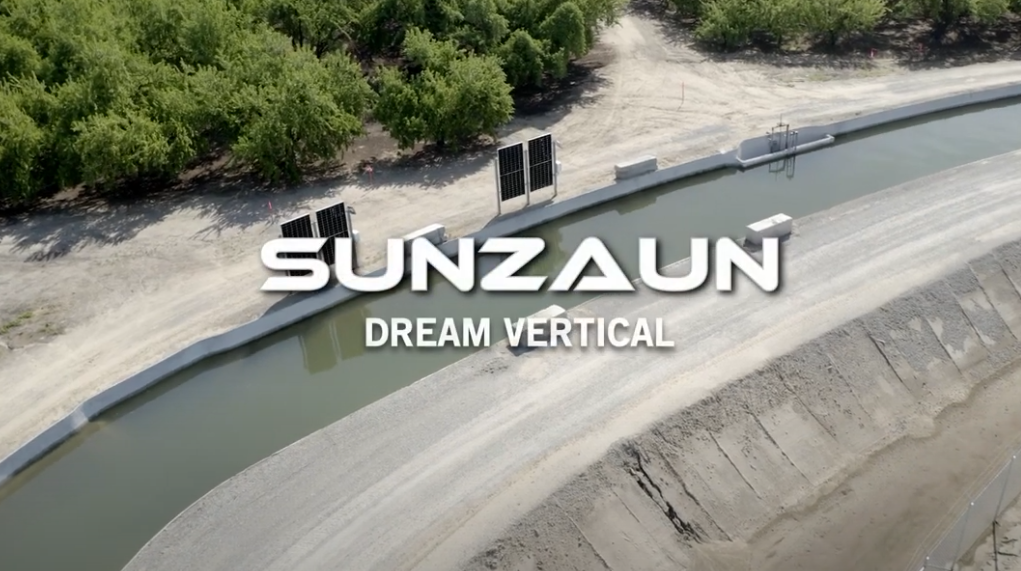
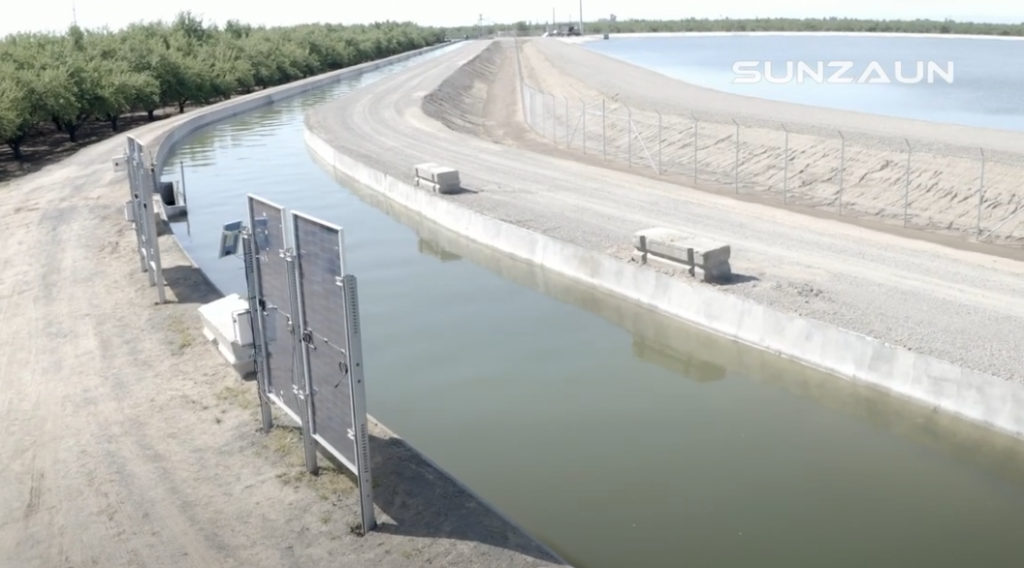
Solar energy systems are evolving—not just in what they’re made of but also in how and where they’re installed. One innovative approach gaining attention is using vertical bifacial solar panels on the sides of irrigation canals.

These panels collect sunlight from the front and back, allowing them to harness more energy throughout the day. But beyond the tech itself, it’s the placement strategy that makes this idea stand out.

Why Go Vertical — Along a Canal?

Traditional solar arrays are typically installed at a tilt (e.g., 20°) facing south. That works well, but it requires open land, is prone to dust accumulation, and creates steep seasonal production curves with big summer peaks and winter valleys.

In contrast, vertical bifacial systems can:

  • Collect light on both sides, especially when ground or nearby surfaces reflect sunlight.
  • It stays much cleaner in dusty environments—vertical orientation reduces soiling by up to 95% compared to tilted panels¹.
  • Perform better in winter months, leading to a flatter seasonal production profile — important for grid stability².

When placed along a single canal bank, these panels avoid the need for complex mounting over the water. This is a major advantage in regions where canal access is only available from one side or where installing overhead structures is too costly or logistically impractical.


What About the Energy Output?

Modeling shows that a south-facing vertical bifacial array, without any reflector, can deliver about 87% of the annual energy of a standard south-facing 20° tilted monofacial array — but with superior performance in the non-summer months².

Adding a simple reflective tarp across the canal (or part of it) can increase that output by another 19%–24 %. If a hybrid reflector is used — combining a durable base with a shiny aluminized Mylar top layer — the boost can reach 41%–44%³.

In addition, this setup helps to reduce evaporation from the canal by about 61%, thanks to shading and reduced wind-driven losses — a valuable bonus in water-stressed regions⁴.

To put that into perspective: saving 610,000 gallons per year (from a canal segment losing 1 million gallons annually) is equivalent to the annual water use of 9 to 22 Californians, depending on regional consumption habits⁵.

In agriculture, this amount of water could irrigate around 0.37 acres of rice or 0.63 acres of field crops, showing how solar canals help conserve both water and energy⁶.

Now scale that up: California has approximately 4,000 miles (6,400 km) of irrigation canals⁷. If similar systems were deployed along the canal network, they could save up to 63 billion gallons of water per year⁸ — enough to supply more than 2 million people annually or to irrigate over 50,000 acres of farmland⁸.


Where and When Does It Make Sense?

This design is particularly well-suited to:

  • North-south oriented canals less than 17 feet (5.2 m) wide⁴
  • Dusty, high-soiling environments (e.g., California’s Central Valley)¹
  • Locations where land availability is limited
  • Projects where only one canal bank is accessible

In these scenarios, vertical systems can be cost-competitive or even cheaper than traditional canopy systems – especially as structural and installation costs (e.g., steel, concrete) continue to rise. Modeling suggests that vertical systems could remain economically viable even on canals up to 25 feet wide, depending on material and labor costs⁴.


Conclusion

Vertical bifacial systems – like SunZaun – offer a promising alternative to conventional solar designs, especially for dual-use applications like canals. They’re more space-efficient, resilient to dust, and better balanced across seasons. And when paired with a smart reflector design, they can rival — or even surpass — traditional systems in total output.

Rethinking orientation and placement may be just as important as improving the panels themselves.

Sources

  1. Bhaduri & Kottantharayil, Soiling Analysis of Vertical PV, IEEE, 2019
    https://ieeexplore.ieee.org/document/8887284
  2. Reagan & Kurtz, Energetic Comparison of Vertical Bifacial to Tilted Monofacial Solar, IEEE, 2022
    https://ieeexplore.ieee.org/abstract/document/9924604
  3. Reagan et al., Material Selection and Cost Modeling for Reflectors in Vertical Canal PV Systems, IEEE, 2024
    https://ieeexplore.ieee.org/abstract/document/10829584
  4. Field data from UC Merced Project Nexus and submitted PVSC 2025 paper (in review)
  5. Water usage per capita:
    USGS California Water Use Statistics
    Valley Water – Understanding Your Water Use
    Los Angeles Times – July 2024 Water Tracker
  6. Agricultural water needs:
    UCANR Rice Irrigation Guide (PDF)
    Press Democrat – California Crops and Water Use
  7. Smithsonian Magazine – California’s Solar Canal Pilot

Los Angeles Times – Opinion: California’s Solar Canals Could Save Water and Generate Power

Vertical Solar & LEED – An Emerging Trend in Real Estate

Vertical Solar & LEED – An Emerging Trend in Real Estate 1080 1080 Sunzaun

In today’s ever-changing landscape of real estate, sustainability and renewable energy solutions have become essential considerations for property owners and developers. Among the leading initiatives in this realm, LEED certification and solar energy integration hold immense promise for creating eco-friendly and energy-efficient buildings. By harnessing the combined benefits of LEED certification and solar energy, real estate owners can unlock a multitude of advantages that go beyond environmental stewardship.

In this blog post, we will explore the powerful synergy between LEED certification and vertical solar energy and shed light on the remarkable benefits they offer to real estate owners. From enhanced energy efficiency and cost savings to reduced carbon footprint and increased property value, we will delve into how this dynamic duo can revolutionize your real estate portfolio.

By adopting LEED certification, real estate owners can ensure that their buildings are designed and operated in a sustainable manner, optimizing energy usage and minimizing environmental impact. Meanwhile, the integration of vertical solar energy systems empowers these buildings to generate clean and renewable electricity on-site, reducing reliance on traditional energy sources and lowering operating costs.

What is LEED?

LEED stands for Leadership in Energy and Environmental Design, which is the most widely used green building rating system globally (source). It was developed by the non-profit U.S. Green Building Council (USGBC) to provide a framework for designing, constructing, operating, and maintaining environmentally responsible and resource-efficient buildings, homes, and neighborhoods.

LEED certification is a voluntary program that enables building owners and operators to demonstrate their commitment to sustainability. The LEED rating system consists of a set of criteria and standards that cover various aspects of building design and operation, including:

  • Location and Transportation
  • Sustainable Sites
  • Water Efficiency
  • Indoor environmental quality
  • Energy and Atmosphere
  • Integrative Process
  • Materials and resources
  • Innovation

By meeting these criteria, a building can earn points and achieve different levels of LEED certification, such as Certified, Silver, Gold, or Platinum, based on the total number of points earned.

LEED is applicable to various building types, including commercial buildings, residential buildings, schools, healthcare facilities, and more. It provides guidelines and best practices for creating healthy, efficient, and cost-saving buildings that minimize environmental impact while promoting occupant well-being and sustainability (source).

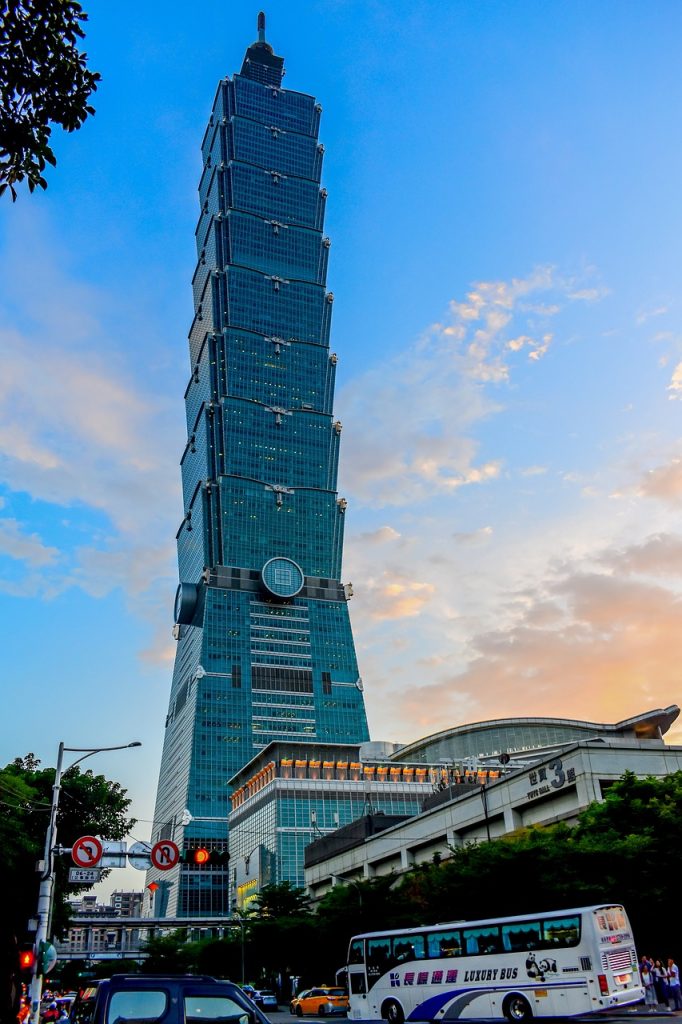
The Taipei 101 in Taiwan is one of the tallest LEED certified buildings

LEED certification has become a recognized symbol of sustainability and is often sought after by building owners, developers, and occupants who value energy efficiency, environmental stewardship, and sustainable practices. LEED also helps investors to meet their ESG requirements (read our blog on ESG requirements). It promotes the adoption of green building strategies, encourages innovation in the construction industry, and contributes to reducing the environmental footprint of the built environment.

Vertical solar panels contribute to earning LEED credits

Vertical Solar panels can contribute to earning LEED credits for buildings by demonstrating the use of renewable energy and promoting sustainability. The primary LEED category relevant to solar panels is the “Energy & Atmosphere” category, specifically EA Credit 2, which is the “On-Site Renewable Energy” credit (source).

The On-Site Renewable Energy credit within LEED rewards projects that generate renewable energy on-site, such as through solar panel installations. This credit can provide up to 7 possible LEED points, depending on the specific project and the percentage of energy output supplied by the renewable source. Builders can earn points under the renewable energy sub-category based on the tier and the percentage of electricity generation provided by the renewable source (source).

Here is a breakdown of the points available under Tier 1 for renewable energy generation:

  • 1 point: 2% electricity generation
  • 2 points: 5% electricity generation
  • 3 points: 10% electricity generation
  • 4 points: 15% electricity generation

The specific number of points earned will depend on the amount of energy produced by the solar panels and its contribution to the overall energy needs of the building.

By incorporating solar panels into a building’s design, owners and developers can demonstrate their commitment to utilizing clean and renewable energy sources, reducing greenhouse gas emissions, and decreasing reliance on fossil fuels. Solar projects can help achieve LEED certification at various levels, such as Basic, Silver, Gold, or Platinum, based on the number of credits attained.

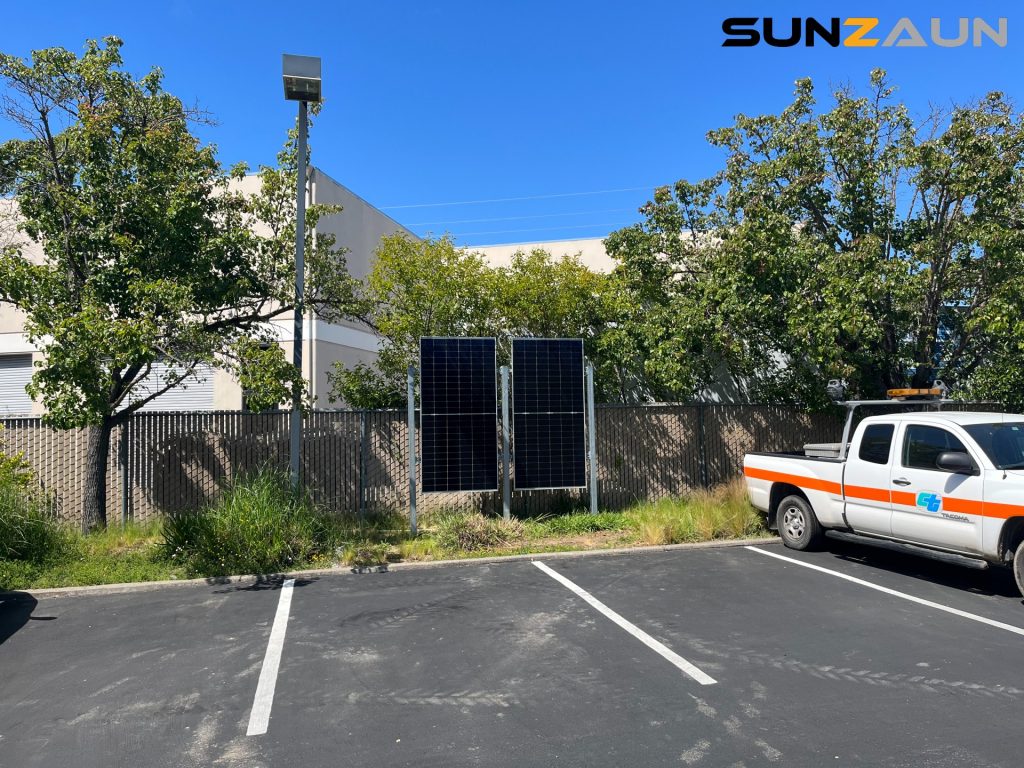
A Sunzaun showcase installation on a parking lot

Benefits of vertical solar for buildings and EV charging

In addition to rooftop solar and panels on a carport, vertical ground-mount solar panels can be integrated into the design of a building. Vertical panels can be used as a fence around property lines. Another way to power batteries and electrical vehicle charging opportunities is to install them on parking lots (Here is an example from Japan). Sunstall Inc. recently installed two Sunzaun modules on the parking lot of the headquarters as a proof of concept model.

In the United States, there are various financial incentives and policies in place to encourage the installation of electric vehicle (EV) charging infrastructure. These incentives aim to promote the widespread adoption of EVs and support the development of a reliable charging network. While the specific details may vary by state, here are some common financial incentives and support mechanisms:

  1. Tax Credits: Many states offer tax credits to individuals, businesses, or property owners who install EV charging stations. These credits can help offset a portion of the installation costs. The availability and amount of tax credits vary by state.
  2. Grants and Rebates: Some states provide grants or rebate programs that offer financial assistance for the installation of EV charging infrastructure. These programs can provide funding for both public and private charging stations, encouraging their deployment in various locations such as workplaces, multi-unit dwellings, and public areas.
  3. Utility Incentives: Many utility companies offer incentives to promote EV charging infrastructure. These incentives may include rebates, grants, or special electricity rates for EV charging stations. Utility incentives can help reduce the upfront costs of installation and make operating the charging stations more cost-effective.
  4. Public Funding Programs: In certain cases, federal or local government entities may provide funding opportunities or grants specifically aimed at supporting the installation of EV charging infrastructure. These programs often target public or semi-public locations such as parks, government buildings, and transportation hubs.
  5. Public-Private Partnerships: Collaborative initiatives between public and private entities can also contribute to the financial incentives for installing EV charging infrastructure. These partnerships may involve cost-sharing arrangements, revenue-sharing models, or other cooperative mechanisms to facilitate the expansion of charging networks.

If you are interested in exploring vertical solar opportunities for the LEED certification of your project, visit our office to see the Sunzaun racking system or reach out to us!