

Annual energy production has long been the primary metric used to compare photovoltaic (PV) configurations. In general, configurations that produce more kilowatt-hours are assumed to perform better. However, electricity is not worth the same amount throughout the day.
Many utilities now use Time-of-Use (TOU) rate structures, where the value of electricity varies by time of day. Under these tariffs, electricity generated during periods of high demand, which is typically in the late afternoon and evening, has a higher economic value than electricity generated during lower-priced periods.
As solar deployment has increased, midday electricity has become increasingly abundant in many markets. In regions such as California, this can reduce the value of electricity generated around noon while increasing the value of generation later in the day. As a result, a PV configuration that produces less total energy may still generate greater economic value if its generation profile better aligns with higher-value periods.
As electricity markets continue to evolve, evaluating PV configurations requires considering not only how much electricity is produced, but also when it is produced.
How Vertical East-West Configurations Differ
Conventional fixed-tilt PV configurations are designed to maximize annual energy production, with generation peaking around solar noon when solar irradiance is highest.
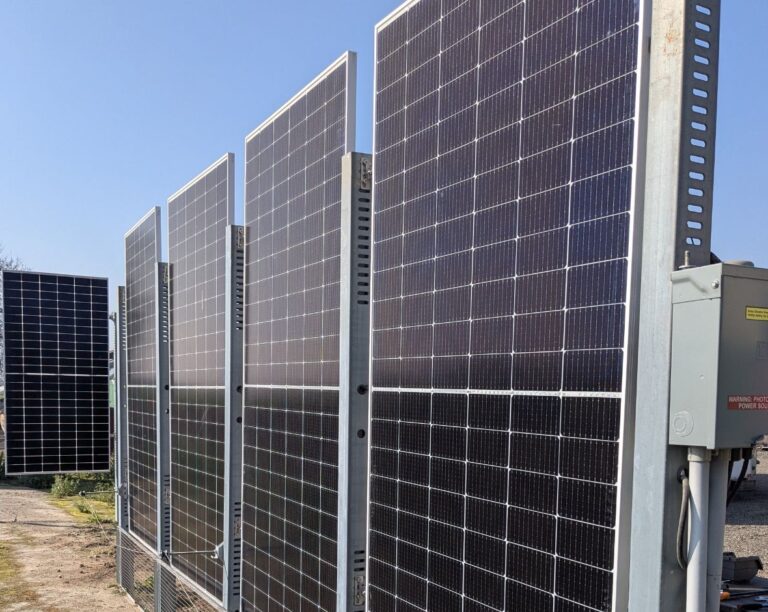
Vertical east-west bifacial configurations produce a different generation profile. Because bifacial modules generate electricity from both faces, the east-facing side captures more morning sunlight while the west-facing side produces more electricity later in the day. This shifts generation away from midday and creates two distinct production peaks—one in the morning and one in the late afternoon.

Measuring the Value of Electricity
To better understand how generation timing affects economic value, we evaluated measured production data from three PV configurations using a representative 2026 PG&E Time-of-Use (TOU) tariff. This allowed us to compare not only how much electricity each configuration produced, but also when it was produced and the corresponding value of that electricity.
The three configurations included an east-west vertical system, a north-south vertical system, and a 20° fixed-tilt system. Each system used identical PV modules and microinverters.
The analysis sought to answer three questions:
- Which PV configuration produces the most electricity?
- Which PV configuration generates the greatest share of its electricity during the highest-value TOU periods?
- Which PV configuration provides the greatest overall economic value under a TOU rate structure?
Initial Findings
Measured field data collected over five representative days in June 2026 revealed a clear difference between energy production and energy value.
Although the fixed-tilt system produced the most electricity, the east-west vertical system generated the greatest economic value. This difference was driven by generation timing. Because the east-west vertical configuration produced a larger share of its electricity during higher-value TOU periods, each kilowatt-hour generated was worth more on average.
- Fixed Tilt: Produced the most electricity (32.2 kWh), but only 14.3% of its energy was generated during peak-rate hours. Its average electricity value was 34.3¢/kWh, which serves as the baseline for comparison.
- East-West Vertical: Produced slightly less electricity (29.2 kWh), approximately 9.3% below fixed tilt, but generated 35.4% of its energy during peak-rate hours. As a result, its electricity averaged 40.6¢/kWh, which is approximately 18% more value per kilowatt-hour than the fixed-tilt system.
- North-South Vertical: Produced substantially less electricity (13.3 kWh). Its average electricity value (35.4¢/kWh) was slightly higher than fixed tilt, but its lower energy production resulted in the lowest overall economic value ($4.71).

The lower performance of the north-south vertical configuration is consistent with the reduced direct solar exposure expected for north-south-oriented vertical systems during summer. Monitoring is ongoing to evaluate seasonal performance throughout the year.
Overall, these initial results highlight that the configuration that produced the most electricity was not the configuration that produced the greatest economic value. Under Time-of-Use pricing, when electricity is generated can be just as important as how much is generated.
Why This Matters
These findings illustrate that maximizing annual energy production does not necessarily maximize economic value.
In regions where solar energy is well established, midday electricity is becoming increasingly abundant, reducing its value during certain periods of the year. At the same time, electricity demand, and often electricity prices, remain higher during the late afternoon and early evening. Under these conditions, a generation profile that shifts production away from solar noon may provide greater economic value, even if total energy production is lower.
As Time-of-Use pricing becomes more common, evaluating PV configurations requires considering both how much electricity is generated and the time at which it is generated. Depending on the utility tariff and site characteristics, a generation profile that better aligns with higher-value periods may provide benefits beyond project revenue, including reduced grid stress, lower reliance on peaker plants, and improved utilization of renewable generation.
Project Considerations
These results do not indicate that vertical east-west PV configurations will always provide greater economic value. Performance depends on several project-specific factors, including:
- Utility Time-of-Use tariff structure
- Geographic location
- Seasonality and weather
- PV system design
- On-site electricity consumption versus grid export
Utilities with relatively small differences between peak and off-peak electricity prices may show only modest economic differences between PV configurations. Conversely, tariffs with larger price differentials may place greater value on generation that occurs outside the midday production peak.
Applications with significant morning or late-afternoon electricity demand may benefit most from this generation profile, including:
- Agricultural irrigation operating under TOU tariffs
- Farms with electrically driven water pumps
- Commercial or industrial facilities with morning and evening demand peaks
- Projects seeking to reduce demand charges
- PV systems paired with battery energy storage
Conclusion
Annual energy production remains an important measure of PV performance, but it does not always capture the full economic value of a system. As Time-of-Use electricity pricing becomes more widespread, generation timing is becoming an increasingly important consideration alongside total energy production. This analysis demonstrates that, under the representative utility tariff evaluated, the vertical east-west bifacial configuration produced greater economic value despite generating less total electricity than the conventional fixed-tilt configuration. Evaluating both energy production and energy value provides a more complete basis for comparing PV configurations and selecting the most appropriate solution for a given project.
Analysis based on production data collected from Sunzaun’s Central Valley, California test site. Results represent an initial five-day analysis from June and should not be generalized across all projects or seasons. The system configurations and utility rate structures may vary depending on location, weather, utility tariffs, and project-specific design.

About the Author
Anika conducted the data analysis and prepared this article. She is part of the Business Development team at Sunzaun, where she focuses on vertical solar technologies, agrivoltaics, and research that supports practical solar deployment.