

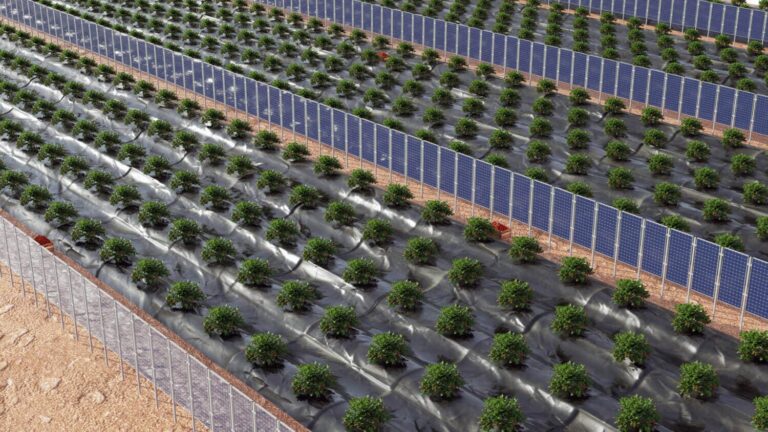

About the Author: Henry Williams is a recent PhD graduate in Mechanical Engineering from Cornell University, where his dissertation focused on microclimate impacts of solar panels in agrivoltaics systems. His agrivoltaics research has been featured in media outlets like Fast Company and PV Magazine, and his agrivoltaics design company, Serida Inc., was a semi-finalist in the Department of Energy American Made Solar Prize Round 8.
High wind speeds can cause severe damage to crops and soils that lack protection from a windbreak or shelterbelt. In the US, the estimated cost of wind damage in the agricultural sector surpasses $9 billion annually.
Wind speeds can be reduced by windbreaks, typically made of shrubs or trees. Well-designed windbreaks can increase crop yield, reduce soil loss, and increase pasture productivity compared to an open field without a windbreak. But windbreaks made of shrubs and trees can be challenging for producers to establish and manage. The shrubs and trees compete for resources with adjacent rows of crops, and they are sometimes removed due to poor condition or age.
Solar panels offer a revenue-generating solution for farmers seeking to establish new windbreaks or replace aging ones. Compared to conventional windbreaks, solar panels offer wind shelter benefits without the downside of soil resource competition.
For a producer turning to an agrivoltaics wind protection system, the question becomes: how should solar panels be designed and managed to control airflow underneath?
In our recent study published in Agricultural and Forest Meteorology[1], we developed a computational fluid dynamics (CFD) model to quantify the windbreak effect of solar panels in various configurations, demonstrating how different panel orientations can alter airflow underneath. Our simulations show that vertical panels provide excellent protection from high wind speeds for crops and soils in the interior of the agrivoltaics system. There is a tradeoff, however. In the first few rows, an acceleration zone is created from air squeezing into the open space between the ground and the lower edge of the solar panels. This tunneling effect can be minimized by dropping the leading row of solar panels closer to the ground.
At the other extreme, when panels are oriented horizontally, airflow is largely uninhibited below. This can be useful in calm conditions if mildew is a concern for producers.
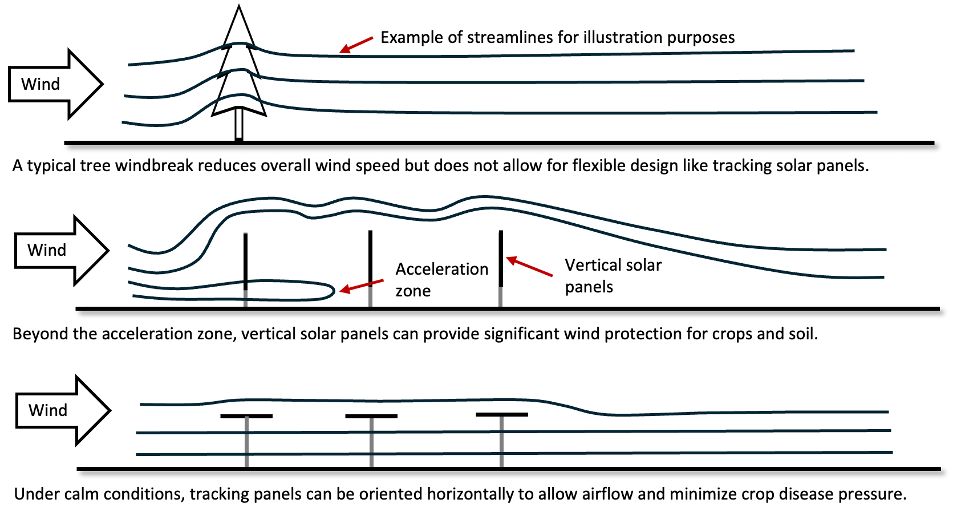
Above: Illustrative streamlines show how air moves through a tree windbreak, vertical solar panels, and horizontal solar panels.
Our study identifies a shelter zone starting after the acceleration zone. In the shelter zone, crops and soils are largely protected from extreme wind. To maximize windbreak benefits in an agrivoltaics system, crops would be planted in the shelter zone.
Under high inlet wind speeds, our simulations indicate that vertical solar panels can achieve a wind reduction of up to 40% of inlet wind speed in the shelter zone. The tree windbreak in our model only achieves up to 20% reduction in the shelter zone. For extreme wind gusts, the difference between 40% and 20% wind reduction can save crops and soils from major damage. This indicates that vertical solar panels can perform better under the simulated conditions than a row of trees planted as a windbreak.
Overall, these results point to the importance of considering airflow in agrivoltaics designs. When solar installations are designed to control wind conditions, agrivoltaics systems can prevent severe wind damage to crops and soils while also generating revenue for the producer.
Combined with other microclimate alterations in agrivoltaics systems, wind protection from solar panels is a meaningful benefit to crops and soils facing extreme weather conditions.
[1] Henry J. Williams, Khaled Hashad, K. Max Zhang, Agrivoltaics wind shelter benefits with single-axis tracking solar panels, Agricultural and Forest Meteorology, Volume 380, 2026, 111091, ISSN 0168-1923, https://doi.org/10.1016/j.agrformet.2026.111091.